
Table of Contents
Quick Summary
- Developers of MidnightBSD face legal risk from age-verification laws such as the Digital Age Assurance Act. To protect the project, they updated their license to block users in regions that require operating-system age verification, including Brazil and California.
- At the same time, they started building a system-level age verification framework (
agedandagectl) that lets apps check a user's age bracket without exposing personal data. - MidnightBSD plans to automatically change user permissions as they get older. A weekly script will check stored birthdays and move accounts into groups like
age13porage18p, which can unlock software access the moment a user reaches the required age. - Operating systems may soon need built-in age-verification infrastructure. Laws aimed at online platforms can also affect open-source operating systems. As a result, developers may need system services, package restrictions, and filesystem controls to manage age-based access.
A Law That Changed Everything
MidnightBSD, often described as "The BSD for Everyone," is a desktop-focused operating system based on FreeBSD that aims to be simple and accessible.
However, California's Digital Age Assurance Act have forced the small volunteer project to rethink how the system can be distributed and used.
The First Response: A License Change
Because the California's law carries civil penalties of up to $7,500 per affected child for intentional violations, the developers concluded that the project could not safely absorb the legal risk.
As an immediate response, they modified the MidnightBSD license to exclude residents of California from using the operating system for desktop purposes, with the restriction scheduled to take effect on January 1, 2027.
The licensing change was later expanded further. The updated license now states that residents of any country, state, or territory that requires age verification for operating systems are not authorized to use MidnightBSD.
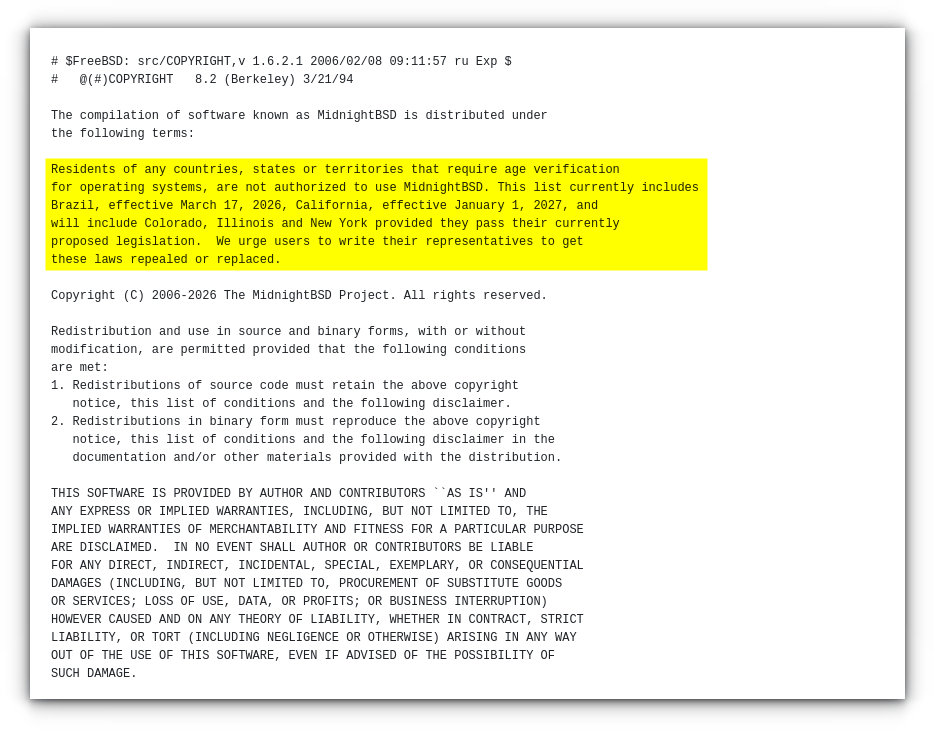
The list currently includes Brazil and California, and may later include Colorado, Illinois, and New York if their proposed legislation passes.
The project also urges users in affected regions to contact their representatives and push for these laws to be revised or repealed.
Regional Bans Won't Work Forever
Regional bans, however, are not a sustainable long-term strategy for a project that aims to be "The BSD for Everyone." So MidnightBSD is now building a system-level age verification system for the operating system.
The developers have said they are tracking similar legislation in Colorado, Illinois, New York, Texas, Utah, Louisiana, and Brazil, which makes a built-in technical solution necessary.
New System Tools: aged and agectl
To follow the law, an operating system must be able to tell other apps if a user is an adult or a child.
MidnightBSD is building two main system tools to do this:
aged: This is a background service (a daemon) that securely stores and checks age data.agectl: This is a command-line tool. If you are the root user (the boss of the computer), you can use it to set a birth date for any account.
When a regular app asks for your age, the system doesn't give away the user's birthday. Instead, it sends a "signal". This signal is just a number that tells the application which age bracket the user belongs to, such as "under 13" or "18 and over".
Locking Apps with ZFS and ACLs
MidnightBSD developers are considering changes to the mports package system. They plan to add age ratings to software, starting with games.
If a game is rated for older players, the system can use Access Control Lists (ACLs) to block younger users from opening it. The developers noted that this is easier to do on ZFS, which is the advanced file system MidnightBSD uses.
Automatic Updates as You Get Older
No one stays the same age forever. To handle this, the system will put users into groups like age13p (for 13 and up) or age18p (for adults).
A special script will run once a week. It will check the birthdays on file and automatically move users to new groups as they get older. This way, a teenager will gain access to more apps the moment they turn 18 without needing a manual update.
What Happens Next?
Right now, these features are still being built and tested. The team is also researching if they can let users outside the United States skip these checks entirely.
For now, the project's goal remains the same: to provide a safe, secure, and optimized desktop experience for all its users while staying within the lines of the law.
If you want to learn more, the developer has provided a documentation about the Age verification issue and a plan to address it in the link below:
You can also track the development progress of the new aged and agectl commands in the following commit:
Frequently Asked Questions (FAQ)
A: MidnightBSD is a desktop-focused operating system built on FreeBSD. The project focuses on a simple and stable BSD desktop environment.
A: Developers started building these tools after laws such as the Digital Age Assurance Act introduced strict penalties for services that fail to verify user age. Because the project is small, the team needed a way to reduce legal risk.
aged and agectl?A: aged is a system daemon that stores and manages age information for users.agectl is a command-line utility that allows administrators to set or query a user's age bracket.
A: The project plans to add age ratings to packages in the mports system. Then the operating system can use filesystem ACLs and user groups to block certain programs for underage accounts.
A: Yes. The project updated its license to prevent users in regions that require operating-system age verification from using MidnightBSD. The list currently includes Brazil and California, with other regions under review.
