
Fedora Linux 44 is now available for download as of April 28, 2026. This release includes significant updates like the transition of the Budgie desktop to Wayland and a goal of 99% reproducible package builds. If you currently run Fedora 43, you can upgrade to the new Fedora Linux 44 version without re-installation as described in the following steps.
Table of Contents
Step 1: Backup Important Data
Back up all important data before you begin. System upgrades are risky and can lead to data loss if the process fails. Keep a Fedora 43 Live USB nearby to repair your system if necessary.
If you don't have a Fedora live USB, create one as shown in the link below:
Step 2: Update Your Current Fedora 43 System
You must start with a fully patched version of Fedora 43. This ensures you have the latest signing keys and upgrade logic.
To update Fedora, open your terminal and run the following command:
sudo dnf upgrade --refresh
You can also update your Fedora system from GNOME Software graphical application. To do so, Open Software center from the application launcher and click the Download button under the Updates tab.
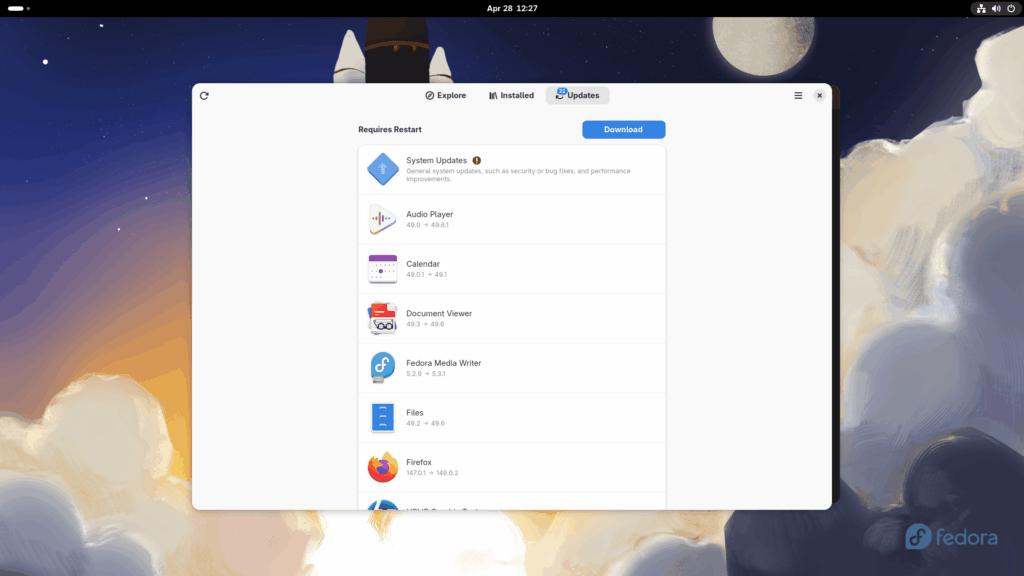
Once the update finishes, you must restart your computer. This step ensures your system uses the latest kernel and libraries before the upgrade starts.
Step 3: Download the Fedora 44 Packages
You can perform Fedora upgrade using the official Upgrade plugin. Most Fedora installations already include this necessary tool.
If your system does not have it, you can install the plugin manually using command:
sudo dnf install dnf-plugin-system-upgrade
Now you can tell the system to fetch the new version of the software. Run this command to download the Fedora 44 packages:
sudo dnf system-upgrade download --releasever=44
This command will download all Fedora 44 packages.
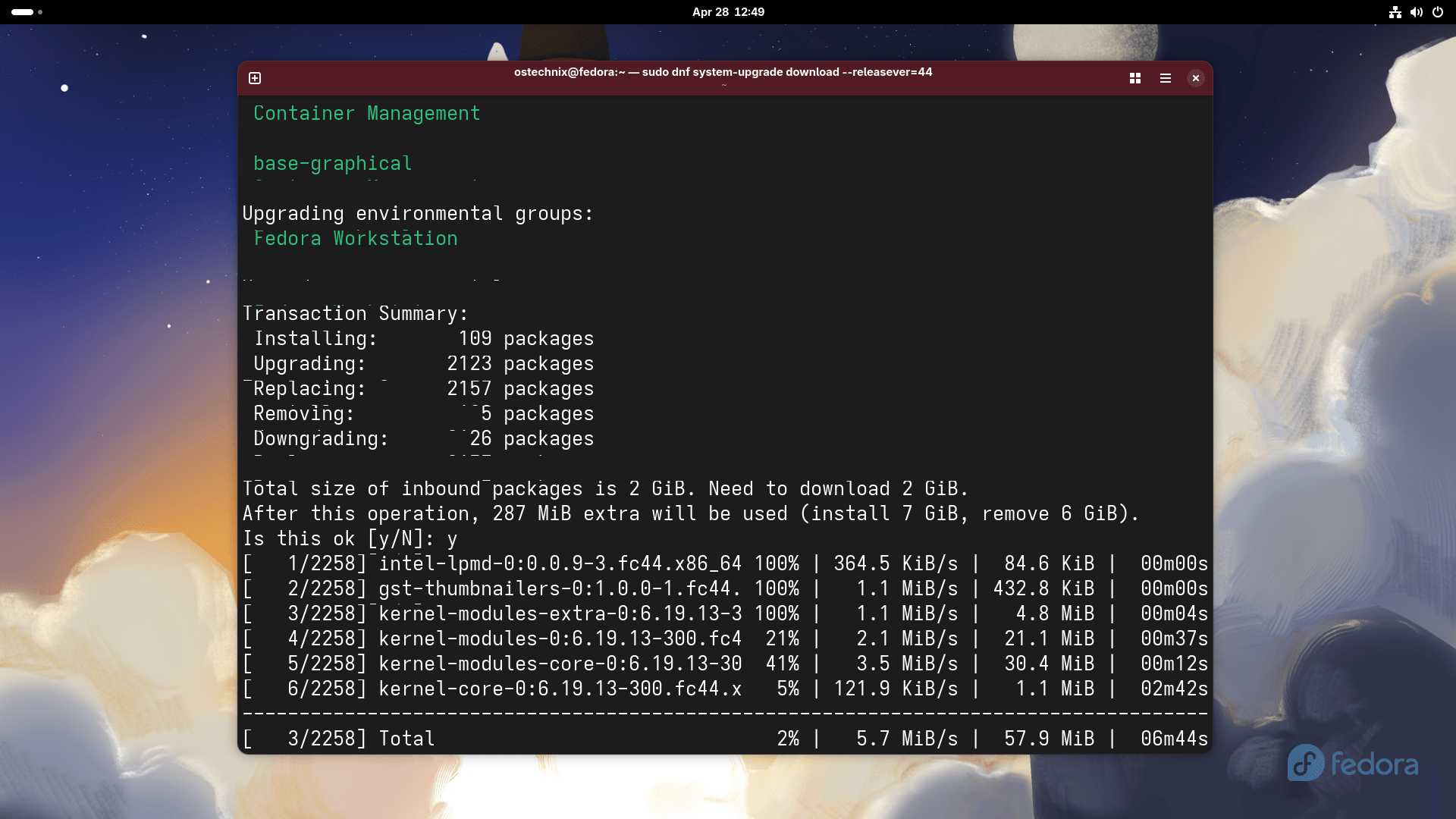
If you have third-party packages that conflict with the new release, the command will stop. You can add the --allowerasing flag to let DNF remove these conflicting packages.
sudo dnf system-upgrade download --releasever=44 --allowerasing
Watch the terminal output carefully to see what the system plans to remove.
Adding the --best option can sometimes provide more details about unsatisfied dependencies.
Step 4: Verify GPG Key
Once the download is complete, a new GPG key will be imported to your system. When prompted, type y and hit ENTER to verify its fingerprint:
[...]
Testing offline transaction
Importing OpenPGP key 0x6D9F90A6:
 UserID     : "Fedora (44) <fedora-44-primary@fedoraproject.org>"
 Fingerprint: 36F612DCF27F7D1A48A835E4DBFCF71C6D9F90A6
 From       : file:///etc/pki/rpm-gpg/RPM-GPG-KEY-fedora-44-x86_64
Is this ok [y/N]: y
The key was successfully imported.

Transaction stored to be performed offline. Run `dnf5 offline reboot` to reboot and run the transaction. To cancel the transaction and delete the downloaded files, use `dnf5 offline clean`.
Complete!
Step 5: Trigger the Fedora 44 Upgrade Task
After the download is finished and the GPG key is added, you must reboot into the upgrade environment. The command depends on which version of the DNF tool you use.
If you use the newer DNF 5 tool, run this command
sudo dnf5 offline reboot
If you use the older DNF 4 tool, run this command instead:
sudo dnf system-upgrade reboot
To confirm the F44 upgrade process, press y and hit ENTER key:
The system will now reboot to upgrade to release version 44.
Is this ok [y/N]: y
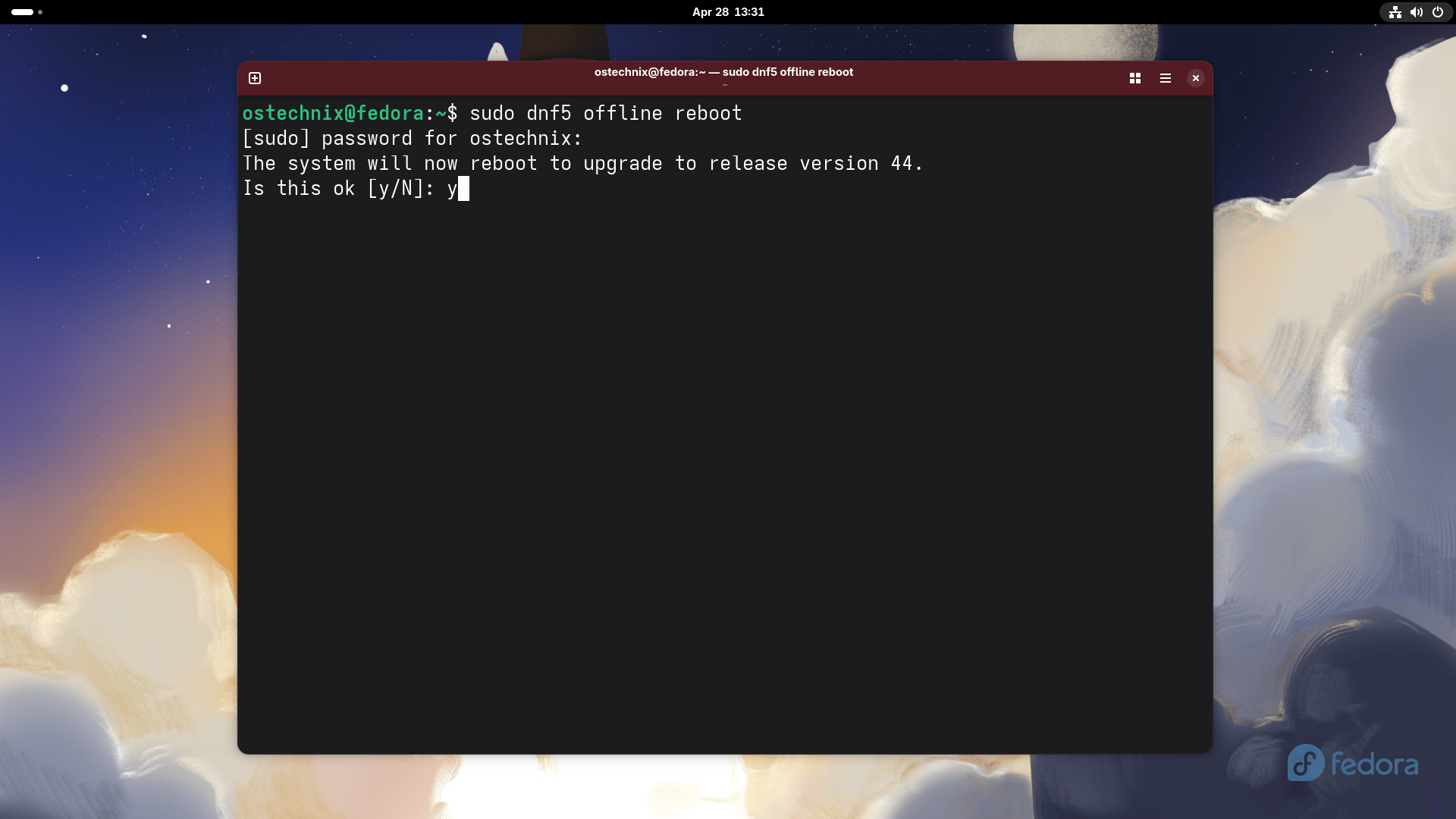
The system will restart immediately. It will then enter a special mode to install the downloaded packages.
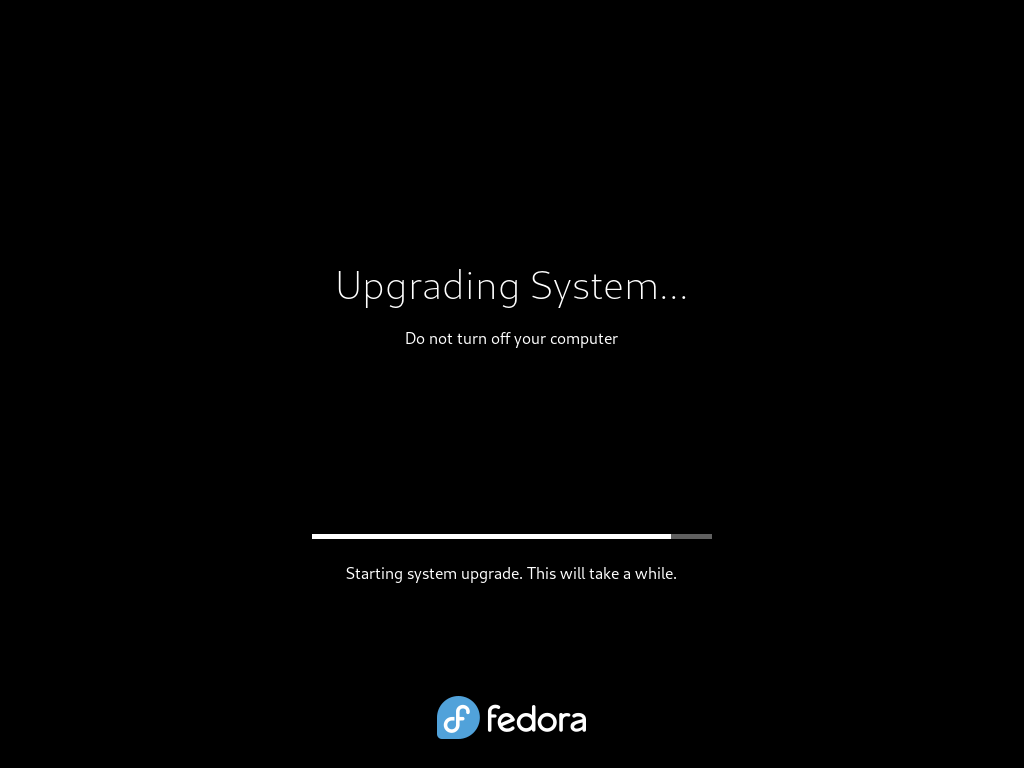
Do not turn off your computer during this time.
You can cancel the upgrade and delete downloaded files at any time using command:
sudo dnf5 offline clean
If you encounter problems, you can try rebuilding the RPM database, using distro-sync, or relabeling files with the latest SELinux policy. We have covered this in Step 7.
Step 6: Login to Fedora 44
After the successful F44 upgrade, your system will reboot into the Fedora Linux 44 release.
Log in and start using the newly upgraded Fedora 44 version:
Step 6.1: Verification
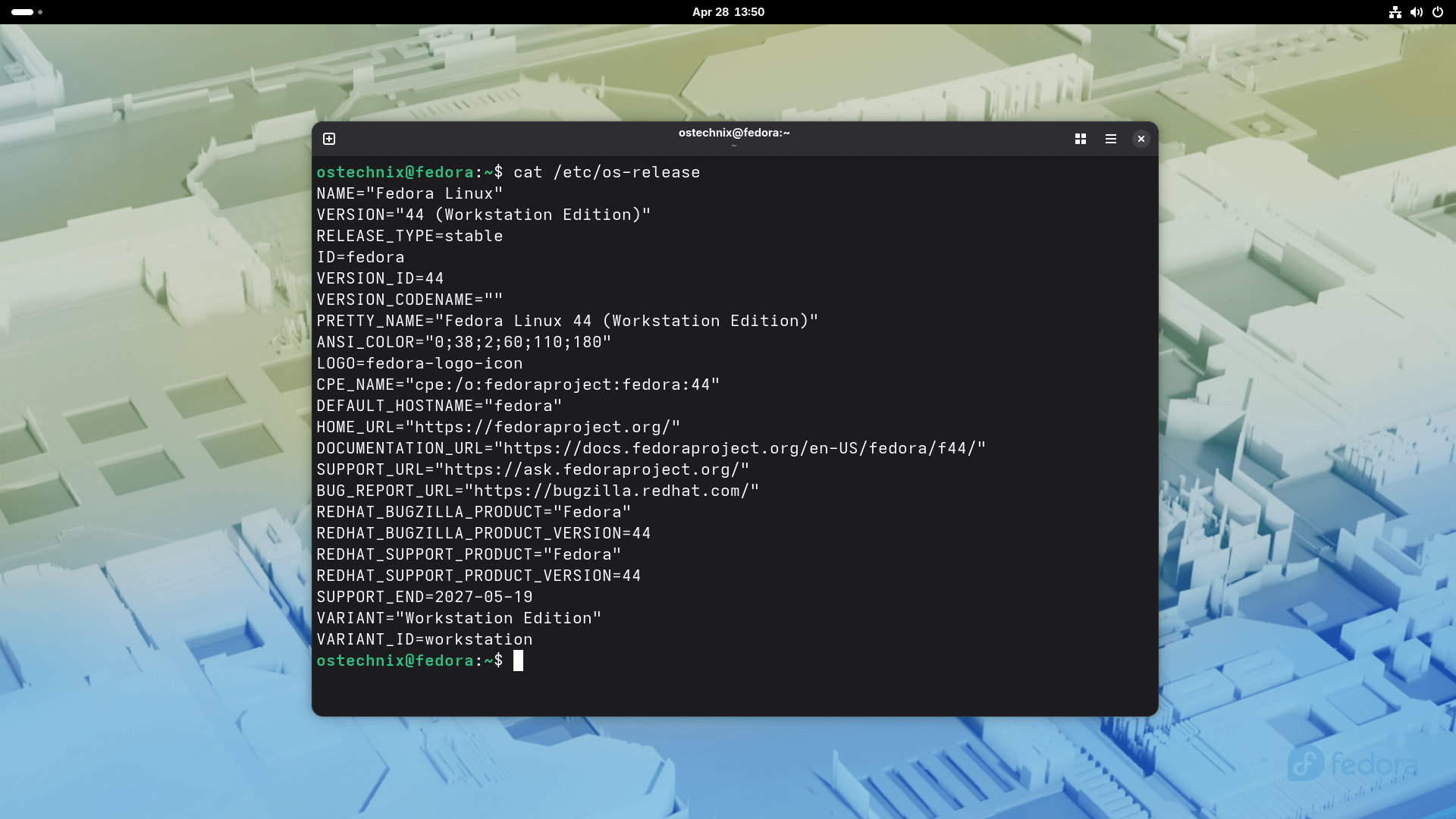
You can verify the Fedora version change by running:
cat /etc/os-release
You should see "Fedora Linux 44 (Workstation Edition)" label.
Sample Output:
NAME="Fedora Linux"
VERSION="44 (Workstation Edition)"
RELEASE_TYPE=stable
ID=fedora
VERSION_ID=44
VERSION_CODENAME=""
PRETTY_NAME="Fedora Linux 44 (Workstation Edition)"
ANSI_COLOR="0;38;2;60;110;180"
LOGO=fedora-logo-icon
CPE_NAME="cpe:/o:fedoraproject:fedora:44"
DEFAULT_HOSTNAME="fedora"
HOME_URL="https://fedoraproject.org/"
DOCUMENTATION_URL="https://docs.fedoraproject.org/en-US/fedora/f44/"
SUPPORT_URL="https://ask.fedoraproject.org/"
BUG_REPORT_URL="https://bugzilla.redhat.com/"
REDHAT_BUGZILLA_PRODUCT="Fedora"
REDHAT_BUGZILLA_PRODUCT_VERSION=44
REDHAT_SUPPORT_PRODUCT="Fedora"
REDHAT_SUPPORT_PRODUCT_VERSION=44
SUPPORT_END=2027-05-19
VARIANT="Workstation Edition"
VARIANT_ID=workstation
If you want to display only the version, use this command:
cat /etc/fedora-release
Sample Output:
Fedora release 44 (Forty Four)
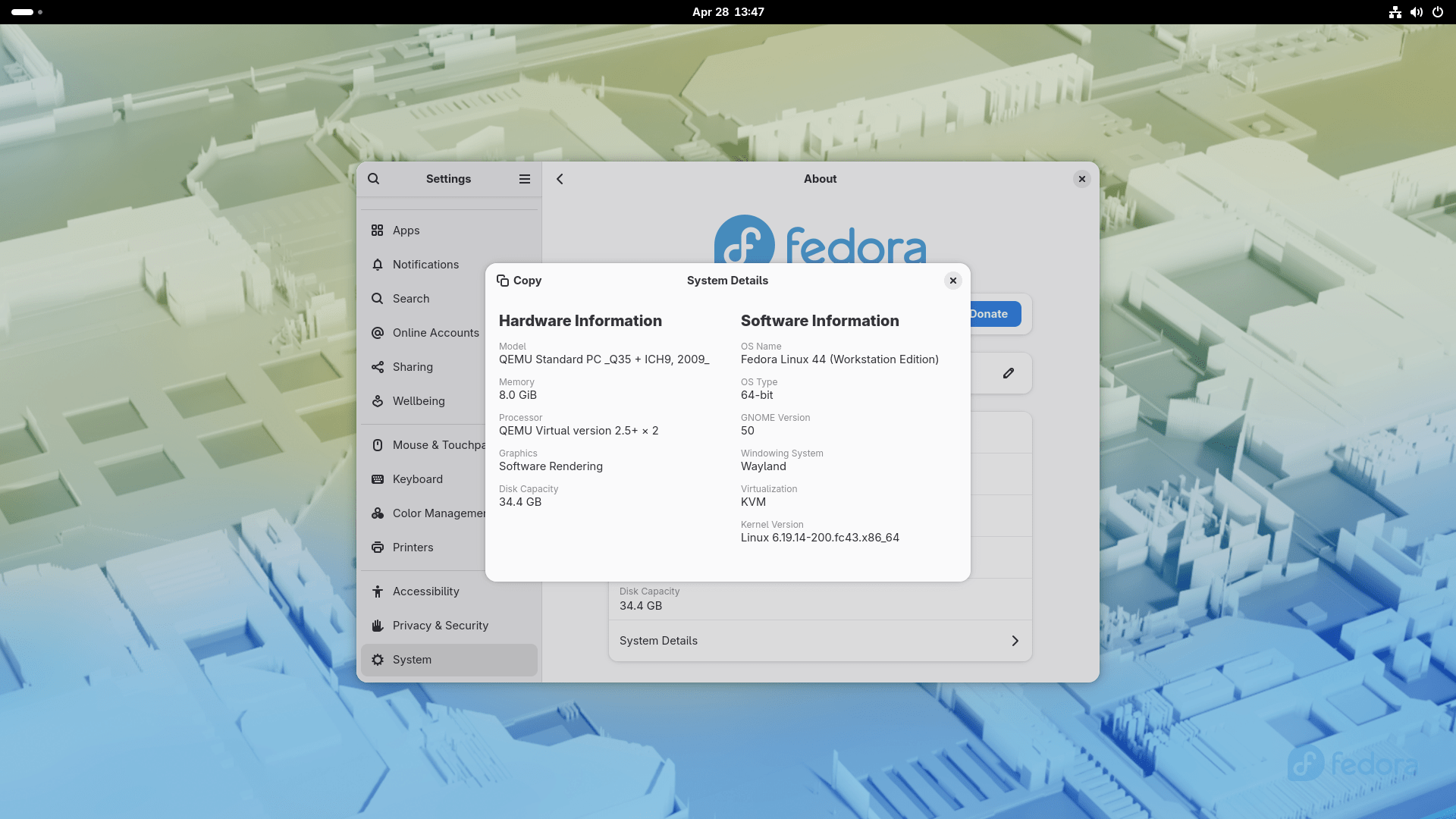
You can also check version details from Settings -> System -> System Details section:
Step 7: Troubleshooting
If you encounter any issues after the F44 upgrade, please do the following steps one by one.
Rebuilding the RPM database:
First back up /usr/lib/sysimage/rpm and run:
sudo rpm --rebuilddb
Using distro-sync:
sudo dnf distro-sync
To resolve dependency issues, do:
sudo dnf distro-sync --allowerasing
Relabeling files with the latest SELinux policy:
sudo fixfiles -B onboot
And finally reboot, especially if SELinux was previously disabled.
Step 8: Fedora Post-Upgrade Tasks
After successfully upgrading your Fedora 43 system to Fedora 44, there are several optional post-upgrade tasks you might consider performing to ensure optimal system performance and maintenance.
These tasks include:
- updating system configuration files,
- updating the GRUB bootloader on BIOS systems,
- cleaning up retired or old packages,
- cleaning up old kernels, old GPG keys, and old symlinks,
- and updating the rescue kernel.
8.1. Update System Configuration Files
Configuration files are typically stored in the /etc folder. During an upgrade, if you've modified a package's configuration file, RPM might create new files with a .rpmnew extension (for the new default config) or back up your old config with a .rpmsave extension.
You can use the rpmconf tool to simplify the process of checking and merging these files.
Install rpmconf:
sudo dnf install rpmconf
Run the following command to review and manage configuration file changes:
sudo rpmconf -a
You should carefully review changes in /etc/yum.repos.d/ as reverting these files to original versions might disable updates for third-party software.
Also, verify critical files like /etc/ssh/sshd_config, /etc/nsswitch.conf, and /etc/ntp.conf as OpenSSH upgrades, for example, might revert sshd_config to a default that doesn't enable public key authentication.
8.2. Update GRUB bootloader on BIOS systems
While GRUB RPM packages are updated, the installed or embedded bootloader on BIOS systems is not automatically updated. It's good practice to update it between Fedora Linux release versions.
Find the device node where /boot/ is located:
sudo mount | grep "/boot "
For example, if it's /dev/sda4, the device node is /dev/sda.
Reinstall the bootloader using command:
sudo grub2-install /dev/sda
Replace /dev/sda with your actual device node without the number.
The expected output will be "Installing for i386-pc platform. Installation finished. No error reported".
8.3. Clean-up Retired Packages
Fedora retires packages due to obsolescence, dead upstream, or maintainer stepping down. These packages remain on your system but will no longer receive upgrades. It's highly recommended to remove them.
For an upgrade across one release (e.g., Fedora 43 to 44), run:
sudo dnf install remove-retired-packages
sudo remove-retired-packages
Please note that upgrades across more than two releases are not supported for this cleanup method.
8.4. Clean-up Old Packages
To find duplicate packages (multiple versions installed):
sudo dnf repoquery --duplicates
To remove them, run:
sudo dnf remove --duplicates
Note that this command uses the default dnf binary (DNF5 on Fedora 39+). This list is only valid on a fully updated system.
To list packages installed on your system that are no longer in the repositories:
sudo dnf list --extras
To remove unnecessary "extra" packages, run:
sudo dnf remove $(sudo dnf repoquery --extras --exclude=kernel,kernel-\*,kmod-\*)
To remove packages DNF deems no longer needed (those not explicitly installed and not required by other packages):
sudo dnf autoremove
Exercise caution as this only removes packages DNF thinks are unneeded, which may not align with your actual usage.
8.5. Clean-up Old kernels
After booting into and testing the new kernel, you can remove older kernels. This helps free up space.
You can use the following script to retain only the latest kernel and clean up old kernels:
#!/usr/bin/env bash

old_kernels=($(dnf repoquery --installonly --latest-limit=-1 -q))
if [ "${#old_kernels[@]}" -eq 0 ]; then
    echo "No old kernels found"
    exit 0
fi

if ! dnf remove "${old_kernels[@]}"; then
    echo "Failed to remove old kernels"
    exit 1
fi

echo "Removed old kernels"
exit 0
Save the contents in a file, for example cleanfedorakernel.sh.
Make it executable:
chmod +x cleanfedorakernel.sh
And, the run it to remove old kernels:
sudo ./cleanfedorakernel.sh
8.6. Clean-up Old Keys Trusted for RPM Package Signing
Over time, GPG keys from older Fedora releases and third-party repositories accumulate in the RPM database. You can remove unreferenced keys with:
sudo dnf install clean-rpm-gpg-pubkey
sudo clean-rpm-gpg-pubkey
8.7. Clean-up Old Symlinks
Install symlinks:
sudo dnf install symlinks
Audit for broken symlinks (e.g., in /usr):
sudo symlinks -r /usr | grep dangling
Delete broken symlinks:
sudo symlinks -r -d /usr
8.8. Update Rescue Kernel
The rescue kernel and initramfs might not be automatically updated with kernel updates, depending on your system configuration. If it's outdated, you can regenerate it.
sudo rm /boot/*rescue*
sudo kernel-install add "$(uname -r)" "/lib/modules/$(uname -r)/vmlinuz"
To automate this process, install dracut-config-rescue:
sudo dnf install dracut-config-rescue
From now on, the rescue kernel will be regenerated as long as dracut is the initrd generator.
Related Read: How To Solve Initramfs Error In Fedora
Common Mistakes
- Skipping the initial update: If you do not run the refresh update in Step 1, the upgrade might fail because of missing GPG keys.
- Ignoring dependency errors: If DNF reports unsatisfied dependencies, do not ignore them. Use the
--bestor--allowerasingflags to see more details. - Low disk space: Ensure your
/bootpartition has enough room. Fedora 43 increased the recommended size to 2 GiB to handle these transitions.
Conclusion
In this step-by-step tutorial, we explained how to upgrade to Fedora 44 from Fedora 43 from command line. Fedora 44 brings the latest Linux technologies like the Nix developer tool and updated GNU toolchains.
Start using Fedora 44 Linux. Good luck!
Read Next:
