
Linus Torvalds has officially closed the two-week merge window and announced the first release candidate (RC1) for the upcoming Linux Kernel 7.3 version to the public on Sunday, August 30, 2026.
While the release is exceptionally large in terms of commit count and diff size, the core kernel development pattern remains completely normal once a massive, routine AMD GPU hardware dump is excluded.
What's New in Linux 7.3-rc1?
In the Linux 7.3-rc1 release announcement mail, Linus noted that Linux Kernel 7.3 RC1 is a remarkably large release candidate in terms of commit count and the actual code diff, even if it follows familiar development patterns.
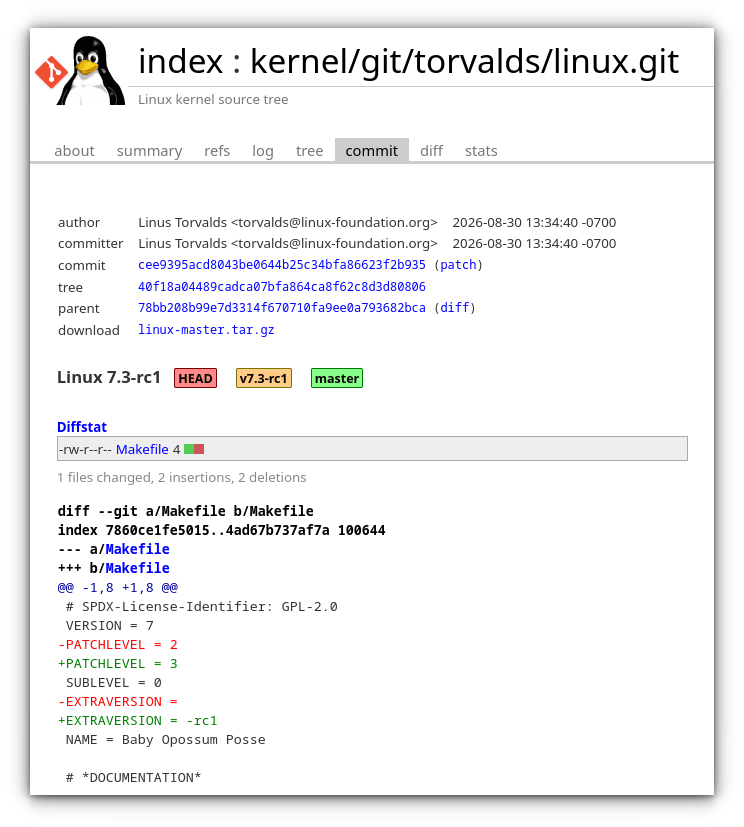
The main technical additions and changes in this release include:
1. Graphics and Major Hardware Enablement
The Massive AMD GPU Update
By far the largest change is a major AMD GPU code and header dump, which alone makes up about one-third of the entire rc1 patch. This footprint is driven by:
- The addition of the AMD DCN6 register headers.
- Dumping these extensive hardware definitions as massive lists of C header
#defines. - The accompanying support code for this new generation of graphics hardware.
Without this single block of graphics definitions, the merge window was entirely standard.
Graphics and Display Updates
The kernel features broad DRM (Direct Rendering Manager) updates, fbdev updates, and panel/backlight controls.
2. Virtual File System (VFS) and Filesystems
The filesystem layer underwent massive cleanups and features several major transitions:
- New Filesystem: The release introduces the
failfsfilesystem. - Legacy Removals: Ancient and legacy elements are cleaned up, specifically resulting in the removal of
efsandfreevxfs, as well as the removal ofcachefiles ondemand. - Core VFS Improvements: Important updates cover VFS writebacks, superblock management, mounts, lookups, metadata
iomaputilities, FAT, andoverlayfs. Additionally, VFS BPF access andkthreadVFS integration received dedicated updates. - Standard & Network Filesystems: Development continues with direct updates to
ext4,btrfs,xfs,f2fs,erofs,ntfs3,exfat, and legacy filesystems likeext2,udf, andisofs. Network filesystems like NFS (both client and daemon), Ceph, and SMB/CIFS (both server and client side) also received updates. - Storage Technologies: Additional updates went to the block layer,
io_uring,fscryptencryption, device mapper, and flash-friendly storage utilities like UBI and UBIFS.
3. Core Kernel, Memory Management and Scheduling
- Scheduler & Locking: The release incorporates multiple scheduling and locking updates, including the newer
sched_extextensible scheduler framework, workqueues, and control groups (cgroups). - Memory Management (MM): There are core MM updates,
memblockupdates, slab allocator updates, and memory hotfixes. - Infrastructure & Interrupts: The core receives updates to the generic entry code, restartable sequences (
rseq), the generic interrupt subsystem, futexes, timers, timekeeping, and Virtual Dynamic Shared Objects (vDSO). - System Lifecycle: Key updates are included for
livepatching,liveupdate, andkexectools.
4. Architecture and Platform Support
- x86 Platform: Received updates to Machine Check Exceptions (MCE), alternatives, resource control, CPUID, MSRs, and Intel Trust Domain Extensions (TDX).
- ARM & arm64: Massive updates arrived for ARM SoC devicetrees, SoC drivers, default configurations, and general
arm64platform fixes. - Alternative Architectures: Platform and CPU enablement updates cover RISC-V, LoongArch, PowerPC, s390, MIPS, OpenRISC, parisc, and m68k.
5. Security and Linux Security Modules (LSMs)
- Sandboxing & LSMs: The release updates key security layers, including
Landlock,AppArmor,selinux, andsmack. - System Integrity & Hardware Security: Integrity subsystems, general capability management, and TPM (Trusted Platform Module) drivers received direct updates.
6. Developer Tooling, Diagnostics and Languages
- Rust in the Kernel: The kernel's support for the Rust programming language continues to mature with dedicated Rust tooling updates and fixes.
- Verification & Tracing: Diagnostic frameworks are expanded with updates to the Real-time Verifier (RTV), Real-Time Linux Analysis (RTLA) tools,
ftrace,tracefs, and ring buffers. - Sanitisers: The Kernel Concurrency Sanitizer (KCSAN) received updates to help catch multi-threaded race conditions.
- Testing & Build Tools: The release improves testing via
kunitandkselftestalongside updates to the Kbuild/Kconfig compilation systems.
The Surprising Detail
Despite decades of experience managing critical kernel releases, Linus Torvalds admits he acted like a "grade A nincompoop" by executing a full system upgrade right in the middle of the intense merge window.
He did so naively thinking "nothing will go wrong", only to break his setup and force himself to spend valuable time troubleshooting the resulting issues while simultaneously managing incoming code merges.
Test Linux Kernel 7.3 RC1
Kernel enthusiasts and curious users can download Linux 7.3-rc1 from the Official Linux Kernel Archives or browse the source code in Linus Torvalds' Git tree.
Please be mindful that this is a pre-release (release candidate) version. It is mainly intended for kernel developers, testers, and Linux enthusiasts who are comfortable compiling the kernel from source.
Like any release candidate, Linux 7.3-rc1 may contain bugs, regressions, or incomplete features.
If you rely on your computer for work or other important tasks, it's usually best to stay with the latest stable Linux kernel and wait until Linux 7.3 reaches its final release.
Expected Linux Kernel 7.3 Final Release Date
Linux 7.3-rc1 was released on August 30, 2026, marking the end of the two-week merge window.
Linux normally follows a roughly 9–10 week cycle from the end of the merge window to the stable release, with a new release candidate generally arriving each Sunday:
- Aug. 30: 7.3-rc1
- Sep. 6: rc2
- Sep. 13: rc3
- Sep. 20: rc4
- Sep. 27: rc5
- Oct. 4: rc6
- Oct. 11: rc7
- Oct. 18: Linux 7.3 final
So our best estimate for the Linux 7.3 final release date is October 18, 2026.
If Linus needs an additional RC8 because of late bugs or regressions, the final release would most likely slip to October 25, 2026.
