
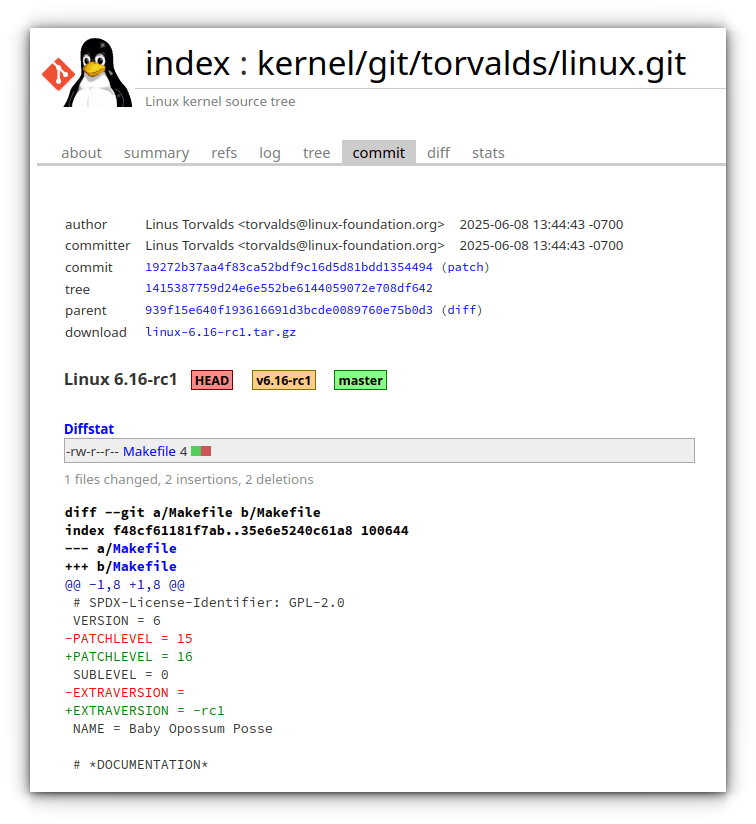
The first release candidate (RC1) for the Linux Kernel version 6.16 is released on 8 June 2025. Linux 6.16-rc1 signals the closure of the two-week merge window, where so many new features and improvements were integrated.
In the 6.16-rc1 announcement mail, Linus Torvalds described it as a "fairly normal merge window," despite a few more "late straggler" pull requests than usual.
Approximately half of the changes in Linux 6.16-rc1 are dedicated to driver updates, with graphics processing units (GPUs) and networking accounting for a significant portion.
The remaining changes are split among architecture updates, documentation, tooling, and core kernel components like file systems and memory management.
Table of Contents
Linux 6.16 Performance Improvements
Linux 6.16 is set to deliver remarkable performance enhancements across various core subsystems, making your Linux experience even smoother and more efficient.
1. EXT4 File System Soars
Even though EXT4 is a mature file system, Linux 6.16 is bringing singnificant performance improvements.
Key changes include fast-commit performance improvements, multi-fsblock atomic write support for bigalloc file systems, and perhaps most notably, large folio support for regular files.
Theodore Ts'o, an EXT4 maintainer, highlighted that large folio support can lead to "really stupendous performance for the right workloads".
For instance, Intel's Kernel Test Robot recorded an impressive 37.7% improvement in the FS-Mark benchmark due to this large folio change.
These EXT4 optimisations, combined with improvements in Bcachefs, Btrfs, and XFS, make this one of the most exciting kernel cycles for file system activity in recent times.
2. Networking Changes for Kernel 6.16
We can expect a lot of exciting networking changes in Linux 6.16, affecting both wired and wireless devices, alongside core networking optimisations.
- The Device Memory TCP transmit path now enables zero-copy data transmissions directly from device memory (like GPU vRAM) to the network, which is a major leap.
- IPv6 routing tables management is now three times faster, thanks to being moved outside the RTNL scope.
- Improvements to TCP receiver buffer auto-tuning and an increased default upper-bound for the receive buffer can boost throughput by over 60% in single-flow maximum throughput tests on a 200Gb link.
- The GRO engine for UDP-tunneled traffic also sees optimisations, leading to around a 10% improvement in stream-related tests.
- Crucially for Virtual Private Network (VPN) users, the OpenVPN DCO driver has finally been merged! This promises "much faster performance for OpenVPN virtual private networking" by offloading data channel processing to kernel-space.
3. Optimise Your Kernel Build with X86_NATIVE_CPU
For those who like to compile their own kernel, Linux 6.16 introduces the X86_NATIVE_CPU Kconfig build time option.
This new feature provides an easy way to enable the -march=native compiler behavior for your kernel build on AMD and Intel processors.
It automatically sets -march=native for C code and -Ctarget-cpu=native for Rust code, optimising the kernel for your system's local CPU architecture.
While it might not deliver the massive performance for everyone, it can offer a valuable edge for industrial applications or IoT devices that are about extreme efficiency.
The kernel already leverages advanced instructions through hand-coded assembly for critical routines, so this option primarily offers additional compiler-driven optimisations.
Extensive Hardware Support and Driver Updates
As is typical for Linux kernel releases, 6.16 brings a number of new and improved hardware support.
1. Graphics and Display
The Nouveau driver now supports NVIDIA Hopper and Blackwell GPUs. The Intel Xe driver gains features like fan speed reporting for Arc Graphics and better PCIe link downgrading handling.
There are also initial patches for Intel Wildcat Lake support, a fix for older Intel Haswell graphics, and the addition of the UAPI header file for the Asahi Apple Silicon graphics driver.
2. Laptop and Platform-Specific Enhancements
Many x86 platform driver updates have been merged, primarily enhancing laptop functionality.
- The Alienware WMI driver now includes hardware monitoring and manual fan controls.
- The ASUS WMI driver improves suspend-and-resume support for the ROG Ally handheld and alerts users about outdated MCU firmware.
- The OneXPlayer driver now supports OneXFly variants, charge limits, and turbo LED controls.
- The Dell DDV driver exposes battery health and manufacturing data to user-space.
- The ThinkPad ACPI driver supports the camera shutter switch hotkey.
- A brand new Dasharo ACPI driver has been added, providing fan and temperature monitoring for users of this Coreboot downstream version.
3. CPU and System Management
The AMD HSMP driver now provides sysfs files for telemetry information for EPYC CPUs. Intel Speed Select Technology driver adds support for SST-TF v2 and SST-PP v2, which are crucial for newer Intel Xeon 6 CPUs.
Additionally, new SiFive RISC-V Vendor Extensions are supported.
4. Networking Hardware Drivers
A variety of new networking drivers have been merged. This includes the Realtek MT9888 2.5G Ethernet device driver, an AMD Renoir Ethernet driver, and the Aeonsemi 10G C45 PHY driver.
The NVIDIA Mellanox MLX5 driver has refactored steering table handling to reduce memory usage, and the Intel IDPF driver now has initial RDMA and PTP support.
The Realtek rtl8211 driver gained Wake-On-LAN magic packet support, and there are significant WiFi 7 improvements for Mediatek MT76 and MT7990 chipsets.
Enhanced Security: Hardware-Wrapped Encryption Keys
Linux 6.16 introduces a significant security upgrade by upstreaming support for hardware-wrapped encryption keys.
As explained by Google engineer Eric Biggers, this feature has been used in Android kernels for a long time.
It is designed to protect file contents keys from "certain attacks, such as cold boot attacks". The wrapped key is passed to the inline encryption hardware via blk-crypto, while other file system encryption operations continue to be handled by the kernel using a "software secret" derived by the hardware.
This security feature is currently applicable to ext4 and f2fs file systems on supported platforms like the Qualcomm SM8650 HDK, which uses the Qualcomm ICE (Inline Crypto Engine) and HWKM (Hardware Key Manager).
Try Linux Kernel 6.16 RC1
With the merge window now closed and 6.16-rc1 released, the focus shifts to testing and bug fixing. The stable Linux 6.16 kernel release is anticipated around the end of July.
If you're a developer or an advanced user, you are encouraged to begin testing Linux 6.16 RC1 to help identify and address any remaining issues before the final release.
Linux Kernel 6.16 RC1 can be downloaded from the Kernel.org website or the Linus Torvalds's git tree.
Kernel 6.16 Estimated Final Release Date
The Linux Kernel release cycle typically follows a predictable pattern, with 7-8 Release Candidates (RCs) before the final stable release. Each RC is released weekly, usually on Sundays (with RC1 often arriving shortly after the merge window closes).
Given that RC1 for Linux Kernel 6.16 was released on June 8, 2025 (a Sunday), we can estimate the timeline as follows:
- RC1: June 8, 2025
- RC2: June 15, 2025
- RC3: June 22, 2025
- RC4: June 29, 2025
- RC5: July 6, 2025
- RC6: July 13, 2025
- RC7: July 20, 2025
- RC8 (if needed): July 27, 2025
The final stable release usually happens one week after the last RC.
Expected Final Stable Release:
- If 7 RCs are sufficient: July 27, 2025
- If an 8th RC is needed: August 3, 2025
Historically, most kernel releases take 7 RCs, so the most likely date for the stable 6.16 release is around July 27, 2025. However, if more testing is required, it could extend to early August.
