
Table of Contents
Quick Summary
- Google Translate is 20 years old now. It serves 1 billion users and supports 250 languages.
- Google Translate does a lot more than most people know, from real-time camera translation to offline mode to live conversation interpreting.
- Most people treat Google Translate as a dictionary. It has quietly become a full communication platform. A third of its mobile users now use it specifically to learn a language, not just translate words.
- After a licensed tool produced a nonsensical translation for an email, Sergey Brin became convinced that Google could build something superior. This frustration sparked the development of Google Translate.
20 Google Translate Facts
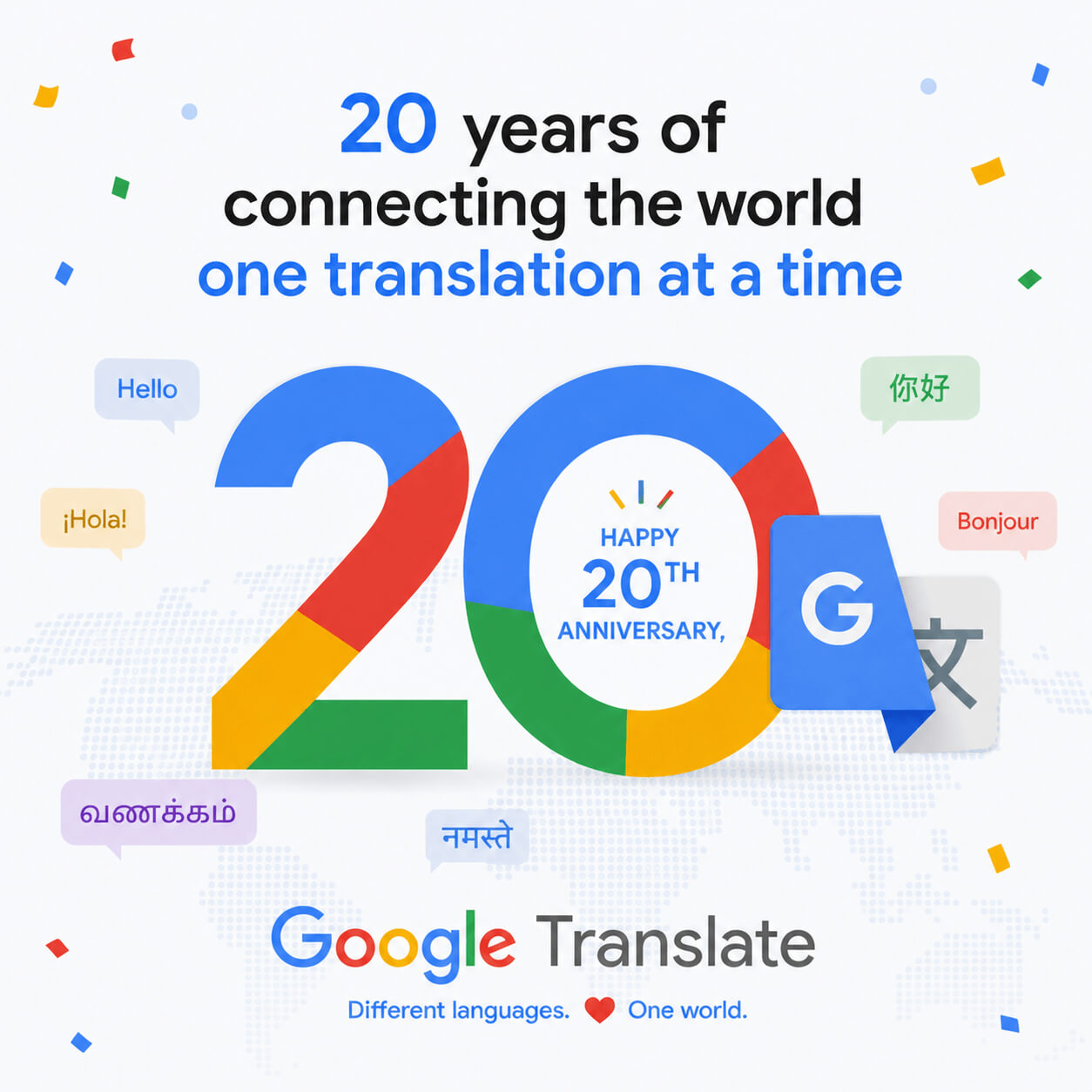
Google Translate turned 20 on April 28, 2026.
You have probably used it dozens of times. Maybe you used it this week. But most people only scratch the surface of what the Google Translate app can do. And very few people know the wild story behind how it started.
So here are 20 Google Translate facts that will surprise you, whether you are a daily user or someone who opens it once a year on holiday.
Google Translate by the Numbers
1. Over 1 billion people use Google Translate every month.
That is not a typo. Every month, more than one billion people open Google Translate for help. That makes it one of the most-used tools on the internet ever.
2. Google Translate processes 1 trillion words every month.
One trillion is very hard to picture. So here is one way to think about it: if someone read all those words out loud, non-stop, it would take them 12,000 years to finish. And that is just one month.
3. It supports nearly 250 languages and covers 95% of the world's population.
From major world languages to rare indigenous ones, Google Translate reaches almost everyone on earth. So no matter where you travel, there is a very good chance it can help you.
4. There are over 60,000 possible language pairs.
A language pair is any combination of two languages, like English to Tamil, or Hindi to Japanese. With 60,000 pairs available, the options are almost limitless.
5. It started with just 2 languages and a few hundred users.
When Google Translate launched on April 28, 2006, it only supported Arabic and English. Only a few hundred people used it.
Fast forward 20 years, and it serves a billion people a month. That is one of the biggest growth stories in tech history.
The History of Google Translate
6. One terrible email translation started the whole thing.
It all started with one terrible email. In 2004, Google co-founder Sergey Brin ran a Korean fan message through a translation tool his company had licensed. What came back was total nonsense: "The sliced raw fish shoes it wishes. Google green onion thing."
That single bad translation was the moment everything changed. Brin decided Google could do far better. And so, Google Translate was born.
7. Google Translate was one of Google's very first AI experiments.
It was not a side project. In fact, building Google Translate helped Google figure out how to work with AI on a large scale.
The lessons learned from Translate led directly to the powerful AI tools, including the Gemini models, that Google builds today.
8. For years, Google Translate used English as a bridge language.
If you wanted to translate Japanese into Spanish, the app did not go directly from one to the other. First, it translated Japanese into English. Then it translated that English into Spanish.
This changed after 2016, but it was how the system worked for its first decade.
9. In 2016, Google Translate Started to Translate Whole Sentences.
Before 2016, the app translated word by word. Then Google switched to a new system that reads the whole sentence before translating any of it.
This one change made translations sound far more natural and cut errors by as much as 85% for some language pairs.
10. Google bought Word Lens in 2014 and that gave Translate its camera superpower.
Word Lens was a standalone app that could read text through your phone's camera and translate it in real time. When Google bought the company behind it in May 2014, that technology became part of Google Translate. That is exactly where the camera translation feature you use today came from.
Google Translate Features Most People Don't Know About
11. You can translate text through your camera in real time.
Open the Google Translate app, tap the camera icon, and point it at any text. A street sign. A restaurant menu. A food label in another language. The app reads it and shows you the translation right on your screen, instantly. You do not need to type a single word.
12. Google Translate works offline, no internet needed.
Yes, really. Just download a language pack while you have Wi-Fi. After that, you can use Google Translate anywhere - on a plane, in a remote village, or anywhere else with no signal. It is one of the most useful travel features most people never set up.
13. Interpreter Mode turns your phone into a live translator.
Turn on Interpreter Mode, speak into your phone in your language, and the app says your words out loud in the other person's language. Then they speak back, and the app translates for you.
It works like having a human interpreter right in your pocket, for free.
14. Live Translate works through any pair of headphones.
Connect your headphones, turn on Live Translate, and the app can translate what someone says to you, in real time, while you listen.
It also keeps the speaker's original tone and rhythm, so the translation still feels human and natural.
15. Google just launched a pronunciation practice tool in April 2026.
This is brand new, added just in time for the 20th birthday. Translate a phrase, tap "Practice," say it out loud, and the app gives you instant feedback on how well you said it, even pointing out which sounds need work.
It is available now on Android in English, Spanish, and Hindi for users in the US and India.
Fun and Surprising Google Translate Facts
16. The most translated phrase on Google Translate is "thank you."
Out of all the trillions of words people translate every month, the phrase they look up most is simply: "thank you." That feels like a lovely reminder of why people use this tool in the first place.
17. The most popular language pair is English to Spanish.
More people translate between English and Spanish than any other pair. This is true globally, not just in a few countries. It reflects just how widely those two languages are spoken around the world.
18. About 1 in 3 mobile users uses Google Translate to learn a language.
Many people think of it as just a translation dictionary. But roughly one third of mobile users actively use Google Translate to study and practice a new language.
Google has even added daily learning goals and AI-powered exercises to support this.
19. People are having real, long conversations through Live Translate.
More than a third of Live Translate sessions last longer than five minutes. That means people are not just looking up words. They are holding full conversations (job interviews, family catch-ups, and even business meetings) across language barriers.
20. Google Translate helps preserve languages that are at risk of disappearing.
Many of the nearly 250 supported languages are rare or endangered. By including them, Google Translate gives those languages a digital presence.
It also gives their speakers a way to connect with the rest of the world in their own language, which matters enormously.
Frequently Asked Questions About Google Translate
A: Google Translate launched on April 28, 2006, with support for just two languages: Arabic and English.
A: As of April 2026, Google Translate supports 249 languages and language varieties — covering about 95% of the world's population.
A: Over 1 billion people use Google Translate every month, across the app, Google Search, Google Lens, and Circle to Search.
A: Yes. You can download language packs to your Android or iOS device and use Google Translate without any internet connection.
A: The most translated phrase is "thank you" and has been for most of Google Translate's 20-year history.
A: In April 2026, Google launched a pronunciation practice tool on Android. It uses AI to listen to you speak and gives instant feedback on your pronunciation. It is currently available in English, Spanish, and Hindi in the US and India.
Final Thoughts
Twenty years ago, Google Translate started with two languages, a few hundred users, and one very bad Korean email translation.
Today, Google translate connects over a billion people every month. It helps travelers, students, families, and businesses communicate across almost every language on earth. And it is still getting better.
So the next time you open it, remember that you are using one of the most quietly remarkable tools ever built.
Happy 20th, Google Translate!
Related Read:
