
The Linux kernel has reached another major milestone. The latest Linux 7.2 development tree contains approximately 43.2 million total lines across all tracked files, or about 42.6 million language-aware lines according to tokei and scc tools.
We independently verified these figures on the official v7.2-rc1 tag using 4 different code-counting tools. Based on our measurements, this is the largest Linux kernel source tree to date.
At first glance, that number may seem huge. But, it does not mean Linux has become bloated. Instead, it shows two things: how much hardware Linux supports today, and how actively the kernel continues to evolve.
Let's look at what changed.
Table of Contents
Linux 7.2 Breaks the 42 Million Line Mark
I measured the Linux 7.2-rc1 Git tree using multiple code-counting tools. For demonstration purpose, I used the exact v7.2-rc1 tag commit (dc59e4fea9d8).
ostechnix@fedora:~/linux$ git log --oneline -1
dc59e4fea9d8 (HEAD -> master, tag: v7.2-rc1, origin/master, origin/HEAD) Linux 7.2-rc1
ostechnix@fedora:~/linux$ git describe --tags
v7.2-rc1
ostechnix@fedora:~/linux$ git rev-parse HEAD
dc59e4fea9d83f03bad6bddf3fa2e52491777482
Here is what each tool found:
| Tool | Files | Total Lines | Code Lines | Comments | Blanks |
|---|---|---|---|---|---|
| cloc v2.08 | 82,309 | 40,416,242 | 30,509,981 | 4,840,469 | 5,065,792 |
| tokei | 89,042 | 42,584,526 | 32,359,896 | 4,893,147 | 5,331,483 |
| scc | 88,988 | 42,582,367 | 32,451,089 | 4,807,573 | 5,323,705 |
| wc -l (all files) | - | 43,179,595 | - | - | - |
I ran all four tools in the same Fedora VM session against the same Git checkout (dc59e4fea9d8) using identical tool versions. This makes the results directly comparable and reproducible.
An earlier test with cloc v1.96 produced a nearly identical total of 40,414,638 lines. The small difference comes from improvements in cloc v2.08, which recognizes a few additional file formats such as Jinja Template and Snakemake.
Tokei and scc agree almost perfectly, both reporting about 42.58 million total lines. Their independent results differ by only 2,159 lines (about 0.005%), making them the most consistent language-aware measurements of the Linux source tree.
By comparison, the default cloc run undercounts the kernel by roughly 2.17 million lines because it does not recognize Linux Device Tree (.dts/.dtsi) source files by default. I verified this by rerunning cloc with:
cloc --force-lang="C",dts --force-lang="C",dtsi .
This increased cloc's totals by approximately 2.1 million lines, bringing its results into close agreement with both tokei and scc.
I reproduced the same behavior on both Linux 7.1 and 7.2-rc1, confirming that the discrepancy comes from cloc's default language recognition rather than a change in the kernel itself.
How the "43 million" headline is derived
A raw wc -l count across every tracked file in the repository produces 43,179,595 lines. This is where the "43 million lines" headline comes from.
There is a gap of roughly 597,000 lines between this figure and the totals reported by tokei and scc. This difference exists because wc -l counts every line in every tracked file, while language-aware tools intentionally exclude or classify many non-source files differently. Examples include documentation, metadata, images, certificates, and other non-source or unrecognized formats throughout the repository.
It is worth noting that a clean Linux kernel Git checkout contains no compiled .dtb binaries and no firmware/ directory (firmware blobs are maintained separately in the linux-firmware repository). Therefore, those files do not contribute to this difference.
In short, the 43 million headline is technically accurate because it reflects every line stored in the Git tree. However, the 42.58 million figure reported by tokei and scc is the more accurate measurement of the kernel's source code.
Linux 7.2 Continues the Kernel's Growth
To measure how much the kernel grew during this development cycle, I repeated the same measurements on the final Linux 7.1 release using the same Fedora VM, tool versions, and methodology.
| Metric | Linux 7.1 | Linux 7.2-rc1 | Growth |
|---|---|---|---|
tokei | 42,021,677 | 42,584,526 | +562,849 |
scc | 42,019,634 | 42,582,367 | +562,733 |
wc -l | 42,606,918 | 43,179,595 | +572,677 |
The results show remarkable agreement across all three measurement methods. Both tokei and scc report that Linux gained approximately 563,000 language-aware lines between Linux 7.1 and 7.2-rc1, representing roughly 1.3% growth during a single development cycle. A raw wc -l count shows a similarly sized increase of 572,677 lines.
That sounds dramatic, but it is entirely expected. Every Linux kernel release adds support for new processors, platforms, filesystems, drivers, virtualization technologies, and security improvements while continuing to refine existing subsystems.
As per the Linux 7.1 final release notes, more than 2,000 developers contributed changes, including over 300 first-time contributors. Sustained contributions on that scale naturally translate into steady growth of the source tree over time.
Linux Keeps Growing Even After Removing Old Code
One surprising aspect of this milestone is that Linux kernel code continues to grow even while removing legacy code.
Linux 7.1 began dropping support for Intel's i486 processors, removing more than 140,000 lines of obsolete code, including legacy PCMCIA host controllers and ISDN drivers. Linux 7.2 continues that cleanup by removing additional i486-related code along with several obsolete drivers and legacy x86 components.
In other words, Linux developers are continuously balancing additions with removals. While new hardware support, architectures, drivers, filesystems, and security features expand the kernel, obsolete code is regularly retired to reduce maintenance burden and keep the project modern.
Why Is the Linux Kernel So Large?
The answer is drivers.
The Linux kernel supports an incredible variety of hardware. Every graphics card, storage controller, network adapter, laptop feature, USB device, and embedded platform needs kernel support.
As new hardware reaches the market, developers add new drivers. At the same time, they maintain compatibility with existing devices. Because of this, most of the kernel's growth comes from hardware support. Very little growth comes from the kernel's core scheduling or memory-management code.
AMDGPU Remains the Largest Driver
The biggest contributor is still the AMD graphics subsystem.
The combined AMDGPU and AMDKFD driver contains approximately 6.35 million lines of code. This makes it the largest driver in the entire Linux kernel.
Linus Torvalds has pointed out something interesting. Roughly one-third of one large pull request consisted of AMD GPU register definition files. These files are mostly generated data. They help Linux communicate with modern AMD graphics hardware.
Bigger Doesn't Mean Slower
Many people assume that more lines of code means slower software. That is not how the Linux kernel works.
Most of the extra code exists to support hardware that many users will never own. Much of it lives in loadable modules. These modules only activate when the matching hardware is present.
As a result, the kernel keeps improving while expanding hardware compatibility. This applies across desktops, servers, laptops, embedded systems, cloud platforms, and supercomputers.
Count the Total Number of Lines in Linux Kernel Code
Anyone can clone the Linux kernel repository and measure it. First, get the kernel source code:
git clone https://git.kernel.org/pub/scm/linux/kernel/git/torvalds/linux.git
cd linux
A full clone is about 5 GB. You can add --depth=1 to the git command for a shallow clone instead (about 1.5 GB):
git clone --depth=1 https://git.kernel.org/pub/scm/linux/kernel/git/torvalds/linux.git
For this guide, I used a full clone.
Method 1: cloc (the widely cited reference tool)
cloc is the most commonly used tool for kernel line counts.
# Install
sudo apt install cloc        # Debian/Ubuntu
sudo dnf install cloc        # Fedora/RHEL
sudo pacman -S cloc          # Arch
Now, run:
cloc --progress=1 .
Note the dot (.) at the end. Meaning - we instruct the cloc to analyze the current directory.
Depending on your hardware, cloc may take several minutes to scan the full Linux source tree. On my Fedora VM it completed in about 3–4 minutes.
Sample Output:
   94718 text files.
   82309 unique files.
   12415 files ignored.

github.com/AlDanial/cloc v 2.08  T=276.85 s (297.3 files/s, 145986.6 lines/s)
----------------------------------------------------------------------------------------
Language                              files          blank        comment           code
----------------------------------------------------------------------------------------
C                                     36898        3801120        2908960       19610084
C/C++ Header                          26648         791061        1600637        8405094
JSON                                    833              2              0         553530
reStructuredText                       4011         197901          81994         540661
YAML                                   5675         104970          25957         518427
Assembly                               1343          47625          99191         230030
Bourne Shell                           1321          40912          27301         159379
Rust                                    473          15277          52795         114347
Python                                  428          21148          18854          90203
Text                                    975          19724              0          89632
make                                   3188          12948          13377          60578
SVG                                      87             98           1311          56094
Perl                                     69           6811           4558          34796
XML                                      32           1514           1706          23049
yacc                                     10            723            442           4848
PO File                                   7           1106           1269           4336
Bourne Again Shell                       63            631            416           2584
lex                                      10            366            355           2219
C++                                       9            356            143           1917
awk                                      16            374            480           1743
CSV                                      11            126              0           1413
Jinja Template                          102             69             98            794
NAnt script                               2            167              0            610
Logos                                     4            115              0            547
Markdown                                  9            162              3            514
XML (Qt/GTK)                              1             50              0            486
XSD                                       1             46              9            349
CSS                                       4             71             96            244
Cucumber                                  1             40             97            199
TeX                                       1              6             73            155
TNSDL                                     2             33              0            140
Windows Module Definition                 2             20              0            137
Linker Script                             5             25             11            126
Snakemake                                 5             15             13            125
Clojure                                  36              1              0             95
m4                                        1             15              1             95
XSLT                                      5             13             26             61
BitBake                                   5             65            178             58
Umka                                      2             20              0             54
TOML                                      3              9             12             36
MATLAB                                    1             17             37             35
INI                                       3              6              0             34
sed                                       2             23             52             31
vim script                                1              3             12             27
HTML                                      2              4              5             25
Ruby                                      1              4              0             25
Velocity Template Language                1              0              0             15
----------------------------------------------------------------------------------------
SUM:                                  82309        5065792        4840469       30509981
----------------------------------------------------------------------------------------
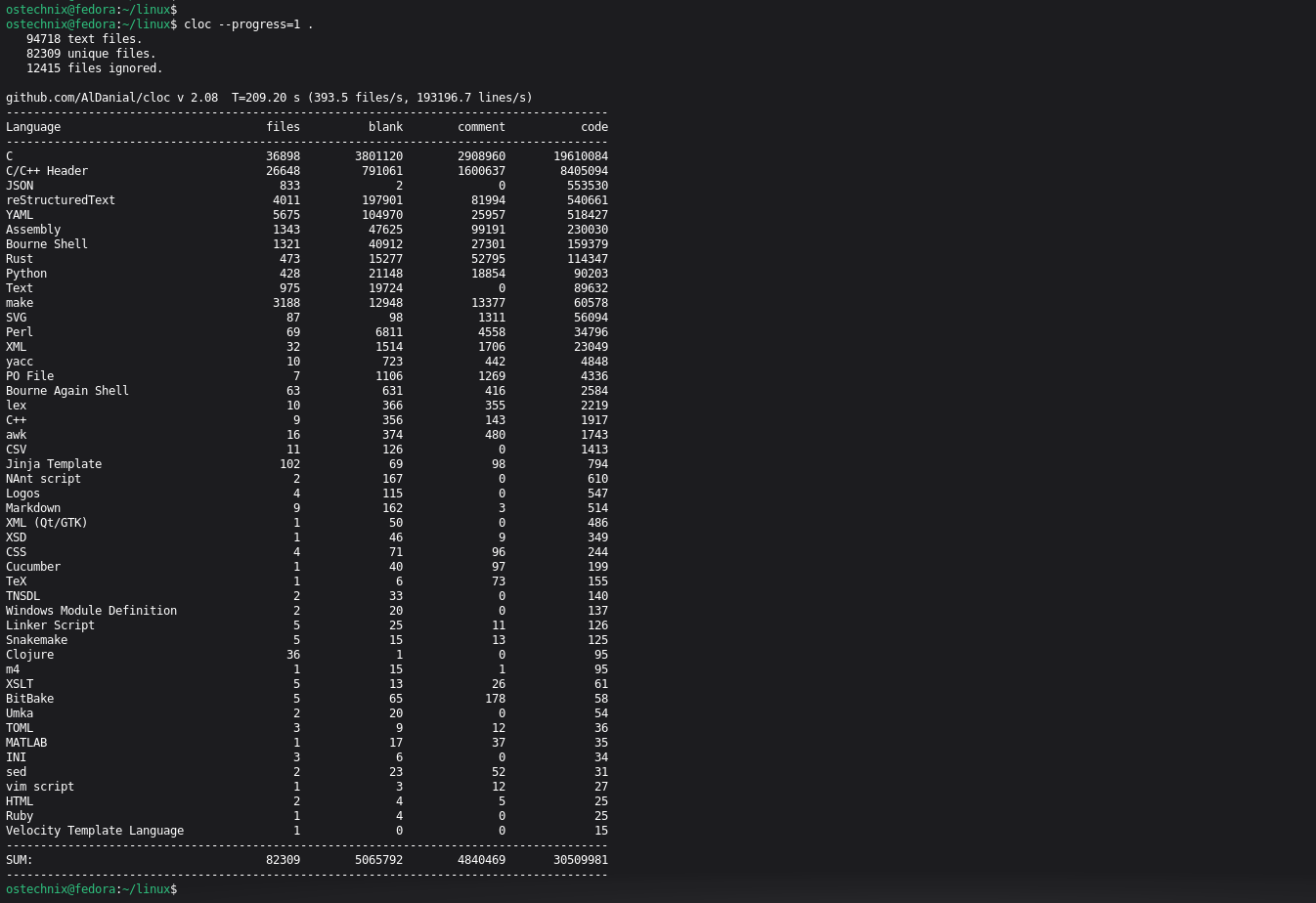
Note: cloc does not recognize Device Tree source files (.dts/.dtsi). This is part of why it undercounts the kernel (see the breakdown earlier in this guide).
To measure only the AMD graphics driver, run:
cloc drivers/gpu/drm/amd
Method 2: tokei (faster and more accurate, recommended)
tokei is significantly faster than cloc. It also correctly counts Device Tree files. This makes it a more accurate choice for the Linux kernel.
First, make sure Rust is installed in your system. And then, install tokei using cargo package manager:
cargo install tokei
tokei is also available in some distribution's official repositories, so you can install it using the default package manager like below:
sudo apt install tokei
brew install tokei
Now, run:
tokei .
Sample Output:
━━━━━━━━━━━━━━━━━━━━━━━━━━━━━━━━━━━━━━━━━━━━━━━━━━━━━━━━━━━━━━━━━━━━━━━━━━━━━━━━━
 Language              Files        Lines         Code     Comments       Blanks
━━━━━━━━━━━━━━━━━━━━━━━━━━━━━━━━━━━━━━━━━━━━━━━━━━━━━━━━━━━━━━━━━━━━━━━━━━━━━━━━━
 AWK                      13         2805         1923          500          382
 Alex                      4          662          547            0          115
 ASN.1                    15          656          441           87          128
 Assembly                 11         5781         5445            0          336
 GNU Style Assembly     1337       371255       270423        56888        43944
 Autoconf                  6          459          395           30           34
 Automake                  3           31           23            3            5
 BASH                     62         3038         2094          437          507
 Bazel                    81         1829         1474           54          301
 Bitbake                   3           13            4            6            3
 C                     36910     26320472     19615926      2909605      3794941
 C Header              26813     10822880      8416361      1615212       791307
 C++                       7         2291         1969           81          241
 C++ Header                2          125           59           55           11
 CSS                       4          411          244           97           70
 Device Tree            6343      2097441      1724154        92401       280886
 Forge Config             15         1352          321          744          287
 Gherkin (Cucumber)        1          336          199           97           40
 Happy                    10         6013         5290            0          723
 HEX                       2          173          173            0            0
 INI                       2           13            6            5            2
 Jinja2                  149         1187          966          145           76
 JSON                   1043       607008       607006            0            2
 Lex                      10         2940         2218          356          366
 LD Script                13          552          427           40           85
 Makefile               3203        87274        60667        13531        13076
 Module-Definition         2          157          137            0           20
 Objective-C               1           89           72            0           17
 Pacman's makepkg          1          134           91           13           30
 Perl                     61        43189        33862         4009         5318
 PO File                   7         6711         3346         2259         1106
 Python                  439       130209       102002         8291        19916
 RPM Specfile              1          215          174           14           27
 ReStructuredText       4011       820556       622655            0       197901
 Ruby                      1           29           25            0            4
 Shell                  1172       219683       153221        27411        39051
 Snakemake                 5          153          125           13           15
 SVG                      87        57503        56094         1311           98
 SWIG                      1          252          154           27           71
 TeX                       1          234          155           73            6
 Plain Text              981       109702            0        89924        19778
 TOML                      3           57           36           12            9
 Unreal Script             5          618          371          156           91
 Apache Velocity           1           15           15            0            0
 Vim Script                1           42           33            6            3
 XSL                      10          200          122           52           26
 XML                      32        26269        23572         1452         1245
 YAML                   5673       648526       529448        23888        95190
─────────────────────────────────────────────────────────────────────────────────
 HTML                      2           29           25            0            4
 |- JavaScript             1            7            7            0            0
 (Total)                               36           32            0            4
─────────────────────────────────────────────────────────────────────────────────
 Markdown                  9          534            0          385          149
 |- BASH                   1            2            2            0            0
 |- C                      1           20           12            6            2
 |- Rust                   1           98           76           13            9
 |- YAML                   1           25           22            0            3
 (Total)                              679          112          404          163
─────────────────────────────────────────────────────────────────────────────────
 Rust                    473       143187       114374        13573        15240
 |- Markdown             351        39084          913        29885         8286
 (Total)                           182271       115287        43458        23526
━━━━━━━━━━━━━━━━━━━━━━━━━━━━━━━━━━━━━━━━━━━━━━━━━━━━━━━━━━━━━━━━━━━━━━━━━━━━━━━━━
 Total                 89042     42584526     32359896      4893147      5331483
━━━━━━━━━━━━━━━━━━━━━━━━━━━━━━━━━━━━━━━━━━━━━━━━━━━━━━━━━━━━━━━━━━━━━━━━━━━━━━━━━
It finishes in under a minute and matches scc results closely (See the next section).
Method 3: scc (fastest, with complexity metrics)
scc matches tokei's accuracy. It also reports cyclomatic complexity per language. This is useful for understanding which parts of the kernel are hardest to maintain.
Make sure Golang is installed in your system and then run the following command to install scc:
go install github.com/boyter/scc/v3@latest
Now, run:
scc .
Sample Output:
───────────────────────────────────────────────────────────────────────────────
Language            Files       Lines    Blanks  Comments       Code Complexity
───────────────────────────────────────────────────────────────────────────────
C                  36,910  26,320,472 3,795,058 2,909,421 19,615,993  2,566,279
C Header           26,813  10,822,880   791,303 1,614,799  8,416,778     66,444
Device Tree         6,343   2,097,441   280,886    92,367  1,724,188         36
YAML                5,672     648,427   104,949    25,934    517,544          0
ReStructuredTe…     4,011     820,556   197,878         0    622,678          0
Makefile            3,203      87,274    13,076    13,531     60,667        464
Assembly            1,348     377,036    41,691    49,680    285,665      3,505
Shell               1,174     220,250    37,034    26,897    156,319     12,925
JSON                1,043     607,008         2         0    607,006          0
Plain Text            981     109,702    19,777         0     89,925          0
Rust                  473     182,419    15,156    52,407    114,856     10,808
Python                439     130,209    15,774    13,048    101,387     15,323
Jinja                 149       1,187        76       145        966        193
SVG                    87      57,503        98     1,311     56,094          2
Perl                   67      46,073     6,048     4,183     35,842      5,246
BASH                   63       3,399       513       413      2,473        324
DOT                    36       1,261        81        62      1,118          0
XML                    32      26,269     1,465     1,755     23,049          0
AWK                    17       3,102       311       232      2,559        532
CSV                    11       1,539       126         0      1,413          0
Extensible Sty…        10         200        26         0        174          0
Happy                  10       6,013       723         0      5,290          0
LEX                    10       2,940       366       355      2,219          0
Markdown                9         679       162         0        517          0
LD Script               8         390        60        29        301          0
C++                     7       2,291       241        81      1,969        332
Autoconf                6         459        34        30        395         11
License                 5         422        84         0        338          0
Snakemake               5         153        15        13        125          0
Unreal Script           5         618        91       156        371         21
Alex                    4         662       115         0        547          0
CSS                     4         411        70        97        244          0
Raku                    3         213        19        21        173         33
Systemd                 3         167        25        63         79          0
TOML                    3          57         8        12         37          0
Bazel                   2         777       167       177        433          6
C++ Header              2         125        11        55         59          2
HEX                     2         173         0         0        173          0
HTML                    2          34         4         5         25          0
INI                     2          13         2         5          6          0
Module-Definit…         2         157        20         0        137          4
bait                    2          64         4        15         45          9
sed                     2         106        23        53         30          0
CloudFormation…         1          99        17         2         80          0
Gherkin Specif…         1         336        40        97        199          0
MATLAB                  1          89        17        37         35          3
Ruby                    1          29         4         0         25          1
Scallop                 1           3         0         0          3          0
TeX                     1         234         6        73        155          0
Vim Script              1          42         3        12         27          5
XML Schema              1         404        46         0        358          0
───────────────────────────────────────────────────────────────────────────────
Total              88,988  42,582,367 5,323,705 4,807,573 32,451,089  2,682,508
───────────────────────────────────────────────────────────────────────────────
Estimated Cost to Develop (organic) $1,473,621,894
Estimated Schedule Effort (organic) 219.99 months
Estimated People Required (organic) 595.12
───────────────────────────────────────────────────────────────────────────────
Processed 1595970277 bytes, 1595.970 megabytes (SI)
───────────────────────────────────────────────────────────────────────────────
On the v7.2-rc1 tree, scc also estimates the cost to rebuild the kernel from scratch. The estimate is about $1.47 billion, using the COCOMO organic model. You can see this detail nearly at the end of the output.
Method 4: wc -l (quick all-files sanity check)
The wc command counts every line in every file, regardless of type. This includes binary and non-text files. It produces the highest number of all four tools.
find . -not -path './.git/*' -type f \
  | xargs wc -l 2>/dev/null \
  | awk '/total/{sum += $1} END{print sum}'
Sample Output:
43179595
Please note that wc is not a language-aware code counter. But it provides a useful upper bound for the total number of lines stored in the Git tree.
Note: Do not add | tail -1 at the end. When there are tens of thousands of files, xargs splits them into multiple batches. Each batch prints its own total line. Using tail -1 only captures the last batch's subtotal. This produces a badly wrong result.
Tool comparison
| Tool | Speed | Language-aware | Notes |
|---|---|---|---|
wc -l | Fastest | ❌ | Counts all files, including binaries |
tokei | Very fast | ✅ | Best balance of speed and accuracy |
scc | Fast | ✅ | Also reports cyclomatic complexity |
cloc | Slow (15–30 min) | ✅ | Undercounts the kernel; doesn't recognize Device Tree files |
Linux 7.2 Code Statistics Summary
Measured on commit dc59e4fea9d8 (tag: v7.2-rc1), June 30, 2026:
| Statistic | Value |
|---|---|
Total lines, all files (wc -l) | 43,179,595 |
| Total lines, source-aware (tokei/scc) | ~42,583,000 |
| Source code lines | ~32,400,000 |
| Comment lines | ~4,850,000 |
| Blank lines | ~5,327,000 |
Difference between wc -l and tokei/scc | ~597,000 lines (non-source files and files classified differently by language-aware tools) |
| Largest driver | AMDGPU + AMDKFD |
| AMD graphics driver | ~6.35 million lines |
| Major source of growth | Device drivers |
| Legacy cleanup | Continued removal of Intel i486 code and obsolete drivers |
| Estimated dev cost | ~$1.47 billion (COCOMO, via scc) |
Conclusion
Crossing 42 million lines is more than a fun statistic. It reflects the scale of one of the world's largest collaborative software projects.
Linux kernel maintainers keep adding support for new hardware. At the same time, they remove code for platforms that have reached the end of their useful life. The result is a kernel that grows where it needs to and becomes cleaner where it can.
For Linux enthusiasts, this milestone is another reminder of how fast kernel development moves. It also shows how much work goes into supporting everything from tiny embedded boards to the world's fastest supercomputers.
Source:
