
Good news, everyone! Linus Torvalds announced the final release of Linux kernel version 6.15 on 25 May 2025. Every kernel release brings better support for new computer parts and makes existing ones work better. Linux 6.15 is no different, with many changes across different areas.
In the Kernel 6.15 announcement mail, Linus noted that the release was slightly delayed due to a last-minute bug report, which resulted in one feature being disabled. Otherwise, it was normal, with various small fixes across the system.
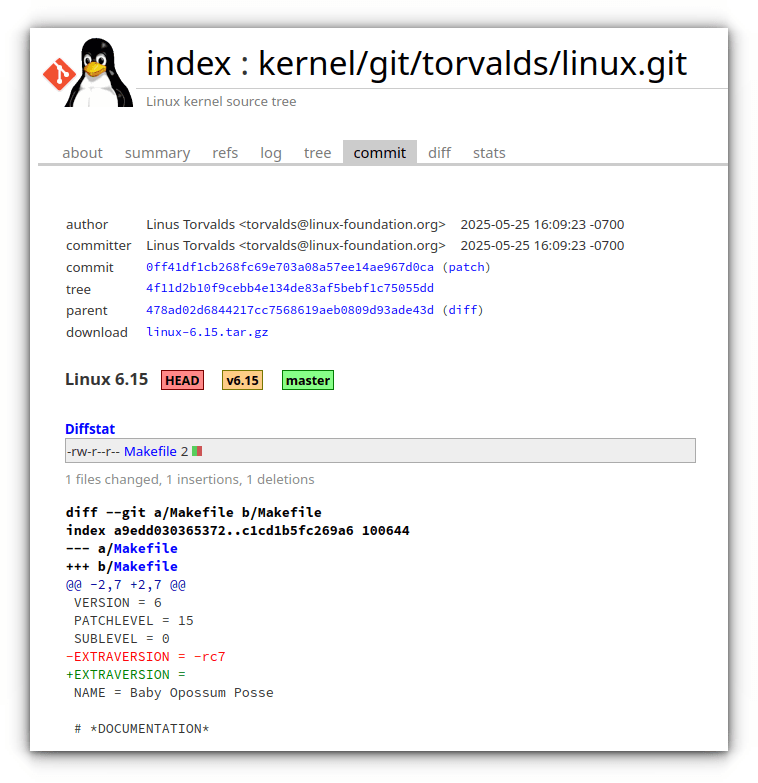
The announcement also marks the opening of the merge window for the next development cycle, noting that pull requests have already been submitted.
What's New in Linux Kernel 6.15?
While Linus described this release as "pretty normal" with lots of smaller fixes and driver updates, there are still some exciting improvements tucked inside that are worth talking about!
1. Better Graphics for Intel, AMD, and Apple!
A big focus in this release is improving how Linux works with graphics cards.
- If you use a computer with Intel graphics, the Intel Xe driver has received many updates. This includes better ways for programs to share memory with the graphics chip (Shared Virtual Memory or SVM) and improved ways to report when the graphics chip stops responding (known as a "hung GPU"). The driver can also now tell you the temperature of your Intel GPU and its memory (VRAM), and supports a new power profile mode.
- For those with AMD Radeon graphics cards, the AMDGPU driver now supports the special connection used by some board partners for things like RGB lighting. It also adds support for new upcoming AMD chips and improved fan speed reporting for some Radeon RX 9070 series cards.
- A really big step was made for people running Linux on Apple Silicon Macs thanks to the Asahi Linux project. An important part that helps graphics drivers talk to the system (userspace API, or uAPI) has been added directly into the main Linux kernel. This is actually quite unique, as this part was merged before the main graphics driver itself. This change is a major milestone because it will finally allow the use of graphics technologies like OpenGL, OpenCL, and Vulkan on Apple Silicon using the standard Mesa drivers. Linux 6.15 also brings support for a specific virtualisation feature (FEAT_PMUv3 emulation) on Apple Silicon within KVM.
2. Continued Progress with Rust
The work to include the Rust programming language in the Linux kernel is still moving forward in 6.15. This release includes initial basic support for Rust with the ARMv7 architecture.
An exciting development here is the inclusion of an early 'stub' or foundational code for "Nova". This is a new, open-source graphics driver for newer NVIDIA GPUs that is being written in Rust.
It's planned as a successor to the existing Nouveau driver. It's very early days, and this driver isn't ready for everyday use yet, but it's a promising step for NVIDIA support on Linux.
3. Faster File Systems and Better Storage
You'll find lots of tweaks and speedups for the file systems that organise your data.
- The newer Bcachefs file system continues to improve, with various fixes and efforts to make it more stable. It's getting closer to being considered stable.
- Deleting files on exFAT file systems (often found on USB drives and SD cards) is now significantly faster. One commit showed deleting a large 80 GB file went from over 4 minutes down to just 1.6 seconds with a specific setting.
- The FUSE system, which lets you run file systems in user space (like for SSH connections), can now handle filenames longer than 1024 characters. It also gains an option to time out requests if a user-space server stops responding, which helps prevent hangs.
- Btrfs gained support for faster Zstd compression levels.
- The block layer now supports using hardware-wrapped encryption keys, meaning encryption keys can be placed onto a storage device without staying vulnerable in main memory.
4. Fixing Performance Hiccups
While adding new features, developers also fix problems.
A performance slowdown affecting the popular Nginx web server (used for websites) was found in the development versions of 6.15.
Thankfully, a fix for this issue was included before the final release, preventing a significant slowdown for users.
Other performance improvements include faster checks (CRC) for certain Intel CPUs (AVX-512).
5. Wider Hardware Support
As always, Linux 6.15 adds support for more devices.
- There's continued expansion for computers using ARM and RISC-V chips. This includes new device definitions for things like the Google Pixel Pro 6 phone, some Allwinner A523 devices, and the Milk-V Jupiter RISC-V board.
- Good news for laptop users. Linux 6.15 adds support for the Apple Touch Bar on Intel and M1/M2 MacBook Pros. This support covers things like backlighting, touch, and function keys.
- Gaming controller support is better, with more Xbox controllers like the Turtle Beach Recon and Stealth Ultra added to the xpad driver. The Sony PlayStation 5 controller also works better.
6. Other Interesting Bits
- A new system called fwctl was added to help standardise how the kernel interacts with device firmware securely from user space. This was a debated change during development.
- A new security feature (a security hook) for the io_uring system (used for fast input/output operations) was included, despite some criticism from Linus Torvalds about its complexity. Its goal is to improve security by allowing systems like SELinux to control access to data read by the kernel.
- Zero-copy receive (zcrx) support via io_uring was added for networking. This can speed up network tasks by letting network data go straight into the program's memory without extra copying steps.
For more details on the Linux Kernel 6.15 release, I recommend you to look at the first part of the 6.15 merge window and rest of the 6.15 merge window.
Support for the Intel 486 and Early 586 Dropped
With technology constantly moving forward, the Linux kernel sometimes has to let go of older hardware.
A while ago, we reported that support for very old processors like the Intel 486 and early 586 will be removed in future kernel versions. This is because these older chips lack certain features that newer kernel code relies on.
Well, support for these old processors has been dropped from Kernel 6.15.
Try Linux Kernel 6.15
For those who like to be on the cutting edge, the Linux kernel 6.15 source code is always available from Kernel.org website or the Linus Torvalds's git tree.
If you're using Ubuntu, you can install the latest Kernel using Mainline utility.
You can also wait for your Linux distribution (like Ubuntu, Fedora, etc.) to make it available in its default repositories. But, it will take a while.
Kernel 6.15 is a solid release with improvements across the board, making Linux better for a wide range of computers, from powerful servers to desktop PCs and even smaller embedded devices.
Now that 6.15 is out, work has already begun on the next version, Linux Kernel 6.16.
Enjoy exploring the improvements in Linux 6.15!
