
Table of Contents
Quick Summary
- Linux Kernel 7.1-rc1 was released on 26 April 2026, officially closing the merge window with approximately 13,000 non-merge commits.
- This release features a massive update for AMD GPU register headers. A single bulk AMD GPU register header sync accounts for roughly 25% of the entire 7.1-rc1 patch.
- Kernel 7.1-rc1 also begins a "spring cleaning" process to remove support for aging hardware, such as the i486 processor and obsolete networking gear.
Linux Kernel 7.1 RC1 Released
Linus Torvalds released the first release candidate (RC1) for the next major Linux Kernel version 7.1 on Sunday, 26 April 2026. This release officially closes the two-week "merge window" where developers add the biggest changes. If you enjoy testing the latest tech, this version offers a first look at what is coming next for Linux.
A Big Update with Surprising Stats
This merge window was fairly busy. It includes about 13,000 new changes (non-merge commits). While that sounds like a massive amount of code, one specific update makes the numbers look even larger.
A bulk update for AMD GPU register headers actually accounts for about 25% of the total patch. Because of this, the statistics look a bit lopsided. But, if you ignore that one big file sync, the rest of the update is quite standard.
About half of the remaining changes focus on drivers, while the rest update networking, filesystems, and core kernel code.
Key Changes in Linux 7.1-rc1
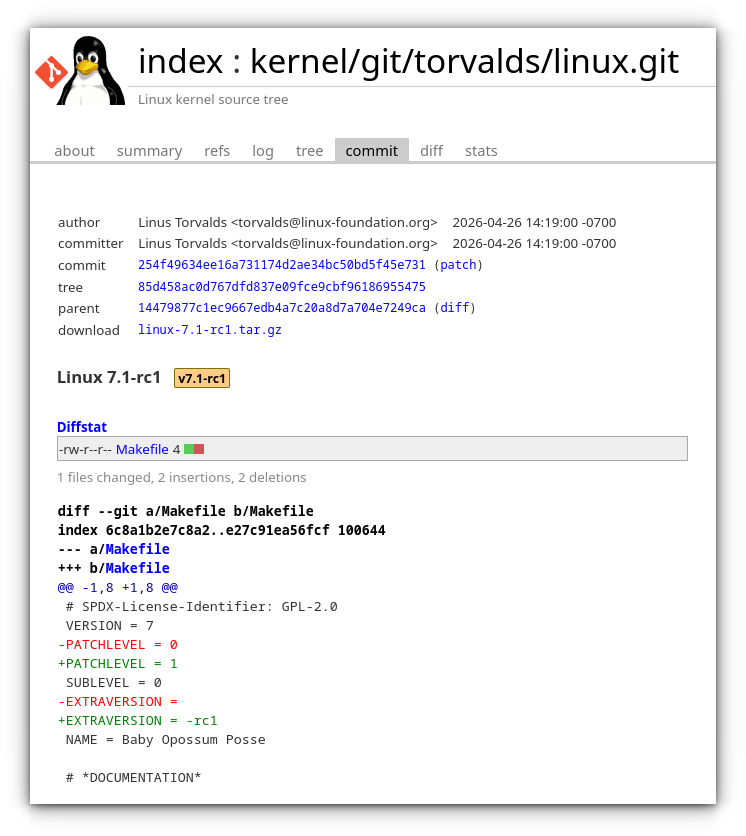
As mentioned in the Linux 7.1-rc1 release announcement mail, the two-week merge window resulted in approximately 13,000 non-merge commits and 1,000 merge commits.
Torvalds characterized these numbers as being "fairly normal" but "possibly slightly on the bigger side".
The key changes and updates in this release include:
Bulk Driver Updates
- AMD GPU Register Sync: A significant portion of the total patch—roughly 25%—is attributed to a bulk AMD GPU register header sync.
- Driver Dominance: Approximately half of all updates in this release are dedicated to drivers.
Core Kernel and Architecture Updates
- x86 Enhancements: There are updates for x86 FRED (Flexible Return and Event Delivery), microcode loading, SEV (Secure Encrypted Virtualization), and TDX (Trust Domain Extensions).
- VFS Updates: Christian Brauner submitted extensive updates for the Virtual File System (VFS), covering writeback, attributes, directory handling, integrity, and pidfs updates.
- Rust and Security: The release includes further Rust updates from Miguel Ojeda, as well as hardening and seccomp updates.
Filesystems and Networking
- Filesystem Updates: Merges were completed for various filesystems, including Btrfs, XFS, Ext4, FAT, F2FS, EROFS, and NTFS3.
- Networking: Updates include networking fixes, general improvements, and the removal of deprecated networking hardware support.
Ending Support for i486 and Old Hardware
Even though the kernel is growing, the developers are also doing some "spring cleaning". They are removing support for very old hardware to make the kernel easier to maintain.
Here is what they are culling:
- i486 support: The release begins phasing out i486 support, with configurations currently deleted and code deletions expected to follow.
- Old networking hardware: Support for very old networking tools is going away.
- Unsuccessful SoCs: They are deleting support for various "System on a Chip" platforms that never became popular.
Despite these removals, the kernel is still getting bigger because developers added many more new features than they took away.
In the Linux 7.1 RC1 release notes, Torvalds noted that many more lines were added than removed due to the influx of new features.
Early Testing and Bugs
The community has already started testing Linux 7.1 RC1. For instance, one user reported a backlight issue on a Dell Latitude 7390 laptop. This bug makes it hard to see the screen properly when using the new kernel.
Because of this report, Linus Torvalds and other top maintainers are working together to find a fix. They have asked the user to help "narrow it down" using git bisect command. Hope they will find a fix for it and release in the next RC.
Download and Test Linux Kernel 7.1 RC1
As with every release, Linus recommended to try the Linux 7.1-rc1 and report back the issues. You can download the latest Linux 7.1 RC1 version from the Official Linux Kernel Archives and the Linus Torvalds's git tree.
Please keep in mind that this is a "prepatch" release. These versions are mainly for developers and Linux fans who know how to compile code from source. RC kernels can be unstable and might contain bugs, just like the backlight issue mentioned earlier.
If you need a computer that works perfectly for your daily job, you should probably stick with the current "stable" version until 7.1 is fully ready.
What's Next?
Now that the merge window is closed, the Kernel team will stop adding major features. Instead, they will focus on fixing bugs and stabilizing the code. We can expect several more "RC" releases over the next few weeks as they get everything ready for the final launch.
Estimated Final Release Date for Linux Kernel 7.1
Based on the standard Linux kernel release cycle, here's what to expect:
How the Cycle Works
After RC1, Linus Torvalds releases a new release candidate every week (on Sundays), typically going through RC7 or RC8 before the final stable release. The whole RC phase usually lasts 7–8 weeks from RC1.
Linux Kernel 7.1: Expected Release Timeline
| Milestone | Expected Date |
|---|---|
| RC1 | Sun, 26 Apr 2026 ✅ |
| RC2 | Sun, 3 May 2026 |
| RC3 | Sun, 10 May 2026 |
| RC4 | Sun, 17 May 2026 |
| RC5 | Sun, 24 May 2026 |
| RC6 | Sun, 31 May 2026 |
| RC7 | Sun, 7 Jun 2026 |
| RC8 (if needed) | Sun, 14 Jun 2026 |
| Final Stable Release | Sun, 7 Jun – 14 Jun 2026 |
Best Estimate
If the cycle wraps up cleanly at RC7 (which is common for well-behaved releases), we can expect the Linux Kernel 7.1 final version on Sunday, June 7, 2026.
If an extra RC8 is needed due to last-minute bug fixes or regressions (also fairly common), the final release might be postponed to one week. So the final release date for Linux 7.1 will be Sunday, June 14, 2026.
Linus Torvalds can extend the RC phase at his discretion if significant issues are found late in the cycle. Watching the kernel mailing list (LKML) around RC6–RC7 will give the best signal on whether an RC8 is likely.
