
Table of Contents
Quick Summary
- Debian 14 "Forky" will introduce a mandate for reproducible packages, requiring that anyone using the same source code and build instructions can recreate bit-for-bit identical binaries.
- This initiative aims to secure the software supply chain by shifting trust from the build infrastructure to the auditable source code, ensuring that any tampering at the build level is immediately exposed by a mismatched cryptographic hash.
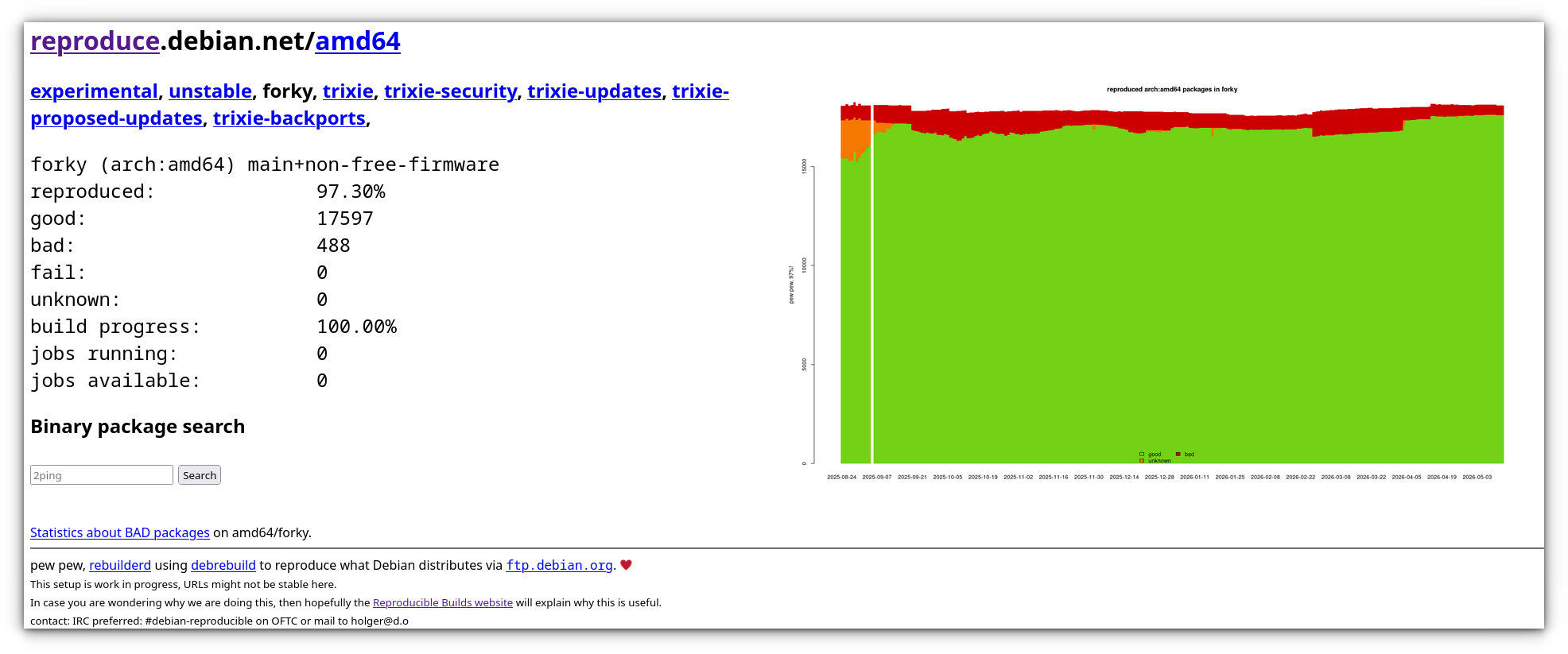
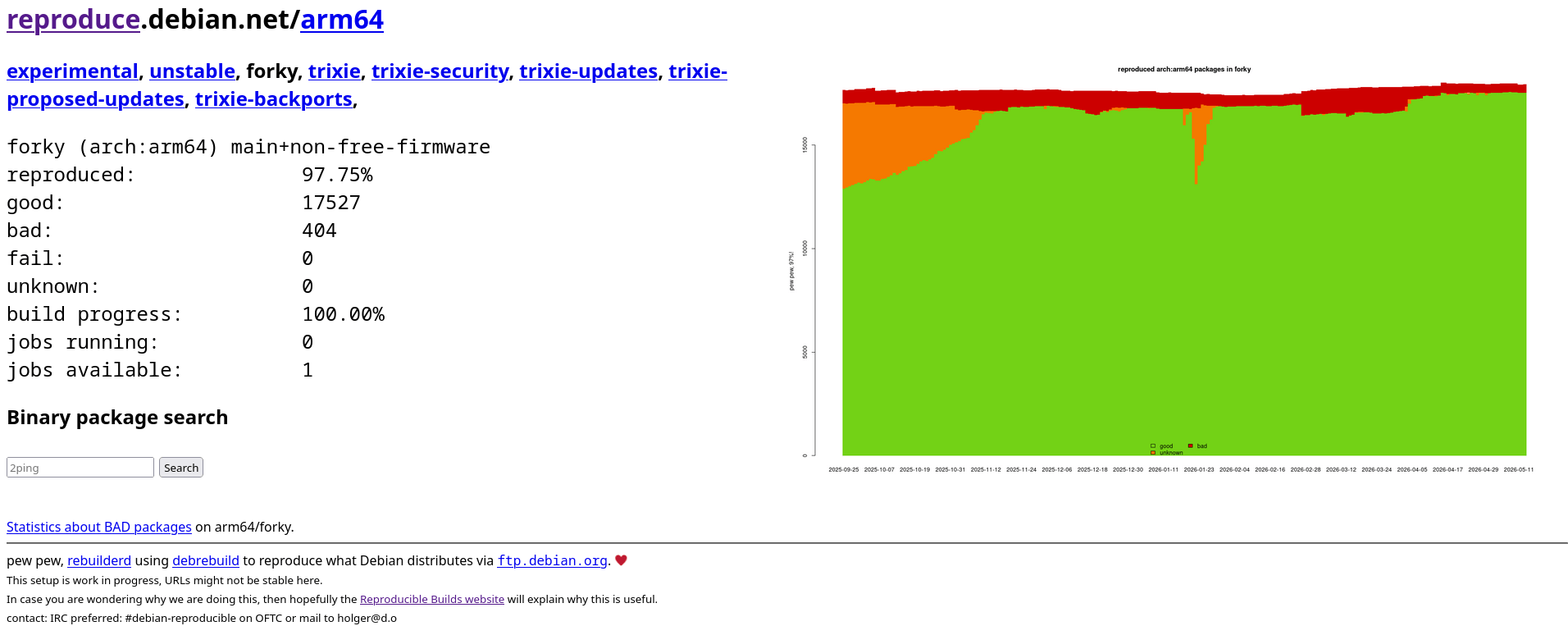
- Currently, the project is seeing great success. For common hardware like amd64 and arm64, over 97% of the software in the Debian "Forky" repository is already reproducible.
Introduction
Imagine downloading a software update and knowing, with absolute certainty, that nobody tampered with it. You don't have to just "trust" the developer or the build server. You can prove it yourself. This is the goal of reproducible builds, and Debian is making it mandatory and a core part of its future.
What Exactly is a Reproducible Build?
In the simplest terms, a build is reproducible if anyone can take the same source code, the same environment, and the same instructions to produce a bit-by-bit identical copy of the software.
This means the final file, whether it is an executable or a distribution package, must be exactly the same, down to the last byte. The primary way to verify this is by using cryptographically secure hash functions to compare the files. If the hashes match, you know the software is genuine.
Why Does Bit-for-Bit Identity Important?
You might wonder why we need such a strict metric. The answer is supply chain security.
Usually, when you install a package via apt, you are trusting that the Debian build servers correctly compiled the source code you see online. But what if that server is hacked? A clever attacker could inject a "backdoor" into the binary without touching the source code.
Reproducible builds solve this problem. Because the output must be identical, anyone can rebuild the code themselves to verify it. If a server ships a tampered binary, an independent rebuild will produce a different hash, exposing the attack immediately.
This shifts the focus of trust from the invisible build infrastructure to the auditable source code.
The Challenge: Killing Non-Determinism
Achieving this level of perfection is hard because most build processes are non-deterministic. They include tiny, random variations that change the final file. To make a build reproducible, developers have to hunt down and fix these common "gotchas":
- Timestamps: Tools often bake the current time into a binary. The fix is to use the
SOURCE_DATE_EPOCHenvironment variable to provide a fixed, consistent timestamp. - File Ordering: Filesystems often return file lists in a random order. Developers now use tools like
disorderfsto force a sorted, predictable order during the build. - Build Paths: Compilers sometimes record the absolute folder path where a dev worked. Using flags like
-ffile-prefix-mapstrips these local paths so the folder name doesn't matter. - CPU Variation: Sometimes, even the number of CPU cores used can change the output.
Debian 14 Forky: The New Mandate
The Debian community has been working on this for over a decade. Now, they are turning that effort into a requirement.
Debian 14 (codenamed "Forky"), which is expected in 2027, will introduce a mandate for reproducible packages. Under this new mandate, software packages must be reproducible to be included in the "Stable" version of the distribution.
If a package isn't reproducible, it won't be allowed to migrate from the "Unstable" repository to the "Testing" repository. This means that if it doesn't meet the standard, it won't make the cut for the final Stable release.
How Debian Rebuilds Everything
Debian doesn't just hope things are reproducible; they test them constantly. The reproduce.debian.net project attempts to rebuild every binary in the archive to verify it.
Here is how their workflow functions:
- Orchestration: A tool called
rebuilderdmanages the queue of packages to be tested. - Environment Reconstruction: The tool
debrebuildlooks at a.buildinfofile to see exactly which versions of dependencies were used in the original build. - The Rebuild: Using
sbuild, the system recreates that exact environment and compiles the code to see if the resulting hash matches the original.
Currently, the results are impressive. For the upcoming Debian 14 "Forky" release, mainstream architectures like amd64 and arm64 already have reproduction rates above 97%.
You can verify this from the following link:
This page shows whether packages in the upcoming Debian 14 release can be rebuilt independently and still produce bit-for-bit identical binaries.
The following screenshots shows the reproducibility results for the arch:all packages in Debian 14 "Forky":
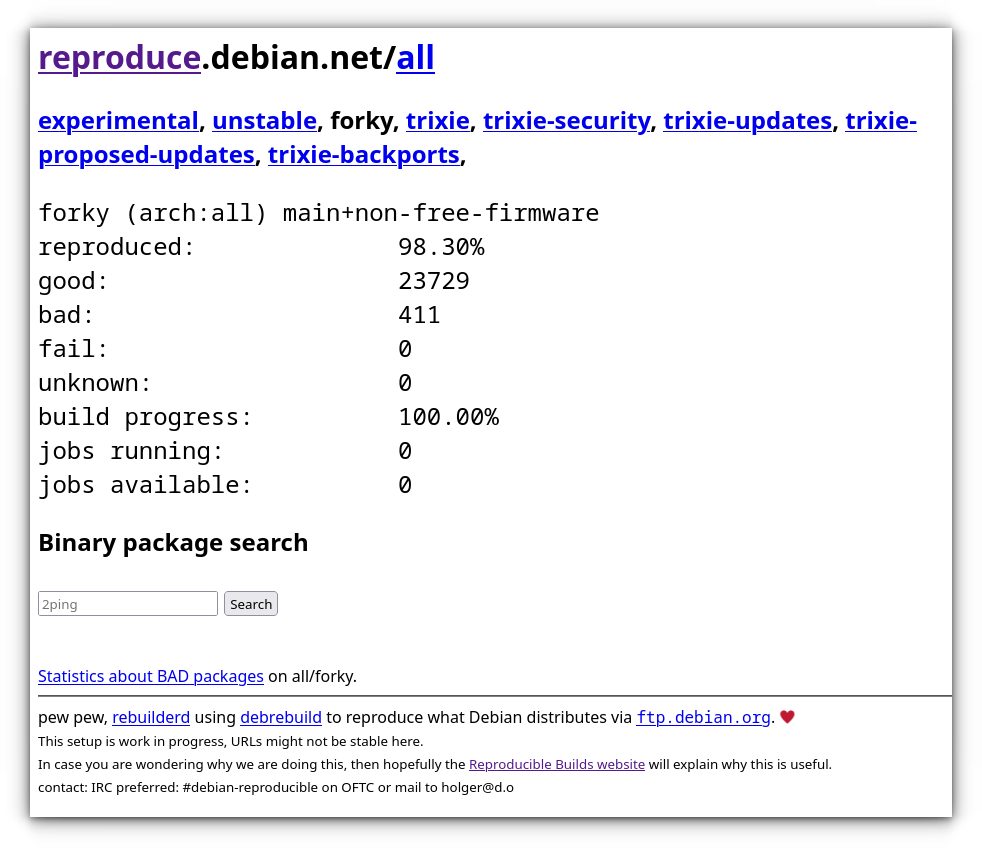
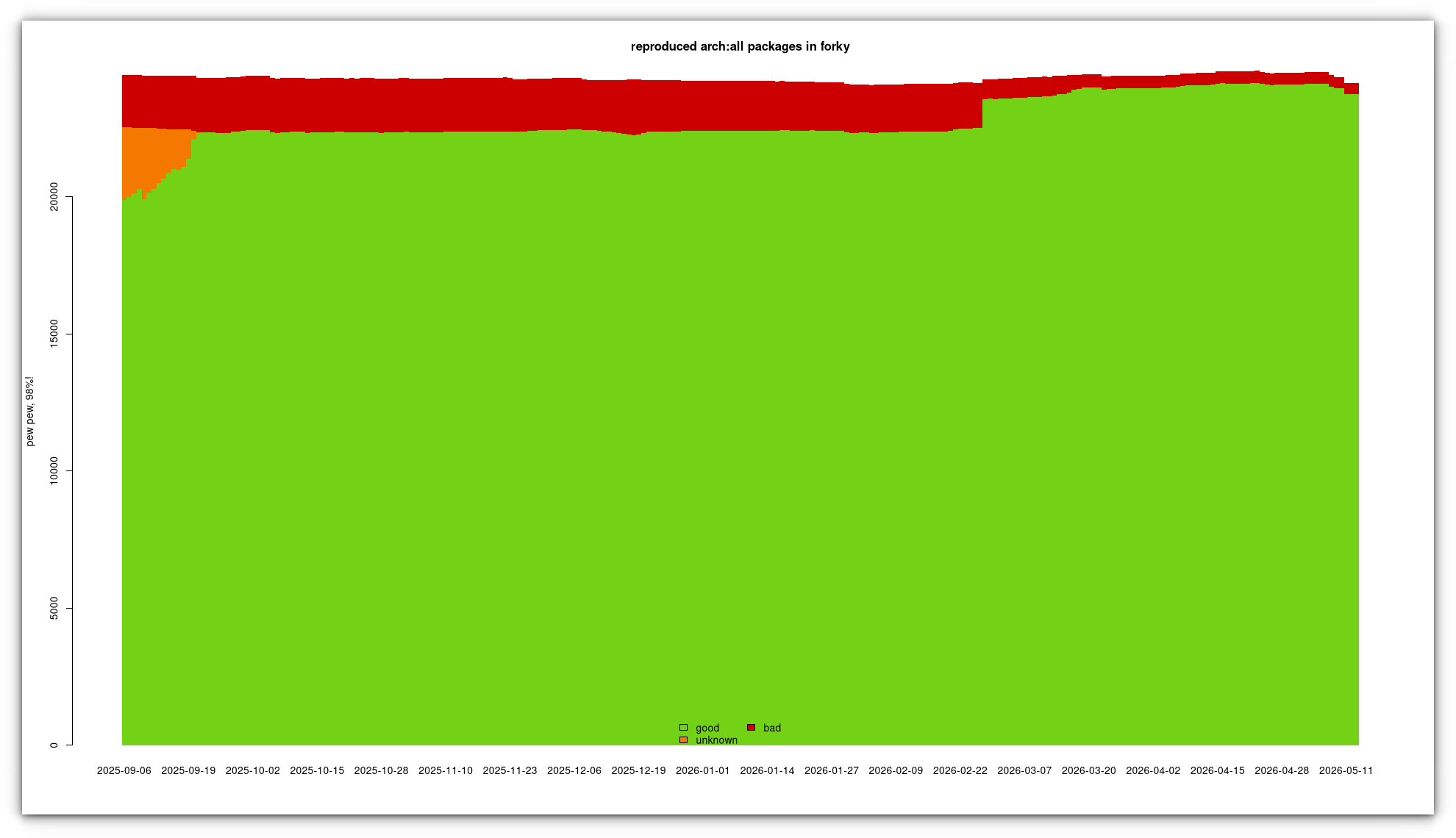
The site works like this:
- Debian publishes a package.
- Independent rebuild servers fetch the same source code and build instructions.
- They rebuild the package from scratch using tools like
rebuilderd,debrebuild,mmdebstrap, andsbuild. - The rebuilt binary is compared against the official Debian binary.
- If the hashes match exactly, the package is considered reproducible.
In this link, you'll also find:
- different architecture pages like amd64, arm64, i386, riscv64, etc.
- statistics about failed reproductions,
- package search,
- rebuild worker status.
Here's the reproducibility results for the arch:amd64 packages in Debian 14 Forky:
The reproducibility results for the arch:arm64 packages in Debian 14 Forky:
Testing Beyond the Code
While reproducibility proves the binary matches the source, Debian also uses autopkgtest to ensure the software actually works.
Unlike standard unit testing, which checks if a component works within itself, autopkgtest performs whole-package integration testing. It runs the package in a virtual environment to make sure it interacts properly with the rest of the system, like checking if a program crashes if a config file is missing.
A New Standard for the Industry
Debian isn't alone in this. Projects like F-Droid are also pushing for reproducibility in the Android ecosystem to ensure users get the exact code the developers intended.
By moving toward reproducible builds, Debian is setting a high bar for accountability and transparency in open source. It's a powerful investment in security that protects developers and users alike from sophisticated attacks on our digital infrastructure.
Resource:
