
Google SynthID is a digital watermarking system developed by Google DeepMind to help identify content generated with supported AI tools. It embeds signals designed to be imperceptible to people but detectable by software. SynthID supports images, video, audio, and text, although the public SynthID Detector checks images, videos, and audio.
Originally, Google announced SynthID in 2023 for AI-generated images. It later expanded the technology to other media types and introduced the SynthID Detector in 2025. On 7 October 2026, Google announced that the detector was becoming available globally in English.
As of writing this, SynthID can check content generated by Google AI and participating partners, including OpenAI, NVIDIA, and Kakao. Apple was mentioned as a future partner at the time of the announcement.
Table of Contents
How SynthID works
SynthID uses different watermarking methods for different media types:
- Images and video: The watermark is embedded in image pixels or video frames.
- Audio: The watermark is embedded in the audio signal and is designed to be inaudible.
- Text: The system adjusts token-generation probabilities so that generated text carries a statistical watermark.
The watermark is designed to remain detectable after some common changes, such as image cropping, colour adjustments, lossy compression, audio noise, or changes in playback speed. Detection is not guaranteed after every transformation, and extensive alterations can make the watermark undetectable.
SynthID differs from metadata-based provenance because its watermark is embedded in the content itself rather than stored only as information attached to the file. Both approaches can provide useful information about a file's origin, but neither establishes every detail about its history on its own.
SynthID Detector
Google introduced the SynthID Detector in May 2025 as a portal for checking whether media contains a SynthID watermark. In October 2026, Google announced broader public access to the detector in English.
The portal checks images, video, and audio. It can also highlight portions of a file that are likely to contain the watermark. The detector supports content generated by Google's own AI tools and a few other participating partners.
Google also provides SynthID verification features through Gemini, Search, and Chrome. Google reported that these built-in features handled more than one million requests per day.
How to Identify AI Generated Media with SynthID Detector
- Go to Synthid website from your web browser.
- Sign in with a Google account and accept the terms of service.
- Upload the file you want to check.
- The portal scans for a SynthID watermark and reports whether it found one.
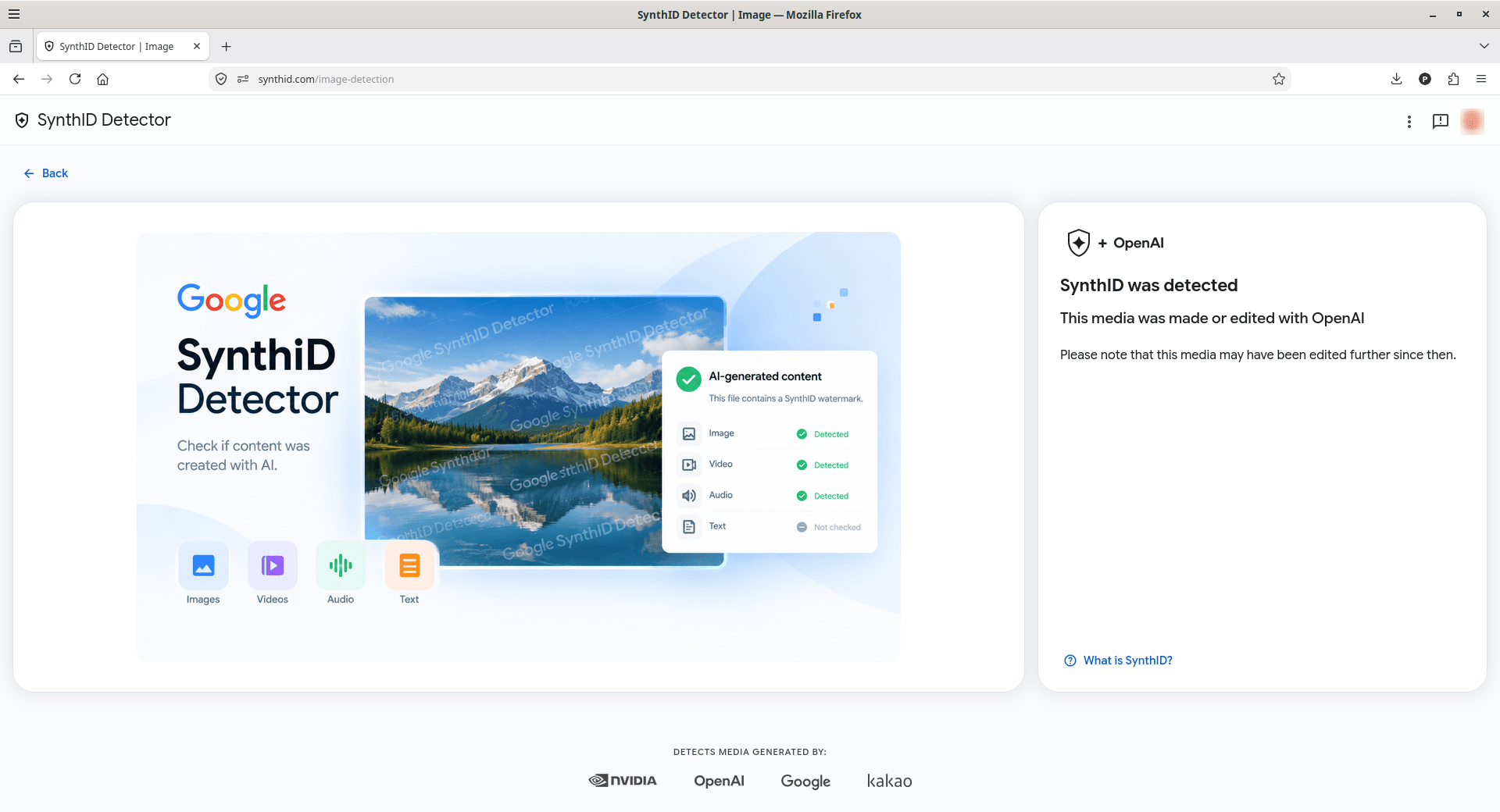
I tested this service with two sample images. One is generated with ChatGPT and another is created using GIMP. SynthID correctly identified which image is created with AI.
Sample image created with AI:
And here's a sample image created without AI:
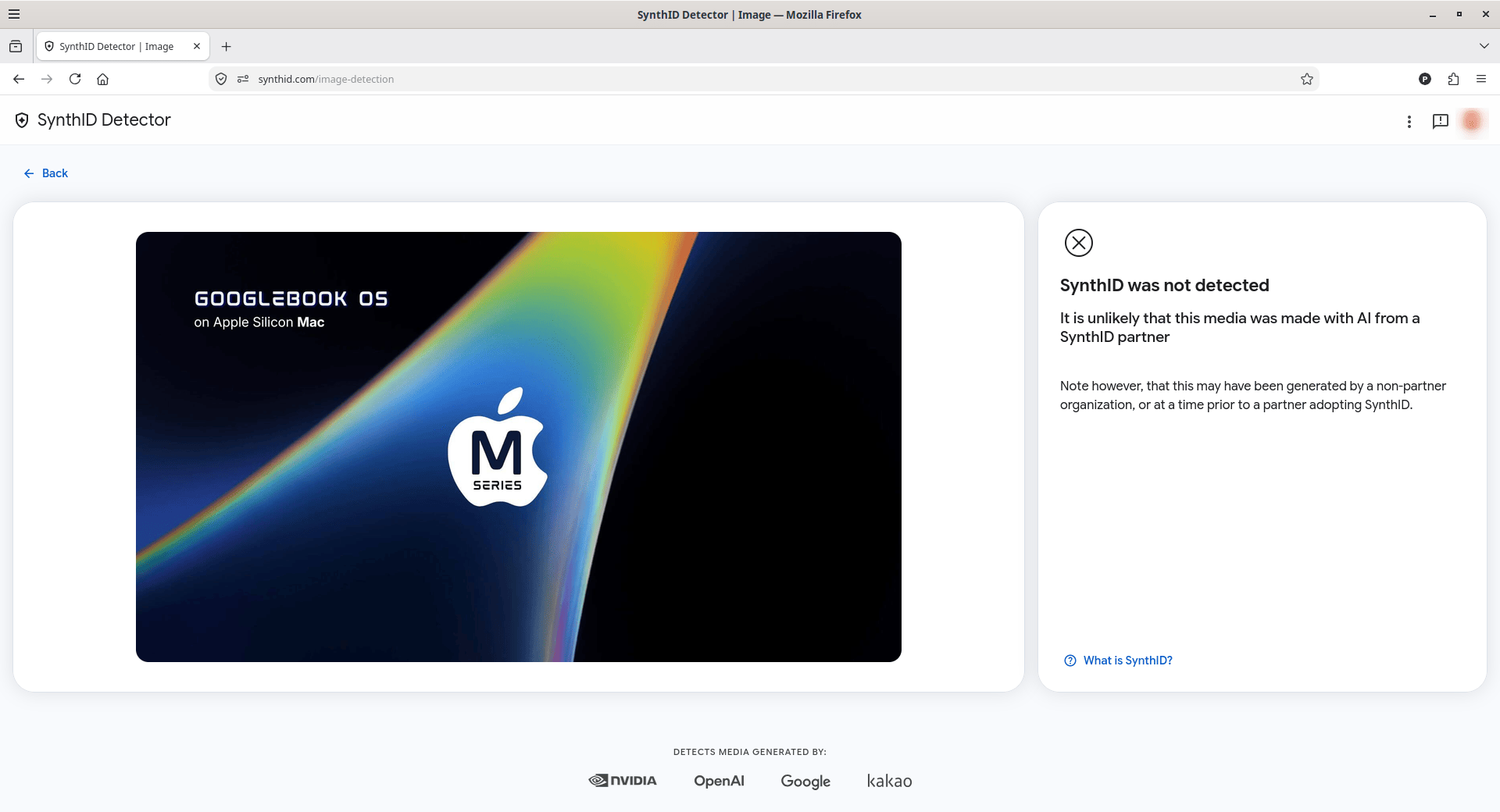
I also tested a few other images. The result is 100% correct.
According to Google, SynthID had been used to watermark more than 180 billion images and videos and the equivalent of 240,000 years of audio content. Please note that these figures are given by Google. They are not independently audited totals.
Limitations
SynthID is not a universal AI detector. It can identify a watermark only when the relevant content was marked with a compatible SynthID system and the signal remains detectable.
A result indicating that no watermark was detected does not prove that a file was created by a human or that it has never been edited using AI.
Although the watermark is designed to withstand common transformations, extensive alterations can make it undetectable. So you should treat SynthID as one source of evidence about a file, rather than a definitive judgment about its authenticity or origin.
Suggested Read:
Resources:
