
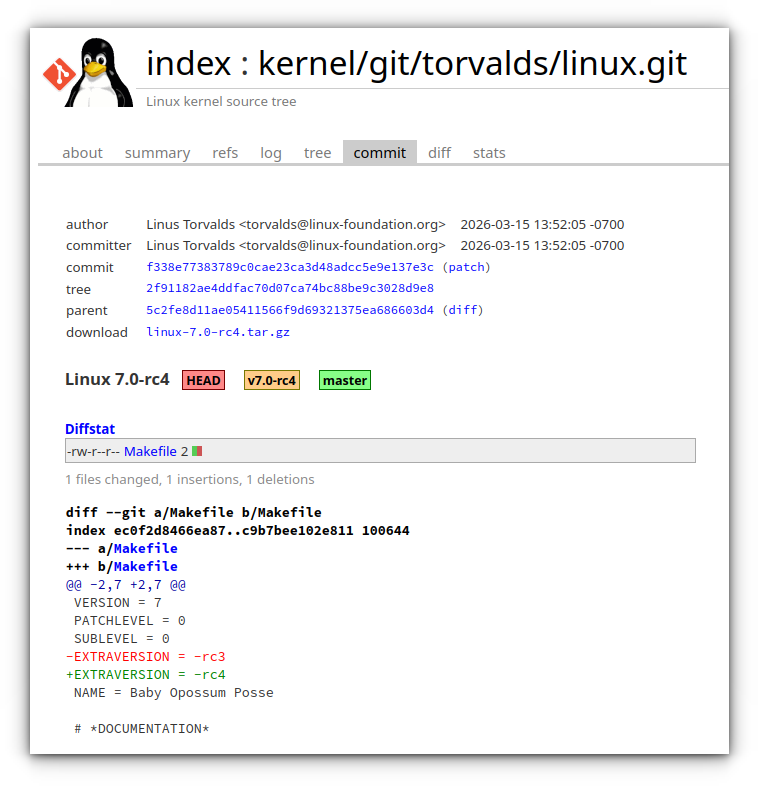
Linus Torvalds announced the release of fourth release candidate (RC4) for the upcoming Linux Kernel 7.0 on March 15, 2026. It continues the trend of being "bigger than usual" for this stage of development.
While Torvalds initially hoped the release cycle would start to quiet down, this week proved otherwise after a sudden surge of work arrived late in the week.
Table of Contents
The Psychology of Version 7.0
Initially, Torvalds thought the large size of recent updates came from a backlog of work from the previous kernel cycle. However, he now has a new theory. He suspects a "psychological result" of the jump to version 7.0.
Specifically, he believes that the new major version number makes developers more active than usual. While the first release candidate was a normal size, the last three have all stayed larger than typical for this stage.
Even so, Torvalds describes the actual changes as "fairly small and benign" and mostly spread out across the system in the Linux 7.0-rc4 release announcement mail.
Key Technical Highlights in Linux Kernel 7.0 RC4
1. Notable Security and Core Fixes
Despite the high number of changes, the team focused on making the kernel more stable. Developers made several key improvements in the Linux 7.0-rc4 release:
- Rust Binder Improvements: The team refined the Rust binder to check ownership better and stop "oneway spam".
- AppArmor Security: This release includes many fixes for AppArmor to stop memory leaks and prevent race conditions.
- RISC-V Safety: Developers fixed several Spectre-v1 vulnerabilities within the RISC-V KVM system to keep virtual machines safe.
- Workqueue Diagnostics: A new stall detector sample module arrived to help developers find and fix tasks that take too long to finish.
2. Hardware and Testing Updates
The Linux Kernel community continues to focus heavily on testing. In fact, selftest updates make up a large and noticeable part of this patch. Additionally, the kernel received better support for various hardware devices:
- USB Support: The update adds "quirks" for video capture devices and Huawei mobile modules to help them wake up or function correctly.
- i3c Master Support: Developers fixed several technical "races" in the mipi-i3c-hci driver to improve how it handles data transfers.
- Networking: A large networking update arrived on Thursday, which contributed significantly to the overall size of this release.
Download and Test Linux Kernel 7.0 RC4
Torvalds is still waiting for the release cycle to enter a "calming down period". While the 7.0 cycle is busier than he would like, the quality of the code remains high.
In short, Linux 7.0-rc4 shows that the move to a new major version has energized the developer community. Because of this extra effort, I hope the final version of Linux 7.0 should be a very polished and stable release for everyone.
If you enjoy testing the latest Kernel release candidates, you can build and boot this new version today to help the team find any final bugs. The latest Kernel 7.0 RC4 version is available for download at the Kernel.org website and the Linus Torvalds's git tree.
