
Linus Torvalds announced the fourth release candidate (RC4) for the upcoming Linux kernel 7.4 on Sunday, November 22, 2026. While developers usually expect release candidates to shrink by the fourth week, the Linux 7.4-rc4 update turned out surprisingly large.
This new candidate contains a high volume of fixes across the entire kernel tree. Let's look at what Linux 7.4-rc4 includes, why the update remains so big, and how you can test it safely.
Table of Contents
Why Linux 7.4-rc4 is Unexpectedly Large
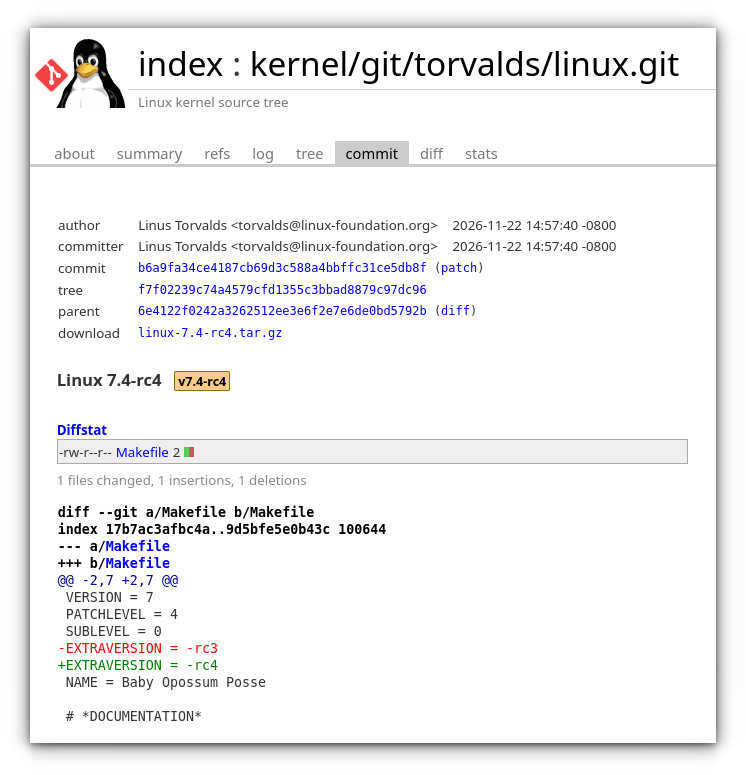
During standard kernel cycles, patches usually taper off after the third release candidate. But, the Linux 7.4 development cycle started with the largest merge window in Git history. Maintainers merged 19,780 total commits during that two-week period.
Because developers introduced so much new code at the start, the stabilization process naturally requires a higher volume of follow-up fixes. As a result, small patch submissions continue to arrive from every corner of the Linux community.
Linus Torvalds acknowledged that he would prefer a smaller release candidate at this stage, but he noted that small release candidates are unlikely during such a massive release cycle.
A 50/50 Split Between Drivers and Core Systems
Device drivers account for almost exactly half of all changes in Linux 7.4-rc4. As usual, graphics processing unit (GPU) drivers and networking drivers make up the largest portion of those changes. Furthermore, maintainers integrated fixes across several other key driver categories, including:
- USB and Thunderbolt: Stability fixes for controller connections and power management.
- Storage and NVMe: Cleanups for non-volatile memory devices and block layer handling.
- Industrial I/O (IIO): Sensor calibration fixes and driver updates.
- Sound Subsystem: Audio quirks and codec adjustments for laptops and desktop sound cards.
The remaining half of the release candidate covers core kernel infrastructure. These updates span memory management (MM), virtual file system (VFS) operations, individual filesystems, networking stacks, kernel selftests, and hardware architecture updates.
Linus Torvalds on the Release Pace
In the Linux 7.4-rc4 release announcement mail, Linus noted that the days of tiny middle-stage release candidates belong in the past when dealing with a record-setting merge window. Instead of worrying about the patch volume, Linus emphasized that routine testing remains the best tool to ensure stability.
Download and Test Linux Kernel 7.4 RC4
Kernel enthusiasts and developers can download Linux 7.4-rc4 directly from the Official Linux Kernel Archives or pull the latest source code from Linus Torvalds' Git repository.
Before installing this preview version, keep these practical guidelines in mind:
- Pre-Release Software: Release candidates contain experimental fixes. Therefore, they may introduce unexpected bugs or hardware regressions.
- Use Dedicated Test Hardware: You should always test release candidates on secondary test machines or inside virtual machines.
- Protect Work Systems: Maintainers strongly advise users to keep daily work systems on the latest stable kernel version until the final 7.4 release arrives.
Timeline to the Final Linux 7.4 Release
Kernel maintainers will spend the remaining weeks testing hardware compatibility, checking filesystem reliability, and fixing edge-case bugs.
Lead maintainer Greg Kroah-Hartman has already said the final Linux 7.4 release will be released on December 20, 2026. Unless developers uncover critical regressions that require an extra release candidate, users can look forward to the official launch right before the end of the year 2026.
| Development Phase | Target Date | Status |
|---|---|---|
| 7.4 Merge Window Close (-rc1) | November 1, 2026 | Completed |
| Linux 7.4-rc2 Tag | November 8, 2026 | Completed |
| Linux 7.4-rc3 Tag | November 15, 2026 | Completed |
| Linux 7.4-rc4 Tag | November 22, 2026 | Current Tag |
| Projected Final 7.4 Release | December 20, 2026 | Scheduled |
