
Linus Torvalds recently released the second release candidate (RC2) for Linux Kernel 7.0, and it came with a bit of a surprise. While the first release candidate (Linux 7.0-rc1) went smoothly, Torvalds admitted he is "not super-happy" with the size of this second update.
If you follow kernel development, you know that the second weekly update is usually small. However, this one is quite large, and it breaks some common patterns.
Table of Contents
Why Is Linux Kernel 7.0 RC2 So Big?
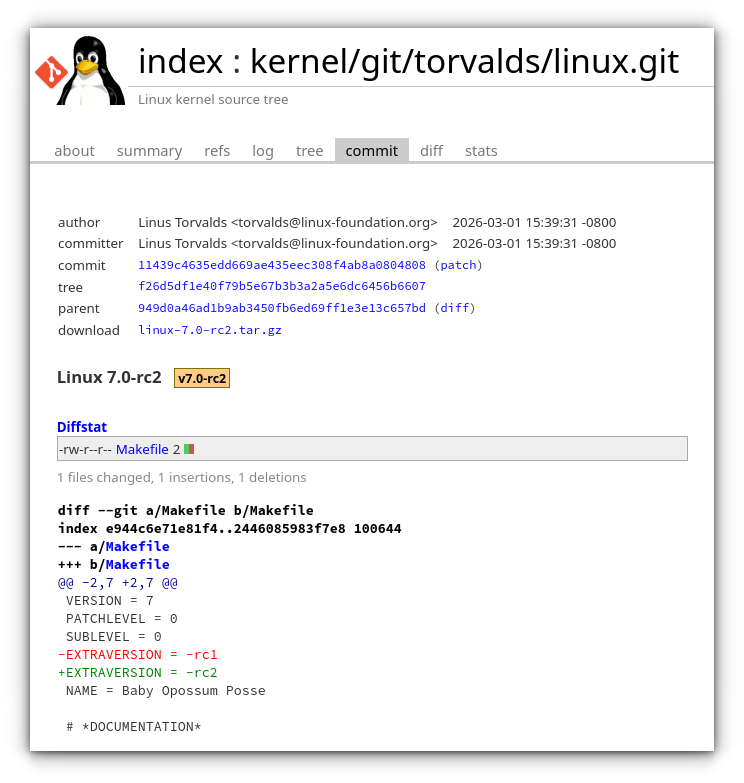
Usually, the second release candidate handles minor fixes. This time, however, the Linux 7.0-rc2 update contains a high number of changes.
In the Kernel 7.0-rc2 announcement mail, Torvalds suggests two main reasons for this spike:
- Timing Noise: Sometimes, developers simply send in more requests during the same week by chance.
- Pent-up Work: The previous version of Linux (version 6.19) lasted an extra week. Because of that delay, a lot of work might have piled up, waiting for the 7.0 cycle to begin.
Despite the large size, Torvalds believes this is likely just a random event rather than a sign of deep trouble.
A Shift in the Code
The most interesting part of Linux 7.0-rc2 is where the changes are happening. In a typical update, drivers make up at least half of the new code. This time, drivers only account for one-quarter (25%) of the total work.
Instead, other areas took the spotlight:
- Filesystems: These made up another 25% of the update. Developers focused heavily on the SMB client, but they also improved XFS and EROFS.
- The Rest: The final 50% is a mix of core kernel code, architecture updates, networking, and testing tools.
Key Technical Improvements in Kernel 7.0-rc2
Even though this is an early version, the team fixed several important issues to keep your system stable.
1. Better Security and Memory
Security is always a top priority. In this release, developers corrected a speculative safety issue for x86 processors. They also fixed memory errors that could cause crashes, specifically addressing KASAN hardware tag faults and potential null pointer problems during boot.
2. Smoother Performance
The scheduler, which is the "brain" that decides which tasks the processor handles first, received several refinements. These fixes help the system track tasks more accurately and manage "lag" better, which results in a snappier experience for the user.
3. Filesystem Safety
The SMB client received a critical update to prevent the system from logging plaintext credentials. Additionally, the team fixed a race condition in the XFS health monitor and enabled better page cache sharing for EROFS.
Test Linux Kernel 7.0 RC2
Because this release is unusually large, Linus Torvalds is keeping a close eye on it. He has asked the community to test the code thoroughly. Testing now helps ensure that the final version of Linux 7.0 is stable for everyone.
If you enjoy staying on the cutting edge, you can download and test the new kernel today. The latest Kernel 7.0 RC2 version is available at the Kernel.org website and the Linus Torvalds's git tree.
For most users, these updates mean that your hardware will run more securely and efficiently when the final version arrives later this spring.
Unless unexpected regressions appear, Linux 7.0 will likely see its final stable release in mid-April 2026.
