
Do you spend too much time jumping between different academic websites? If you love using the terminal, there is a much better way to work. Lixplore-cli is a command line tool built for researchers who want speed and simplicity. This Python-based tool lets you search for scientific papers, filter results, and manage your library without ever leaving your command line.
Table of Contents
What is Lixplore-cli?
Lixplore-cli is a "Unix-inspired" tool designed for terminal enthusiasts. It combines several research tasks into one easy interface. It works on Linux, macOS, and Windows, so it fits into almost any workflow.
It is open-source tool licensed MIT License, so anyone can use it or help improve it.
Why Should Researchers Use It?
Most researchers waste time clicking through multiple tabs. Lixplore-cli changes that. Here is why it stands out:
- Five Sources in One Search: You can search PubMed, arXiv, Crossref, DOAJ, and EuropePMC all at the same time.
- Powerful Query Options: Use Boolean operators like AND, OR, and NOT to find exactly what you need.
- Smart Exporting: You can save your results in over eight formats, including Excel, BibTeX, RIS, and EndNote.
- Automatic PDF Access: The tool finds open-access PDFs for you. You can download them automatically or click a link in your terminal to open them in a browser.
- Reference Manager Links: It connects directly to Zotero and Mendeley, making it easy to build your bibliography.
- Smart Sorting and Selection: Sort results by relevance, newest, oldest, journal, or author and select subsets using flexible patterns
- Interactive Review Mode: A unique "review mode" lets users inspect articles in separate terminal windows — perfect for quick browsing before exporting.
How to Get Started: Search Academic Papers with Lixplore-cli
Setting up the tool is very simple. First, ensure you have Python 3.8 or higher on your machine. Then, install lixplore-cli using pip like below:
pip install lixplore-cli
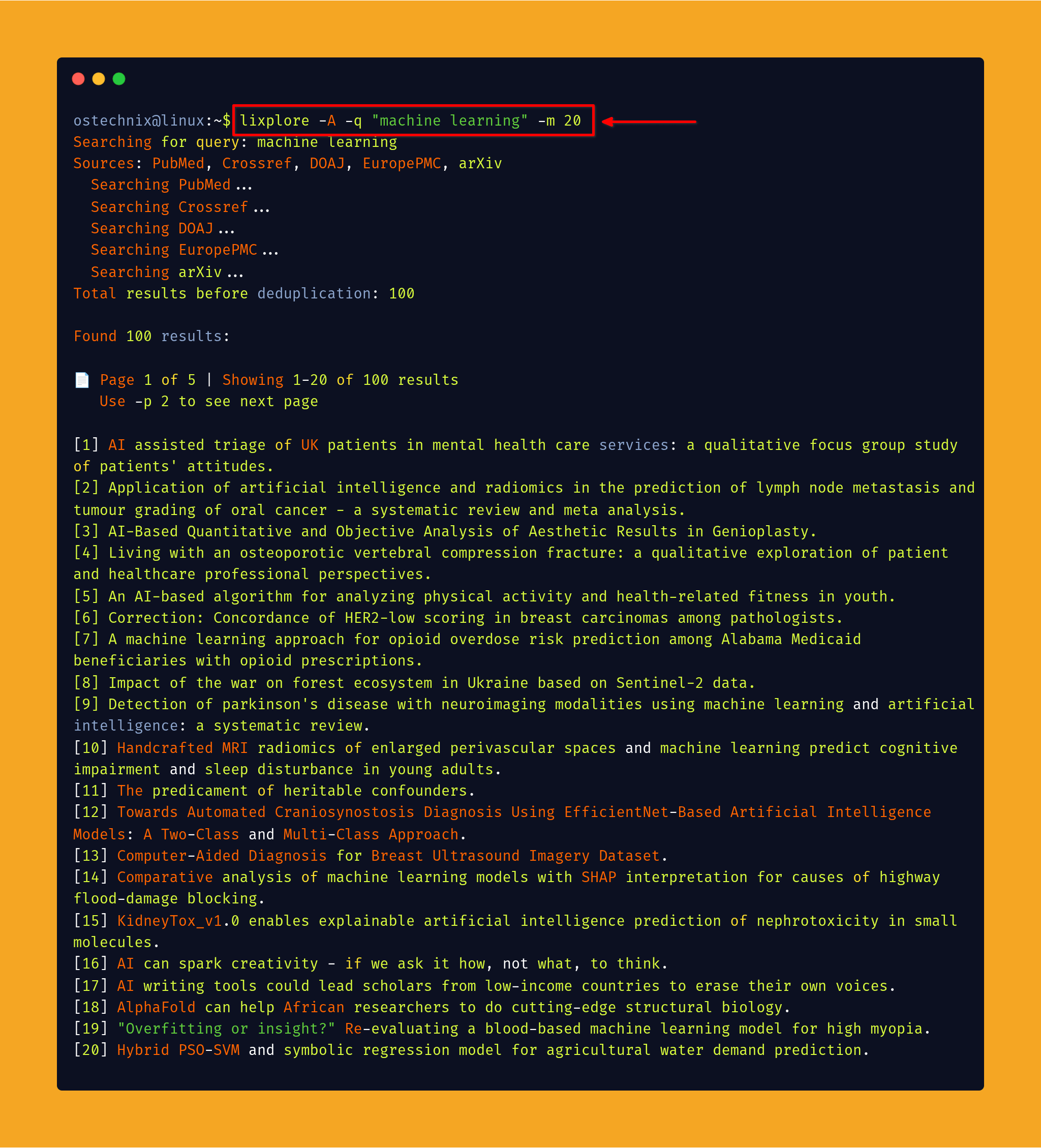
Once you install it, you can start searching immediately. For example, if you want to find twenty papers about "machine learning" from all sources, just type:
lixplore -A -q "machine learning" -m 20
Sample Output:
Searching for query: machine learning
Sources: PubMed, Crossref, DOAJ, EuropePMC, arXiv
  Searching PubMed...
  Searching Crossref...
  Searching DOAJ...
  Searching EuropePMC...
  Searching arXiv...
Total results before deduplication: 100

Found 100 results:

📄 Page 1 of 5 | Showing 1-20 of 100 results
   Use -p 2 to see next page

[1] AI assisted triage of UK patients in mental health care services: a qualitative focus group study of patients' attitudes.
[2] Application of artificial intelligence and radiomics in the prediction of lymph node metastasis and tumour grading of oral cancer - a systematic review and meta analysis.
[3] AI-Based Quantitative and Objective Analysis of Aesthetic Results in Genioplasty.
[4] Living with an osteoporotic vertebral compression fracture: a qualitative exploration of patient and healthcare professional perspectives.
[5] An AI-based algorithm for analyzing physical activity and health-related fitness in youth.
[6] Correction: Concordance of HER2-low scoring in breast carcinomas among pathologists.
[7] A machine learning approach for opioid overdose risk prediction among Alabama Medicaid beneficiaries with opioid prescriptions.
[8] Impact of the war on forest ecosystem in Ukraine based on Sentinel-2 data.
[9] Detection of parkinson's disease with neuroimaging modalities using machine learning and artificial intelligence: a systematic review.
[10] Handcrafted MRI radiomics of enlarged perivascular spaces and machine learning predict cognitive impairment and sleep disturbance in young adults.
[11] The predicament of heritable confounders.
[12] Towards Automated Craniosynostosis Diagnosis Using EfficientNet-Based Artificial Intelligence Models: A Two-Class and Multi-Class Approach.
[13] Computer-Aided Diagnosis for Breast Ultrasound Imagery Dataset.
[14] Comparative analysis of machine learning models with SHAP interpretation for causes of highway flood-damage blocking.
[15] KidneyTox_v1.0 enables explainable artificial intelligence prediction of nephrotoxicity in small molecules.
[16] AI can spark creativity - if we ask it how, not what, to think.
[17] AI writing tools could lead scholars from low-income countries to erase their own voices.
[18] AlphaFold can help African researchers to do cutting-edge structural biology.
[19] "Overfitting or insight?" Re-evaluating a blood-based machine learning model for high myopia.
[20] Hybrid PSO-SVM and symbolic regression model for agricultural water demand prediction.
Better Ways to Organise Research
Lixplore-cli does more than just search. It also helps you stay organised. You can use the Annotation System to give articles a five-star rating, add custom tags, or write private notes.
If you want to see your data visually, the tool includes a Statistics Dashboard. This feature creates charts right in your terminal to show you publication trends and top authors.
If you prefer a more visual experience, you can try the Interactive TUI Mode, which lets you browse and select articles using your keyboard.
Custom API Integration
Add ANY API source via simple JSON configuration:
- No code modification needed
- Supports Springer, BASE, and more
- Plugin architecture for extensibility
Final Thoughts
Lixplore-cli is a fantastic utility for students and professionals who value their time. It removes the clutter of traditional websites and gives you a clean, fast way to handle scientific literature.
Whether you're scripting a literature review pipeline, filtering evidence for systematic reviews, or generating reports for academic publication, Lixplore-CLI fits into automation workflows seamlessly.
Its direct command syntax makes it ideal for reproducible research practices and batch processing of large search queries.
If you are ready to speed up your literature reviews, visit the Lixplore-cli GitHub page or check out the official documentation to learn more. Your terminal is now the only research assistant you need.
Help to Make it Better
Like all great open-source projects, Lixplore-CLI welcomes contributors — from documentation improvements and advanced feature requests to API integrations with additional data sources. Its plugin architecture encourages community contributions and extensibility.
