
Good news, Debian enthusiasts! The moment you've been waiting for is almost here. Debian 13, known by its codename Trixie, is getting ready for its official launch as the next stable version of the Universal Operating System.
Update:
Debian 13 Trixie Is Officially Released With Kernel 6.12 LTS And RISC V Support
Table of Contents
Debian 13 Trixie Release Date Announced
After much anticipation and careful development, the Debian Release Team has announced the planned release date for Debian 13 Trixie.
The new Debian 13 Trixie stable release is set to arrive on 9th August 2025! Mark your calendars today! A fresh, reliable operating system will soon be available for everyone to enjoy.
Understanding the Freeze: What Does It Mean?
Before a major Debian release, the project goes through various "freeze" stages to ensure everything is perfect. Trixie will enter its Full Freeze on 27th July 2025. What does this mean? You might wonder!
During the Full Freeze:
- All package updates will require manual review by the release team before they can migrate to the testing branch.
- Only small, targeted fixes for critical bugs are generally accepted.
- In the final week leading up to release (which includes the period just before 9th August), testing will be completely frozen, and no packages will be unblocked except for the most critical fixes.
This rigorous process helps ensure that Debian Trixie is exceptionally stable and ready for widespread use, free from major issues.
Ready to Upgrade? Tips for a Smooth Transition
If you're currently running Debian 12 (Bookworm) and planning to upgrade to Trixie, you'll be pleased to know that upgrades from one stable Debian release to the next are fully supported and usually work very well.
Many users have already found Trixie to be "rock solid" during its testing phase, reporting "no issues".
Here are some top tips for a seamless upgrade:
- Disable Third-Party Repos: A very good suggestion is to temporarily disable backports and any third-party software repositories before you start the upgrade. Once the upgrade is complete, you can then adjust the sources for these repositories and reinstall any packages you need. There's generally no need to remove the packages themselves unless conflicts arise during the upgrade.
- Handle Configuration Files with Care: During the upgrade process, the
aptpackage manager might ask you about overriding configuration files. It's crucial not to simply type "yes" without looking at the differences (diff) first. Blindly overriding config files could revert your custom settings to default, for example, changing yoursshd_configback to its original state. Some software might also have significant changes in their configuration options, so reading thediffis a safer approach.
What's New in Trixie? (A Sneak Peek)
Debian Trixie is bringing updates to many key packages and features. While a full list is still a "work in progress," some notable inclusions and changes mentioned include:
- Updated Software: Expect new versions of popular applications such as LibreOffice, Inkscape, GIMP, along with updates to core components like Perl, Python, Geany, and Apt.
- Dovecot Changes: If you use Dovecot, be prepared for some adjustments, as the version shifts from 2.3 in Bookworm to 2.4 in Trixie. This includes changes in how variables are expressed, so checking the Dovecot website for their how-to guide is recommended.
- Desktop Environments: There's hope among users for Plasma 6.3.6 to make it into the release.
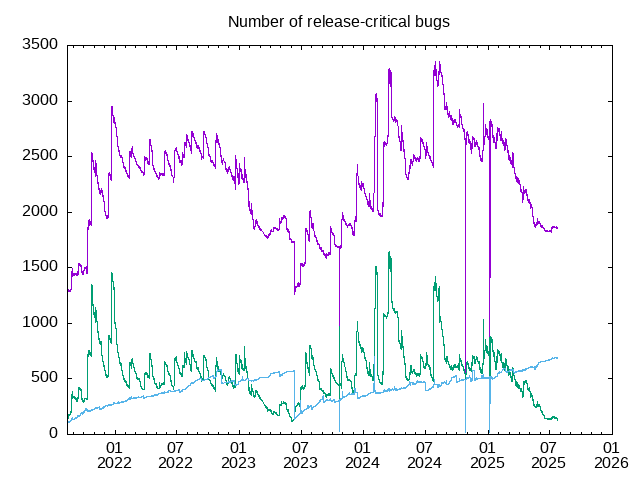
The Debian team is actively working on resolving "release-critical" bugs to ensure a smooth and stable experience for all users.
As of 24th July 2025, there were 128 bugs specifically concerning the next release that needed attention.
A Look Back at the Freeze Stages
Trixie's journey to becoming a stable release has been a multi-year process:
- 2020-11-08: The distribution codename "Trixie" was first announced.
- 2023-06-10: After Debian 12 (Bookworm) was released, Trixie became the "testing" branch.
- 2025-03-15: Trixie entered its Transition and Toolchain Freeze. During this phase, no new major transitions or disruptive changes to core system components were allowed.
- 2025-04-15: The Soft Freeze began. At this point, only small, targeted fixes were deemed appropriate for Trixie, and the migration delay for packages to testing increased. New packages or packages removed from testing were no longer allowed back.
- 2025-05-15: The Hard Freeze started. This stage applied stricter rules to "key packages" and those without automatic tests, treating them much like the upcoming Full Freeze. Other packages with automatic tests continued under the Soft Freeze rules but with even longer migration delays.
Get Ready for Debian 13 Trixie!
The Debian developers, along with volunteers, are working diligently to bring this new release to life. With the release date set for 9th August 2025, it's an exciting time for the Debian community.
You can help by testing upgrades from Bookworm to Trixie and reporting any issues you find.
Resource:

2 comments
“And Debian begat Ubuntu……
and Ubuntu begat Linux Mint, Elementary OS, Zorin OS, Pop!_OS,,,,,and a few others”
Grandpa Slackware says “Hi”.