
Flathub, often called "the Linux App Store", has officially surpassed an incredible milestone: 3 billion downloads. When I saw that number, I am quite impressed! This isn't just a big number; it's a proof to the growing popularity and impact of Flathub and Flatpak in the Linux community.
Table of Contents
What is Flathub?
Flathub serves as a centralized repository where developers can publish their applications as Flatpaks, and users can discover and install them. It's essentially the "official" app store for the Flatpak ecosystem.
As a universal package format, Flatpak allows you to easily install, run, and update applications across most Linux distributions. It also runs apps in a sandboxed environment, giving users more control over app permissions.
Key features
- Universal compatibility: Apps on Flathub work across different Linux distributions without modification
- Sandboxing: Applications run in isolated containers with limited system access for better security
- Easy installation: Users can install apps with simple commands or through graphical software centers
- Automatic updates: Apps update independently of the base system
How it works
When you install a Flatpak from Flathub, it downloads the application along with its runtime dependencies. These run in a sandbox separate from your main system, which means apps can't interfere with each other or access system files they shouldn't.
Popular Applications
Flathub hosts thousands of applications including major ones like Firefox, LibreOffice, GIMP, Steam, Discord, Spotify, and many others. Both open-source and proprietary applications are available.
Benefits for Users
- No need to worry about distribution-specific packaging
- Apps work the same way regardless of whether you're on Ubuntu, Fedora, Arch, or other distros
- Safer app installation due to sandboxing
- More up-to-date applications compared to traditional repositories
FlatHub Reaches 3 Billion Downloads
As of writing this guide, FlatHub reaches 3,020,205,484 downloads. This is truly a big achievement!
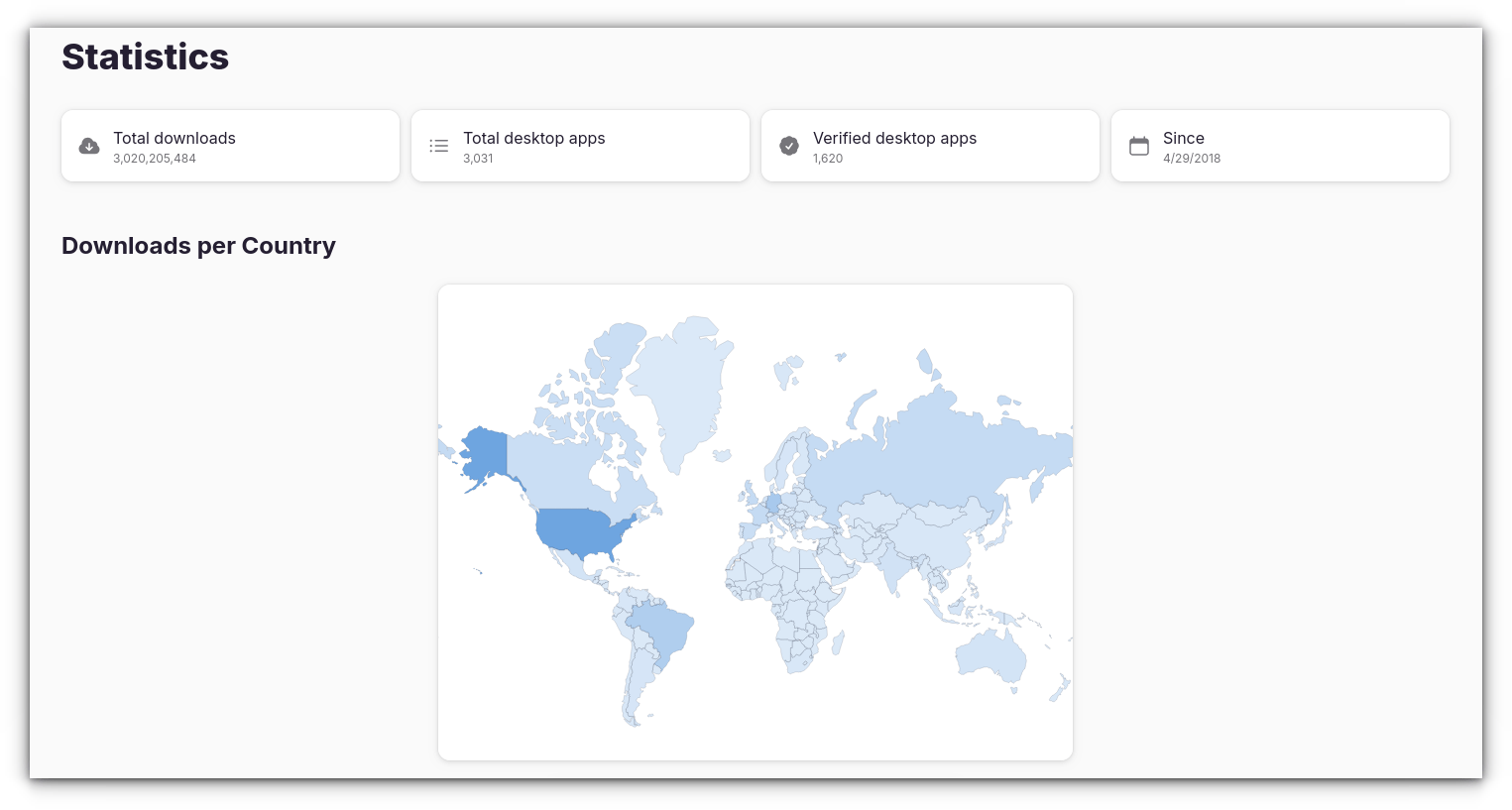
Reaching 3 billion downloads speaks volumes about several key strengths:
- Massive App Availability: Flathub offers thousands of apps, from well-known software to exciting indie projects, ensuring there's something for everyone. I really love that it includes categories like productivity, graphics, audio & video, games, developer tools, and even apps for Linux phones.
- Accessibility for Everyone: Flathub ensures apps are available wherever you are. Whether you're using a Steam Deck, a powerful Linux workstation, a Raspberry Pi, or even a Linux phone, Flathub has apps for you. This broad compatibility really makes a difference.
- Transparent Safety: As a user, I appreciate the clear information Flathub provides. You can easily see if an app is verified by its developer, understand the permissions it requires, and check if it's open source and auditable. This transparency builds a lot of trust.
- Effortless Updates: Forget about manual web downloads! Flathub delivers apps and automatic updates directly to users through their native app store clients, just like you'd expect. It just works!
- Empowering Developers: For developers, Flathub offers an unparalleled reach to millions of users. With over a million active users and being pre-installed on many Linux distributions, it's a prime platform to distribute software. The platform also provides clear documentation and a large community for support.
Flathub Download Statistics by Country
What makes this 3 billion download milestone even more impressive is its global reach. Looking at the FlatHub statistics, it's clear that people all over the world are embracing Flathub.
Here are the top ten countries with the most Flathub downloads:
| Rank | Country | Downloads |
|---|---|---|
| 1 | United States | 676,972,231 |
| 2 | Germany | 314,867,818 |
| 3 | Brazil | 263,479,298 |
| 4 | United Kingdom | 138,462,653 |
| 5 | Russia | 133,024,596 |
| 6 | France | 131,535,802 |
| 7 | Spain | 104,444,527 |
| 8 | Canada | 99,765,795 |
| 9 | Italy | 75,328,888 |
| 10 | Poland | 62,994,246 |
The United States leads with over 676 million downloads, followed by Germany with more than 314 million, and Brazil with over 263 million downloads.
Other top countries include the United Kingdom, Russia, France, Spain, Canada, Italy, and Poland, each contributing tens to hundreds of millions of downloads. It's exciting to see such widespread adoption across continents!
India is very close to joining the top ten countries for Flathub downloads. Currently, India is ranked 11th globally with 61,198,614 downloads.
The country currently in 10th place, Poland, has 62,994,246 downloads. This indicates a relatively small gap of less than 2 million downloads between India and the current tenth-ranked country.
Given this proximity, it seems quite plausible that India could soon enter the top ten list.
Conclusion
In my opinion, Flathub is a fantastic solution for getting up-to-date GUI programs in containers. It simplifies the process of installing and managing software on Linux, making the ecosystem more accessible and user-friendly for everyone.
This 3 billion download count shows countless users installing and benefiting from the diverse range of applications available on Flathub. It's a huge win for the Linux desktop and a sign of continued growth!
Kudos to the hard work of the Flathub team and its open-source community!

4 comments
i really don’t believe the figures. Why use any external clunky solution like flathub? There is just no reason for that. Totally zero of my colleagues and friends use flathub.. We have our native package managers in our distributions which are faster and easier to use anyway.
I respect your choice. I do use Flatpak if the package is not available in the default repositories.
The advantages have mostly to do with dependencies:
1. Flatpak comes with several advantages that address the challenges faced by developers and users in the Linux ecosystem: Cross-Distribution Compatibility: Since Flatpak applications are not tied to a specific Linux distribution, developers can build once and deploy universally across different systems. This significantly reduces the overhead of managing multiple builds and ensures that users have access to the same application across various distributions.
2. Dependency Management: By bundling applications with their dependencies, Flatpak alleviates the “dependency hell” problem typical of traditional package systems where conflicts can arise if applications require different versions of the same library.
3. Security through Isolation: The sandboxing feature significantly enhances user security. Flatpak applications run in a limited environment that restricts their access to system resources, providing an additional layer of protection against malicious software.
4 .User-centric Updates: Flatpak allows users to update applications independently of the system package manager. This means that applications can be updated without requiring root access, thus simplifying the update process and enhancing user experience.
5.Easy Distribution: Developers can publish their applications to Flatpak repositories like Flathub easily, enabling users to discover and install applications without complex setup or configuration.
Disadvantages of Flatpak:
1. Increased Disk Space Usage: Applications packaged with Flatpak may consume more disk space compared to traditional package formats due to the inclusion of dependencies. This might become an issue on systems with limited storage capacity.
2. Performance Overheads: As applications run in a sandbox, there may be some performance overhead. Depending on the application, the managed environment can affect the overall performance when launching applications.
3. Limited Access to System Libraries: Flatpak applications may struggle with certain features that rely on specific system libraries or configurations. This can lead to limitations when trying to interact with hardware or system-specific features.
4. Growing Learning Curve: For new users, Flatpak may introduce complexities in terms of understanding how to manage applications. Being a modern tool, users accustomed to traditional package management systems may require time to adapt.
5. Still Evolving: Though Flatpak has gained significant adoption, it is still an evolving technology, and as such, might not have the same level of stability or functionality as more established tools.
Simply put flatpaks solve dependency issues but take up a lot of space. The space issue is what I have against bot flatpaks and snaps.
Wow, such a comprehensive comment. Much appreciated. We covered a detailed guide about why flatpak use so much disk space here – https://ostechnix.com/why-flatpak-apps-use-so-much-disk-space/