
Imagine receiving a legal notice giving GitHub just three hours to remove your software from public view.
That is what happened to Jack Dorsey and his open-source messaging project, BitChat, after the Indian Cyber Crime Coordination Centre (I4C), under the Ministry of Home Affairs, issued an emergency notice directing GitHub to disable access to three BitChat repositories.
Dorsey later published screenshots of the notice on X (formerly Twitter) platform.
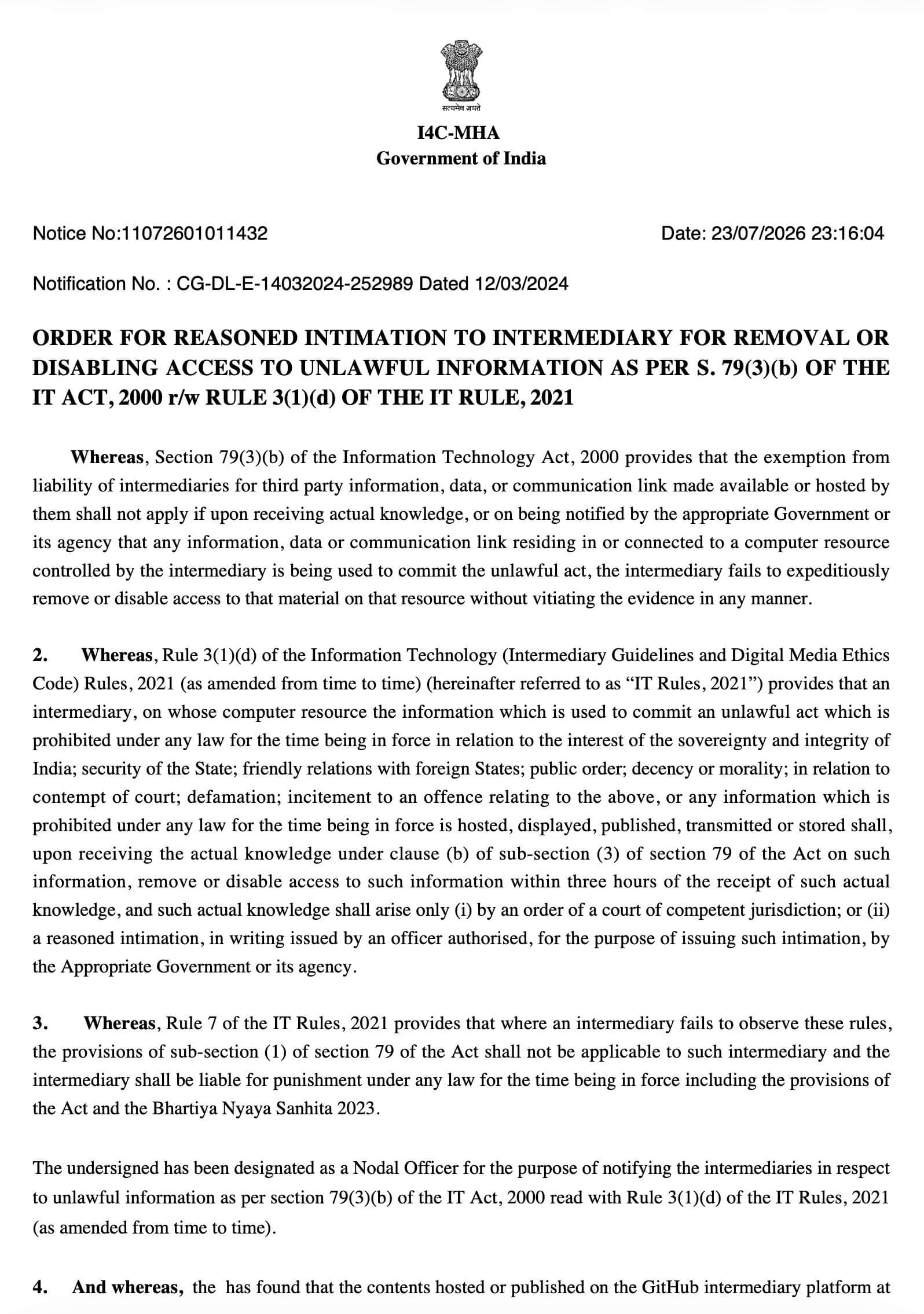
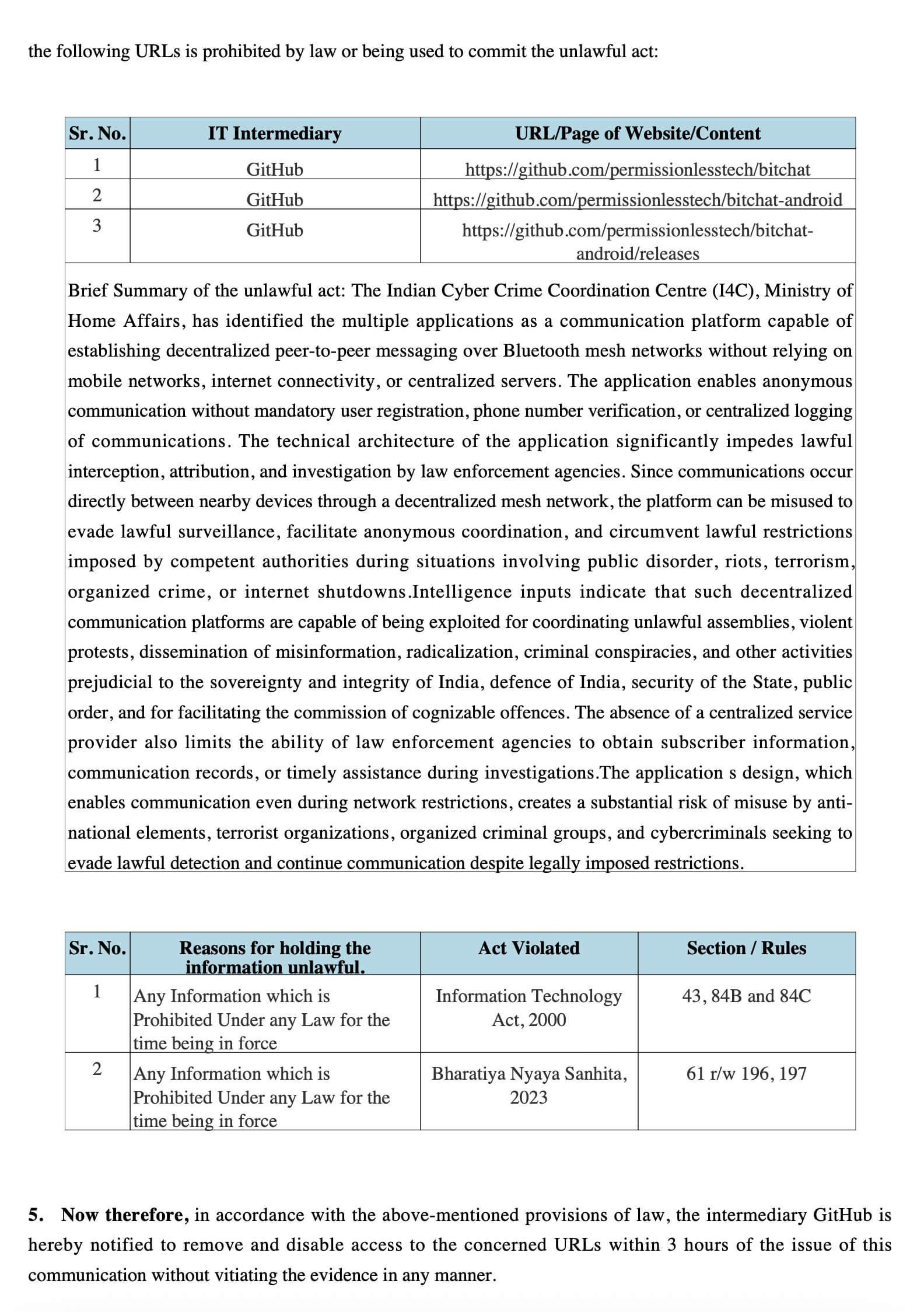
The notice alleges that BitChat's architecture poses risks to public order and national security because it enables communication that is difficult to intercept or attribute. It cites concerns that the app could be misused by unlawful assemblies, organised crime, terrorist organisations and cybercriminals.
Ironically, the notice also brought unprecedented attention to the BitChat project. Rather than disappearing quietly, BitChat became the subject of intense discussion among developers, journalists and digital-rights advocates around the world.
Table of Contents
The App That Made Authorities Nervous
BitChat is not a conventional messaging application.
It is a decentralised, peer-to-peer messenger that uses Bluetooth Low Energy (BLE) mesh networking instead of the internet. Unlike traditional messaging services, it operates without:
- Phone numbers
- Central servers
- Mobile data
- Wi-Fi
- User accounts
Nearby devices relay encrypted messages between one another, allowing conversations to continue even when mobile networks are unavailable.
The government notice was issued amid the ongoing Cockroach Janata Party (CJP) protests in Delhi, where authorities had imposed mobile internet restrictions in parts of the city.
Multiple news outlets reported that investigators were examining whether Bluetooth-based messaging applications were used by protesters, although authorities had not publicly confirmed that BitChat itself was used.
According to the notice, BitChat's decentralised design "significantly impedes lawful interception, attribution and investigation", making it more difficult for authorities to monitor communications during public-order situations.
The Streisand Effect: A Global Backfire
The government's action quickly became a textbook example of the Streisand Effect—the phenomenon in which attempts to suppress information instead attract greater public attention.
Following publication of the notice, the BitChat repository rapidly gained visibility within the developer community. At the time of writing, it had accumulated more than 27,600 GitHub stars and over 3,600 forks, indicating widespread interest and independent copying of the code.
One Reddit user joked:
"Thanks for the recommendation, Modiji. Didn't even know this existed."
Whether or not that sentiment was representative, many online discussions echoed the same idea: the takedown notice introduced BitChat to far more people than had previously heard of it.
The Bluetooth Paradox
The controversy highlights an interesting policy tension.
During the COVID-19 pandemic, governments around the world, including India, encouraged the use of Bluetooth-based contact-tracing technology to improve public-health monitoring.
Today, Bluetooth itself is not the issue. The debate centres on who controls the network and the data.
When Bluetooth helps governments collect information, it is viewed as a public-health tool. When it enables private, decentralised communication beyond conventional infrastructure, it raises law-enforcement and national-security concerns.
The technology has not fundamentally changed; the governance model has.
Software as "Social Memory"
BitChat is more than an offline chat application.
According to bitchat Protocol whitepaper, it includes a feature called Gossip Sync, which periodically reconciles recent public message history between nearby devices.
Rather than depending on a central server, participating phones opportunistically exchange messages they have already seen, allowing information to propagate gradually through the mesh.
In practical terms, this means that when groups become temporarily disconnected (for example, during network disruptions) messages can continue spreading as people move through physical space.
Rather than relying on internet infrastructure, the devices themselves become carriers of information.
Can the State Actually Kill the Code?
Supporters of open-source software often argue that code is extremely difficult to erase once it has been publicly released.
Repositories can be mirrored on alternative hosting platforms such as Codeberg, forked on GitHub or shared directly between developers.
However, there is an important technical caveat.
The software may be open, but mainstream mobile platforms remain controlled by Apple and Google.
BitChat depends on Bluetooth capabilities, background execution and operating-system APIs that those companies ultimately control. While there is no evidence that either company intends to restrict BitChat specifically, platform-level policy or technical changes could materially affect how applications like BitChat function on iOS and Android.
Open-source software can be remarkably resilient, but the ecosystems on which it runs remain highly centralised.
How to Stay Connected
The BitChat community has proposed several practical measures for improving resilience:
- Mirror the repository: Maintaining multiple copies across different hosts reduces reliance on any single platform.
- Use Mutual Favourites: BitChat's strongest identity verification occurs when users exchange QR codes in person, reducing the risk of impersonation.
- Emergency Panic Wipe: According to the project's documentation, a triple-tap gesture can securely erase locally stored cryptographic keys, message history and other sensitive data.
These features reflect BitChat's emphasis on privacy, decentralisation and resilience during network disruption.
More Than Another Messaging App
BitChat is still an early project, and even its supporters acknowledge that Bluetooth mesh networking has practical limitations, including limited range, bandwidth, battery consumption and dependence on nearby participating devices.
Yet the controversy surrounding BitChat has already become larger than the software itself.
It highlights an increasingly important question for governments, technology companies and civil society alike: how should societies balance resilient, private communication with legitimate law-enforcement needs?
Regardless of where that balance is ultimately drawn, one lesson is already clear.
In the age of open source, removing a repository is rarely the same as removing the software. Attempts to restrict decentralised technologies often amplify interest in them. And the debate over privacy, surveillance and digital freedom is unlikely to end with BitChat.
