
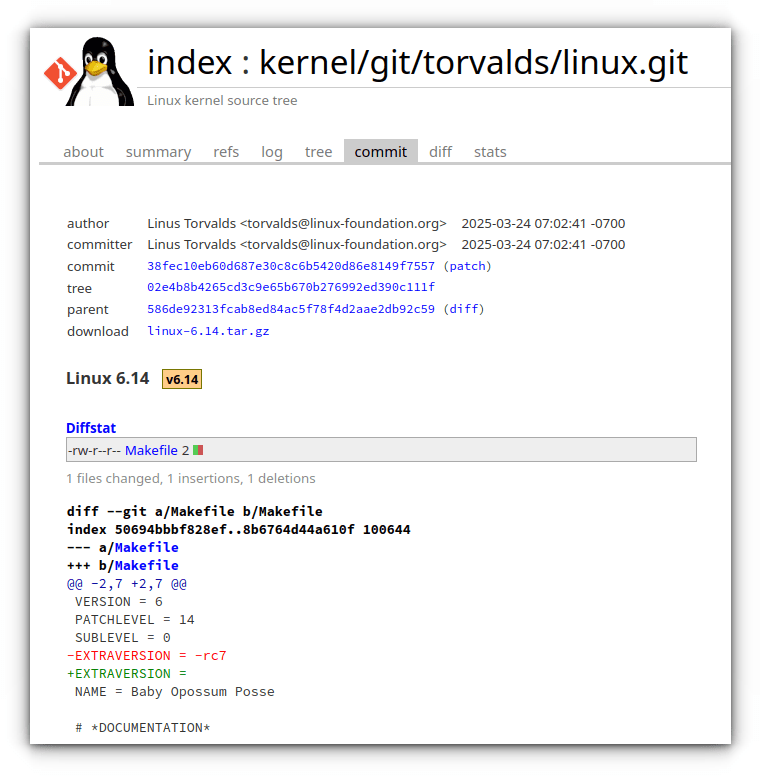
Linux Kernel 6.14, codenamed "Baby Opossum Posse", is officially released! The development of Linux Kernel 6.14 started with fewer changes but focused heavily on stability and bug fixes. The final version includes many updates for drivers, architectures, virtual machines, filesystems, networking, and more.
Table of Contents
A Slight Delay
The final Linux Kernel 6.14 was released on Monday, March 24, 2025, slightly delayed due to Linus Torvalds' oversight. It was actually expected on March 23, 2025, but Linus Torvalds forgot to press the release button!
In the Linux Kernel 6.14 release announcement mail, Linus stated that,
"absolutely nothing last-minute happened yesterday, and I was just clearing up some unrelated things in order to be ready for the merge window. And in the process just entirely forgot to actually ever cut the release. D'oh"
Therefore, the one-day delay was not due to any technical issues or last-minute problems, but rather because Linus Torvalds forgot to initiate the release process on the expected date.
Linus also mentioned that the final week before Kernel 6.14 release was quiet. The main updates during this time were improvements to AMD graphics drivers, along with minor changes in other areas.
A Smaller Start
The development of Linux Kernel 6.14 began with fewer changes than usual. Linus Torvalds said the first release candidate (RC1) [[Linux Kernel 6.14 RC1 Released]] was "tiny" compared to past releases.
This was because many developers were less active during the holiday period. However, even though RC1 was considered small, it still included about 9,300 changes (commits) and half a million lines of code updates.
As more test versions (Release Candidates or RCs) were released, the main focus shifted to fixing bugs and improving stability.
The second release candidate (RC2) mainly aimed to make the system run smoothly rather than adding new features. This focus on stability continued throughout later test versions.
Smooth Testing Process
Linus Torvalds described the release candidates as "boring," meaning there were no major issues. The development process was smooth, with each RC improving stability.
Here is a compilation of the major changes, improvements, and fixes from Linux Kernel 6.14 RC1 to RC7:
Linux Kernel 6.14 RC1
- This release was smaller than usual, with around 9,300 non-merge commits and about half a million lines of code changes, primarily in drivers.
- About half of the changes were in the drivers, covering graphics cards, network cards, and storage devices.
- There were also updates for different computer architectures, including x86 and ARM.
- Improvements were made to how the computer stores and manages files (filesystem improvements).
- There were improvements to tools and documentation for the kernel.
- Testing revealed build failures for i386, parisc, and sparc64 architectures.
- Qemu tests failed, mostly on ARM computers, affecting network, storage, and USB components.
- Some unit tests inside the kernel failed, mainly related to stack initialisation.
- Developers started working on fixes for these issues, available in a special "fixes" branch.
Linux Kernel 6.14 RC2
- This release was mostly focused on fixing bugs and making things more stable, rather than adding many new features.
- Significant work was done on KVM, especially for the s390 architecture, including code reorganisation and fixes for virtual memory handling.
- There were also KVM updates for arm64 and x86 architectures.
- Several updates were made to filesystems like bcachefs and xfs, focusing on reliability and error correction.
- There were some improvements to fsnotify, which helps track file changes.
- Updates were made to network drivers and the ethtool utility.
- The graphics drivers received attention, including fixes for AMD and Intel i915 graphics, aiming to improve display functionality and power management.
- Hector Martin stepped down as the upstream maintainer for the Apple Silicon platform due to concerns about the kernel development process and community management.
- Janne Grunau became a new co-maintainer for the ARM/Apple platform.
- Fixes were included for CPU frequency scaling (cpufreq) on AMD processors.
- Improvements were made to the SCSI UFS core for storage devices.
- Corrections were made to ACPI for power management and hardware resource handling.
- There were updates to the way the kernel uses the Rust programming language.
- Bug fixes were implemented for timers.
- The MAINTAINERS file was updated.
- A Rust maintainer resigned in August 2024 due to "nontechnical nonsense".
Linux Kernel 6.14 RC3
- This release had a significant focus on architecture-specific improvements, accounting for about a third of the patch.
- There was new infrastructure for upcoming platform device handling, and some DRM and OF test updates, suggesting better device management and graphics support.
- A fair amount of fixes centred around arm64 KVM, particularly FP/SIMD/SVE, aiming to boost virtualisation and performance on ARM64.
- UML virtio virtualisation also received updates.
- Numerous fixes and improvements were made to KVM, especially on the ARM64 architecture, including updates to FPSIMD/SVE state management, better timer handling, and simplified hypercalls. KVM on x86 also received updates related to Hyper-V and PSP module initialisation.
- A large number of networking fixes were included, such as the addition of "dev_net_rcu() helper" and the use of RCU (Read-Copy-Update) protection in various IPv4, IPv6, and related functions, improving reliability and speed. Specific fixes for drivers and protocols like batman-adv, team, and vxlan were also included.
- The bcachefs filesystem received several fixes related to reflink pointers, journal pinning, b-tree node handling, and transaction restarts.
- LoongArch architecture-specific issues were addressed, particularly in KVM and related areas.
- Many USB device quirks were added or modified, suggesting compatibility improvements for a wide range of USB devices.
- Several fixes and improvements were included for the sched_ext scheduler extension.
Linux Kernel 6.14 RC4
- This was described as a "boring" release, indicating stability without significant problems.
- A large portion of the updates involved driver fixes across various subsystems, including drivers for GPU (nouveau, msm, xe, i915), sound (hda, SOF, tas2781, conexant, arizona/madera, cs35l41, imx-audmix, rsnd, rockchip), NVMe, network (tcp, fc, wwan(mhi_wwan_mbim), Ethernet (axienet), PDC(qcom-pdc)) devices.
- Several smaller fixes applied to filesystems such as XFS, SMB, NetFS, CacheFS, and Bcachefs.
- Networking also received considerable attention, with updates including fixes for geneve, gtp, tcp, flow_dissector, arp, wwan(mhi_wwan_mbim), and nfp.
- Several updates focused on the Berkeley Packet Filter (BPF), including fixes to the verifier and selftests, addressing deadlocks, softlockups, and errors related to map key extraction.
- There were specific updates for arm64, powerpc, s390, and x86 architectures.
- Sound Open Firmware (SOF) drivers received fixes and enhancements, particularly for AMD platforms.
- A fix addressed a deadlock when freeing cgroup storage (BPF).
- A fix improved the reliability of NVMe-TCP connections.
- A fix prevented mounting XFS filesystems in specific modes to avoid issues.
- A fix addressed audio-related issues on Realtek hardware (ALSA/Realtek).
- A fix avoided hangs in network file system operations (NetFS).
- A fix skipped watchdog timer programming for certain hardware configurations (DRM/MSM/DPU).
Linux Kernel 6.14 RC5
- This release continued the trend of stability, with no major issues standing out.
- The patch distribution was fairly balanced, with about half of the changes targeting drivers, particularly in networking and DRM.
- Other areas, such as architecture, filesystems, and core networking, also received attention.
- The AMDGPU driver received several patches, including fixes for enforcing isolation, BAR resizing on Dell G5 SE, and updates to the maintainers list.
- Networking updates included improvements in network drivers such as mlx5, idpf, and enetc.
- The ALSA subsystem saw fixes for microphone regressions on ASUS N705UD and Realtek codec adjustments for ASUS VivoBook 15.
- SCSI and UFS driver improvements aimed to fix crashes and ensure reliable data handling.
- Fixes in I2C, USB, and Bluetooth stack improved stability and compatibility with newer hardware.
- bcachefs saw fixes for deadlocks, memory movement issues, and directory size corrections.
- Btrfs addressed use-after-free bugs and optimized buffered writes when block size was smaller than page size.
- NFS enhanced handling of direct writes and delegated timestamps.
- x86 fixes included IRQ event definitions, atomic operations, and improved support for Intel Arrow Lake U in the perf subsystem.
- RISC-V updates to KVM, futex, and atomic operations improved performance and reliability.
- ARM64 patches addressed boot panic issues on Ampere Altra and corrected signal handling inconsistencies.
- Several networking patches improved the robustness of ipvlan, loopback, and ethtool functionalities. Enhancements were also made to kernel sockets.
- Landlock received updates to refine restrictions on non-TCP sockets and improve documentation.
- EFI and Secure Boot modifications ensured proper alignment and prevented excessive memory mappings.
- Various updates to selftests improved coverage and fixed minor issues.
- Several maintainers updated their roles.
- Small refinements across the kernel improved efficiency, especially in the scheduling and memory management subsystems.
Linux Kernel 6.14 RC6
- This release had no significant issues reported, and the development remained on track.
- A major focus was the resolution of an AMD microcode signing problem, ensuring only SHA256-checksummed patches are loaded for added security.
- x86 updates included improvements in CPUID leaf 0x2 output validation, fixes in microcode loading, and refinements in speculation mitigation mechanisms.
- KVM updates for Arm64 ensured proper initialisation of SCTLR_EL1.
- Multiple LoongArch kernel virtualisation fixes were implemented.
- LoongArch-specific bug fixes in memory management and NUMA configuration were included.
- Various fixes for AMD GPU drivers were implemented.
- Improvements were made in Intel and Imagination Technologies DRM drivers.
- Nouveau driver update enabled firmware caching for better performance.
- Fixes in Wi-Fi drivers (mac80211 and iwlwifi) addressed various issues.
- Enhancements in DSA (Distributed Switch Architecture) drivers were made.
- A patch corrected ownership handling in UDP segmentation offload (GSO).
- Bug fixes in XFS, Btrfs, NVMe-TCP, and exFAT addressed various issues like buffer readahead, chunk map leaks, response drops, memory corruption, soft lockups, and file write handling.
- Fixes in USB Type-C UCSI drivers prevented NULL pointer dereferences.
- Resolution of interrupt handling issues in Renesas USB host controllers was achieved.
- HID driver updates were included for various peripherals.
- Several KVM fixes for x86 and Arm64 focused on debug control registers, event injection, and virtual machine run state handling.
- Fixes in memory-hotplug and swap mechanisms ensured stable migration and recovery.
- Adjustments in userfaultfd behavior prevented unexpected page table entry unmapping.
- Refinements in pipe buffer logic fixed race conditions and improved performance.
Linux Kernel 6.14 RC7
- This was the final Release Candidate and was described as "quite calm", suggesting a stable state for the final release.
- The biggest changes were mostly selftest updates and a few reverts (undoing code changes).
- BCacheFS improvements were made, including a fix for an overflow issue.
- Network tweaks included refining Open vSwitch and various driver updates.
- GPU fixes, especially for AMD’s DCN display engine, were implemented.
- Rust language updates mostly cleaned up small details in the new Rust kernel code.
- Xpad got more love, with official support added for Zotac Gaming Zone, TECNO Pocket Go, and Hyperkin X91 controllers.
- AMD GPU power fixes addressed issues with display brightness after a GPU reset.
- Improvements were made for Lenovo ThinkPad E16 Gen 2 microphones.
- There were further Rust improvements and documentation updates.
- A fix was included for guests running with SEV-SNP.
Changes in Kernel Maintainership
There were several changes in kernel maintainership during the Linux Kernel 6.14 development cycle.
During the RC2 phase, Hector Martin stepped down as the upstream maintainer for the Apple Silicon platform due to "a loss of faith in the kernel development process and community management".
Janne Grunau stepped up to become a new co-maintainer for the ARM/Apple platform, sharing the role with Sven Peter. Janne Grunau had been working with the downstream Asahi Linux tree.
Despite his departure, Hector Martin indicated that Apple/ARM platform development would continue downstream.
Also during the RC2 phase, a Rust maintainer resigned in August 2024 due to "nontechnical nonsense".
The final release notes for Linux Kernel 6.14 also indicate some maintainership changes:
- Eric W. Biederman removed himself as a maintainer.
- Hector Martin added the apple-spi driver & binding files to his maintainership.
- Neal Gompa added himself as a reviewer for ARM Apple support.
- Wolfram Sang corrected the list and scope of LTC4286 HARDWARE MONITOR maintainership.
The departure of Hector Martin was a notable event specifically mentioned during the release candidate phase.
Get Linux Kernel 6.14
You can obtain the Linux Kernel 6.14 from the following links:
Related Read:
