
Linus Torvalds announced the second release candidate (RC2) for the upcoming Linux kernel 7.4 on Sunday, November 8, 2026. He tagged Linux 7.4-rc2 shortly after closing the largest merge window in Git history.
This second release candidate brings important bug fixes and widespread code cleanups across the kernel tree.
Table of Contents
Key Takeaways
- Automated Script Noise: Linus Torvalds merged delayed Coccinelle cleanup patches, which touched thousands of files with simple one-line fixes.
- Balanced Code Spread: Once maintainers filter out the script noise, the code splits evenly across drivers, networking, and core systems.
- Positive AI Trend in BPF: BPF maintainer Alexei Starovoitov reported that developers are now fixing AI-discovered bugs faster than new reports arrive.
- Stable Early Testing: Early testers report clean boots on laptops.
The Role of Coccinelle Automated Scripts
The Kernel lead maintainer Linus Torvalds held back a series of automated Coccinelle script updates during the initial merge window while he was traveling. He merged these widespread cleanup scripts right at the start of the rc2 cycle.
Although these scripted updates touch thousands of individual files across the repository, they consist mainly of simple one-liner and two-liner code cleanups.
As a result, the raw diffstat count looks unusually high at first glance. However, Linus emphasized that these changes remain very straightforward and carry minimal operational risk for testers.
Subsystem Breakdown: How Code Changes Division Looks
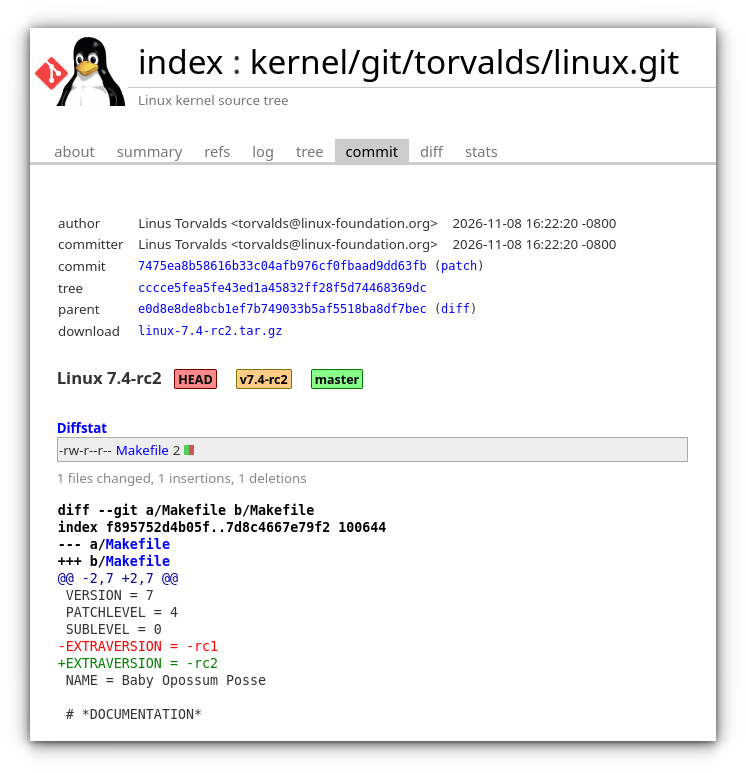
When Kernel maintainers mask out the widespread Coccinelle script noise, the underlying patch distribution returns to a normal, predictable pattern.
The remaining modifications divide cleanly into three equal categories:
| Subsystem Focus | Share of Real Changes | Primary Components & Subsystem Details |
|---|---|---|
| Device Drivers | One-Third (33%) | GPU drivers, network controllers, sound chips, and auxiliary hardware. |
| Networking & BPF | One-Third (33%) | Core socket layer, eBPF verifier updates, packet routing, and transport fixes. |
| Core Systems | One-Third (33%) | Memory management (MM), virtual filesystems (VFS), and CPU architecture patches. |
Specifically, driver updates focus heavily on graphics processors and audio hardware. Meanwhile, core memory management and architecture teams integrated targeted stability patches following the massive Linux 7.4-rc1 feature import.
BPF Maintainers Resolve AI-triggered Bugs Faster
Artificial Intelligence tools continue to shape the Linux 7.4 release cycle. Developers originally used AI tools primarily to find bugs during post-release testing. Now, teams actively use AI models to write, refine, and submit patches before maintenance windows open.
During the 7.4-rc2 cycle, Linus Torvalds highlighted an encouraging milestone from BPF maintainer Alexei Starovoitov. Specifically, Starovoitov reported that in the BPF subsystem, maintainers are currently resolving AI-triggered bugs faster than new bug reports come in.
Torvalds noted that while most kernel subsystems have not reached this tipping point yet, it provides the first clear sign that AI-assisted debugging can lead to net stability gains rather than endless patch noise.
Early Community Testing Results
Early kernel community testing shows promising initial results. A community tester Luna Jernberg reported that Kernel 7.4-rc2 works smoothly on his Dell laptop during initial testing runs. I believe this is true for other hardware as well.
If you want to test the latest release candidate yourself, you can download Linux 7.4-rc2 directly from the Official Linux Kernel Archives or inspect the source code in Linus Torvalds' Git tree.
As always, testers should install release candidate kernels on secondary test machines rather than mission-critical production servers.
What Comes Next for Linux 7.4?
With 7.4-rc2 now available, the kernel team enters the steady development of weekly release candidates. Linus Torvalds will publish weekly preview builds (-rc3 through -rc7) as developers refine driver compatibility and fix remaining regressions.
According to Greg Kroah-Hartman, the Kernel development team targets December 20, 2026, for the final stable release of Linux 7.4.
