
Linus Torvalds has announced the second release candidate (RC2) for the upcoming Linux Kernel 7.3 version on Sunday, September 06, 2026.
While the second release candidate is historically the quietest period of the development cycle, giving developers a chance to breathe after the frantic two-week merge window, this release broke that trend.
In the Linux 7.3-rc2 announcement mail, Torvalds describes 7.3-rc2 as a "full fat" release that turned out to be surprisingly busy.
What's New in Linux 7.3-rc2
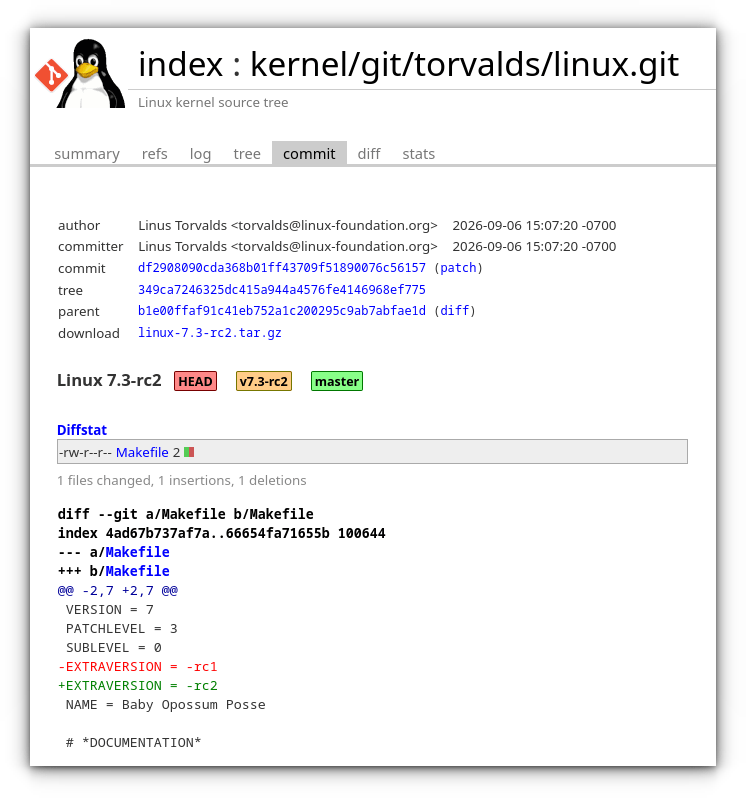
Linux 7.3-rc2 release features a broad mix of fixes across tooling, filesystems, the core kernel, and networking.
The main changes and features introduced in Linux Kernel 7.3-rc2 include:
1. Tooling and the Extensible Scheduler Surge
Outside of the massive driver updates that dominate every Linux release, developer tooling is the largest area of change in this release candidate, representing about 20% of the entire patch.
This surge is heavily driven by updates to sched_ext (the kernel's extensible scheduler framework). The updates bring synchronized common and compatibility headers, cleaner documentation, and improvements to the BPF scheduler callbacks.
It also resolves a bug where the framework would experience spurious aborts during ownership change races. Alongside these scheduler improvements, developers added a large wave of kernel self-tests covering CGroups, BPF verification, and Linux Security Modules (LSMs) to ensure long-term stability.
2. Merging the "Forgotten" EDAC Code
During the intense Linux 7.3-rc1 merge window, a pull request for the EDAC (Error Detection and Correction) subsystem was accidentally left out. This release corrects that oversight by merging the "forgotten" code.
The EDAC updates bring several notable improvements:
- Intel Starfire SoCs: The subsystem now fully supports these platforms.
- Decoupled DIMM Width Decoding: The decoding logic no longer relies on hardcoded enum orders, making memory error reporting more robust.
- System Display Improvements: The code transitions
EDAC/sysfsto usesysfs_emit_at()for displaying DIMM device locations, avoiding potential string truncation bugs.
3. Subsystem Bug Fixes and Hardware Enablement
As always, driver updates represent the bulk of the code changes, but 7.3-rc2 also introduces crucial bug fixes for stability and power management across major hardware platforms.
3.1 Graphics & Display (DRM)
The Direct Rendering Manager (DRM) received a series of scattered graphics fixes:
- AMD GPU: The update implements queue reset support version updates, resolves DCN5/DCN6 compilation warnings, and fixes backlight control issues on luminance-capable OLED displays. It also enforces a minimum GPU virtual memory page size of 4K on DCN35 and DCN36 platforms.
- Nouveau: The driver now uses write-combined maps for coherent memory and fixes HDMI vendor infoframes and head-timing state readbacks on newer GB20x hardware.
- Virtio-GPU: The code now safely reclaims pending video buffers before tearing down queues and resolves NULL-pointer and compilation bugs on Xen platforms.
3.2 Audio and Sound
To prevent audio hardware from crashing or misbehaving during system power state transitions, developers added Power Management (PM) guards to several popular audio interfaces.
These interfaces include the Audient iD24, Studio 1810c, US-16x08, Scarlett (including protocol and meter reads), and RME Digiface controls. Additionally, the audio subsystem integrates hardware-specific quirks for laptops like the MacBook Air 7,2, Lenovo Yoga Slim 9, and Acer Predator.
4. File Systems and Core Kernel Security
4.1 Filesystems & SMB Server (KSMBD)
The filesystem layer received a thorough round of hardening:
- NTFS: The update fixes directory lookup failures by correctly returning
DT_UNKNOWNon inode lookup failure. It also bounds the$AttrDeftable walk to prevent out-of-bounds reads, rejects invalid boot sector cluster configurations, and resolves a race condition between fallocate and mmap reads. - SMB & KSMBD: The in-kernel SMB server fixed critical use-after-free bugs in tree connections and oplock break notifications. It also validates normalized name response lengths and implements safer session draining during logoffs to prevent data corruption.
- Btrfs: The code restores active device pointers after failed sprout operations and fixes lost error return values during send operations.
4.2 BPF Verification Hardening
BPF (Berkeley Packet Filter) continues to receive rigorous security analysis. The BPF verifier has been updated to:
- Properly infer if a register is NULL during conditional jumps, preventing unsafe memory operations.
- Reject BPF pseudo-function references to the main program.
- Block dangerous direct tail calls from callback frames and mark syscall helpers as sleepable.
- Prevent out-of-bounds pointer leaks on speculative execution paths.
4.3 Core Memory Management
Memory management fixes resolve issues in several edge cases:
- Tmpfs: The kernel fixes incorrect flag usage when checking allowable memory page orders.
- Bulk Page Allocations: Developers resolved sleeping allocation bugs in bulk page actions.
- Secretmem: The kernel now properly accounts for locked memory pages in
secretmemallocations.
Download and Test Linux Kernel 7.3 RC2
Enthusiasts and users can download the Linux 7.3 release candidates, including 7.3-rc2, directly from the Official Linux Kernel Archives. If you prefer to explore the code directly, you can browse and clone the source files in Linus Torvalds' Git tree.
Please bear in mind that this is a pre-release version mainly intended for kernel developers, testers, and advanced Linux enthusiasts who are comfortable compiling a kernel from source.
Since these release candidates can contain bugs, regressions, or unfinished features, it is highly recommended that you stick to the latest stable Linux kernel if you rely on your computer for daily work or important tasks.
Estimated Linux Kernel 7.3 Final Release Date
Normally, the kernel development follows a 9 to 10-week cycle from the close of the initial merge window to the final stable release, with new release candidates debuting each Sunday.
Linux 7.3 Release Forecast Calendar:
- August 30, 2026: Linux 7.3-rc1 (Released)
- September 6, 2026: Linux 7.3-rc2 (Released)
- September 13, 2026: Linux 7.3-rc3 (Released)
- September 20, 2026: Linux 7.3-rc4 (Released)
- September 27, 2026: Linux 7.3-rc5 (Released)
- October 4, 2026: Linux 7.3-rc6 (Released)
- October 11, 2026: Linux 7.3-rc7 (Released)
- October 18, 2026: Linux 7.3 Stable Final Release (Estimated)
If late bugs, regressions, or integration problems emerge during testing, Linus Torvalds may decide to release an additional rc8 candidate. If that happens, the stable final release date will most likely slide back by one week to October 25, 2026.
