
If you spend long hours working at a computer, taking regular breaks is strongly recommended to prevent eye strain. Prolonged screen time can cause eye fatigue, dryness, and discomfort, making it important to give your eyes regular rest.
Fortunately, Linux offers several utilities that can remind you to take periodic breaks. Safe Eyes is one such application, designed to help reduce eye strain by encouraging regular breaks during extended computer use.
In this tutorial, we’ll explore Safe Eyes, its key features, and how to install and use it on Linux.
Table of Contents
What Is Safe Eyes?
Safe Eyes is a free and open-source Linux alternative to EyeLeo, an application available exclusively for Microsoft Windows. As its name suggests, Safe Eyes helps reduce eye strain by reminding you to take regular breaks after a specified period of computer use.
During breaks, Safe Eyes can suggest simple activities and eye exercises, such as walking around or moving your eyes, to help you relax and step away from the screen.
Features
Safe Eyes provides several useful features to help you maintain a healthier work routine:
- Short breaks with suggested eye exercises.
- Long breaks to change your physical position and relax.
- Strict breaks for users who tend to spend extended periods at the computer.
- Do Not Disturb mode when using full-screen applications, such as watching movies.
- Keyboard locking during breaks.
- Notifications before each break.
- Multi-workspace support.
- Highly customizable settings.
- Free and open-source software.
How to Install Safe Eyes on Linux
SafeEyes is available through the package repositories of several popular Linux distributions. You can also install it from the Ubuntu PPA, Arch User Repository (AUR), Flatpak, or PyPI.
Ubuntu, Linux Mint, and Ubuntu Derivatives
For Ubuntu 22.04 and later, the Safe Eyes project provides an official PPA containing the latest version supported by the available dependencies.
First, add the SafeEyes PPA:
sudo add-apt-repository ppa:safeeyes-team/safeeyes
Update the package index:
sudo apt update
Then install SafeEyes:
sudo apt install safeeyes
On older Ubuntu releases, Safe Eyes is also available from the standard Ubuntu repositories, although the version may be older:
sudo apt install safeeyes
Ubuntu's package archive currently includes Safe Eyes in the universe repository.
Debian
On Debian versions that provide Safe Eyes in the official repositories, install it with:
sudo apt update
sudo apt install safeeyes
The Safe Eyes project specifically notes that users of Debian testing/unstable can install the package directly from the official repository.
If your Debian release does not provide a suitable package, you can use the PyPI method described below.
Arch Linux
Safe Eyes is available through the Arch User Repository (AUR). If you use an AUR helper such as yay, install it with:
yay -S safeeyes
The current AUR package is maintained separately from the official Arch repositories. As of September 2026, the AUR package is based on SafeEyes 3.5.0.
If you prefer to build AUR packages manually, you can clone the Safe Eyes AUR repository and build it with makepkg.
Fedora
The Safe Eyes project currently recommends installing SafeEyes through PyPI on Fedora:
pip3 install --user safeeyes
For the Smart Pause feature on Wayland, you may also need the python3-pywayland package if it is not installed automatically. On X11, Safe Eyes may require xprintidle for Smart Pause.
Alternatively, Fedora users can install the Flatpak version, which bundles its dependencies and supports automatic updates.
openSUSE Tumbleweed
Safe Eyes is available directly from the openSUSE Tumbleweed repositories:
sudo zypper refresh
sudo zypper install safeeyes
This is the preferred approach on Tumbleweed because it uses the distribution's native package management system.
Gentoo
Gentoo users can install Safe Eyes from the Portage tree:
sudo emerge -av x11-misc/safeeyes
Alpine Linux
Safe Eyes is also available as an Alpine package:
sudo apk add safeeyes
Flatpak
If Safe Eyes is not available in your distribution's repositories, Flatpak provides another installation option.
First, make sure Flatpak and the Flathub repository are configured on your system. Then run:
flatpak install flathub io.github.slgobinath.SafeEyes
You can launch Safe Eyes with:
flatpak run io.github.slgobinath.SafeEyes
The Flatpak package includes its dependencies and supports automatic updates. However, some plugins and features may not work as well as they do with native packages, so the project recommends using a native package when one is available.
Installing Safe Eyes with PyPI
Safe Eyes is also published on PyPI and can be installed on Linux distributions that have a compatible Python environment.
For a user-local installation:
python3 -m pip install --user safeeyes
The current SafeEyes package requires Python 3.10 or newer. The PyPI release available in September 2026 is SafeEyes 3.5.1.
For systems where a system-wide pip installation is appropriate, the upstream documentation also provides:
sudo pip3 install safeeyes
However, using a virtual environment or a distribution package is generally preferable to modifying the system Python installation.
Installing from Source
If Safe Eyes is not packaged for your distribution, you can run it directly from the project's Git repository.
Clone the repository:
git clone https://github.com/slgobinath/safeeyes.git
cd safeeyes
Then run Safe Eyes with:
python3 -m safeeyes
The current source version requires Python 3.10 or newer along with several GTK and Python dependencies. The upstream project recommends using an installed package whenever possible because running directly from source can cause issues with application and window icons, particularly under Wayland.
Which Installation Method Should You Use?
For most users, the native package provided by your Linux distribution is the simplest option. Ubuntu users can use the official Safe Eyes PPA when they want a newer version, while Arch, openSUSE Tumbleweed, Gentoo, and Alpine users can use their respective package-management systems.
If your distribution does not provide a suitable native package, Flatpak is a convenient alternative. PyPI is another option for users who have a compatible Python environment.
After installation, you can start Safe Eyes from your desktop's application menu or by running:
safeeyes
You can verify the installed version with:
safeeyes --version
At the time of writing, the latest PyPI release is SafeEyes 3.5.1, published on September 5, 2026.
Prevent Eye Strain Using Safe Eyes In Linux
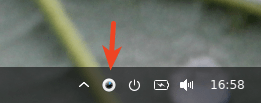
Once installed, launch Safe Eyes from your application menu or launcher. When you start SafeEyes for the first time, it will automatically be added to your system's startup applications. As a result, SafeEyes will launch in the background each time you log in, with its icon available in the system tray.
You can access Safe Eyes at any time from its system tray icon on the taskbar.
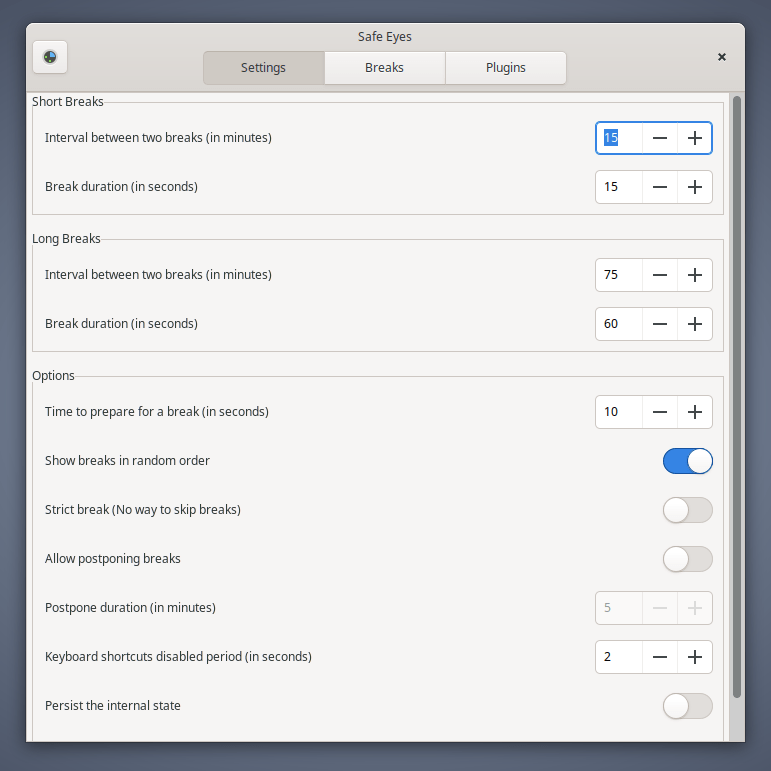
Safe Eyes has both short and long break options with different configurable time duration. By default, short break duration is 15 seconds, and long break duration is 60 seconds. The default interval between two short breaks is 15 minutes and interval between two long breaks is 75 minutes. You will be notified before 10 seconds to prepare for a break. You can change and set the time duration as per your liking.
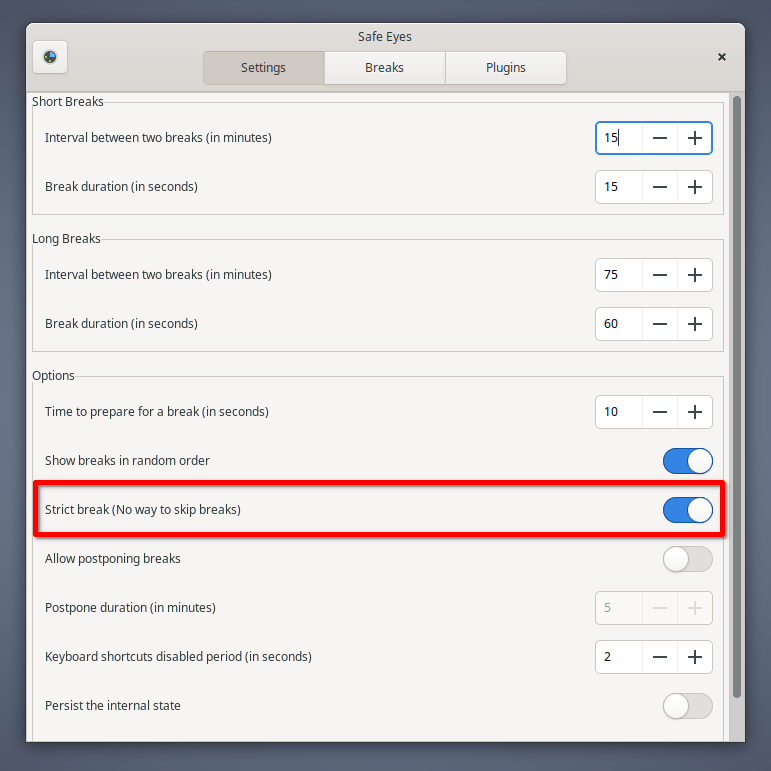
During the break, Safe Eyes disables your keyboard. Safe Eyes also has a skip button, however there is a strict break option that hides the skip button, so that you have no choice but to take a break.
To enable strict break, right click on the Safe Eyes tray icon on the taskbar and go to Settings, and enable the 'strict break' option by moving the slider from left to right.
The default settings is enough and will work just fine. For advanced configuration, go to ~/.config/safeeyes folder. There you can change the Skip button text in safeeyes.json file and the look and feel of the break screen in style/safeeyes_style.css file. These files will be created after you start Safe Eyes application.
Suggested Read:
- How To Adjust Monitor Brightness From Command Line In Linux
- Brightness Controller - A Simple GUI Application To Control The Brightness In Ubuntu
Resource:

1 comment
Looks like great stuff.