
The FreeBSD Release Engineering Team announced the availability of FreeBSD 15.0-RELEASE on December 2, 2025. This is the first release derived from the stable/15 development branch. This version arrives packed with improvements, especially focusing on how you install, manage, and secure your operating system.
This is a production-quality release, giving users a robust and dependable platform. Therefore, many users and system administrators will find several key changes that improve security and streamline system administration.
Table of Contents
FreeBSD 15.0 Highlights
1. The Biggest Change: A Packaged Base System (Pkgbase)
FreeBSD 15.0 introduces a major update to how the system handles base system installations and updates. Now, the system foundation itself can be installed and managed using the powerful pkg(8) package manager. Developers frequently called this feature "pkgbase" during development.
1.1. New Installation Choices
During installation, the bsdinstall(8) utility prompts you to choose your installation method:
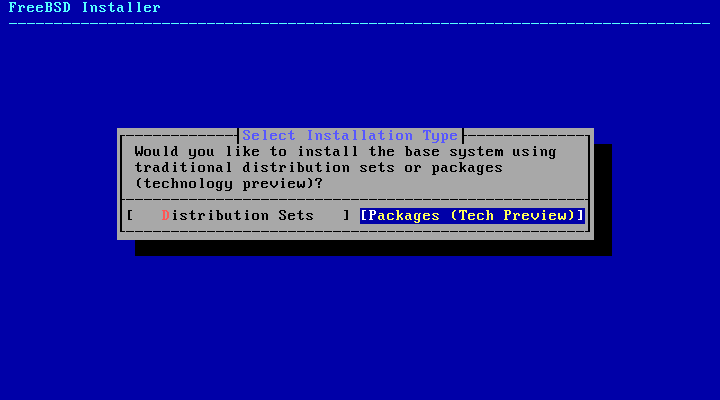
- Distribution Sets (Traditional Method): This method relies on the
freebsd-update(8)utility for maintenance, just like previous releases. However, the project plans to remove support for distribution sets in FreeBSD 16. This method remains available for the full lifetime of the FreeBSD 15 stable branch. - Packages (Pkgbase / New Method): Using this approach, the system installs the base components as a collection of packages from the "FreeBSD-base" repository. So, you manage the entire system using the
pkg(8)tool. The project offers pkgbase as a technology preview in FreeBSD 15.0, anticipating it will become the standard for base system installations and upgrades in future releases. Notably, all VM images and public cloud images use this new package-based method by default.
2. Enhanced Security and Modern Components
The new release significantly boosts security by updating core components and embracing modern encryption standards.
2.1. Quantum-Resistant Encryption
FreeBSD 15.0 includes major cryptographic upgrades, protecting users against current and future threats:
- OpenSSL 3.5.4: The system updates OpenSSL to the latest long-term support (LTS) version, 3.5.4. This update brings support for the QUIC network protocol. Furthermore, it includes support for standardized quantum-resistant algorithms, such as ML-KEM, ML-DSA, and SLH-DSA.
- OpenSSH 10.0p2: OpenSSH now supports quantum-resistant key agreement by default, thanks to the upgrade to version 10.0p2.
2.2. Key System Component Updates
Several other crucial components received updates:
- OpenZFS: The OpenZFS filesystem updates to version 2.4.0-rc4.
- Native Inotify: FreeBSD now features a native inotify implementation. This native support simplifies directory watching and makes software porting much easier.
- Kernel TLS: The default
GENERICkernels for the aarch64, amd64, powerpc64, and powerpc64le architectures now enable Kernel TLS support by default. - Build Process: The FreeBSD team generated all 15.0 release artifacts, including install images and VM images, without requiring root privilege.
3. Architecture and Cloud Coverage
The 15.0-RELEASE expands platform availability while saying goodbye to some older architectures.
3.1. Supported Platforms
You can download and install FreeBSD 15.0-RELEASE for these architectures:
- amd64
- aarch64
- armv7
- powerpc64
- powerpc64le
- riscv64
3.2. Retired 32-bit Architectures
The project retired several older 32-bit hardware platforms. Specifically, i386, armv6, and 32-bit powerpc are no longer supported. However, you can still run 32-bit applications using the 32-bit compatibility mode available on their respective 64-bit platforms. The armv7 platform remains the only supported 32-bit platform.
3.3. Enhanced Cloud Performance
The project significantly improved support for cloud environments.
- Broad Availability: FreeBSD 15.0-RELEASE is available across major cloud providers, including Amazon EC2, Google Compute Engine, Microsoft Azure, and Oracle Cloud Infrastructure.
- Speed Improvements: Notably, FreeBSD "base" EC2 images now boot up to 76% faster than the corresponding 14.0-RELEASE images. The largest speed improvements show on aarch64 ("Graviton") instances.
- Virtualization: The
bhyve(8)hypervisor gains support for the arm64 and riscv platforms. - Containers: The FreeBSD project now publishes OCI-compatible container images.
4. Security and Bug Fixes Included
Finally, FreeBSD 15.0 incorporates fixes for numerous security advisories and errata notices that appeared since the 14.0-RELEASE.
These fixes addressed vulnerabilities in many areas, including the packet filter (pf(4)), NFS client, bhyve(8) hypervisor, OpenSSH, OpenSSL, and the libnv library.
I recommend you to consult the release errata for "late-breaking" information about known bugs or security issues.
5. Long-Term Support
The FreeBSD project offers long-term support for this release series:
- FreeBSD 15.0-RELEASE (the current point release) will receive support until September 30, 2026.
- The entire FreeBSD 15 release series will receive support until December 31, 2029.
Download FreeBSD 15.0
To get this latest FreeBSD 15.0, head to the official FreeBSD download page and download your preferred version.
Users can find FreeBSD 15.0-RELEASE available as bootable ISO images, VM disk images (QCOW2, VHD, VMDK), and SD card images for embedded systems.
The dvd1 image contains the full base system, documentation, and small pre-built packages to set up a graphical workstation. In comparison, the disc1 image contains only the base operating system without pre-built packages.
Read Next:
Resource:
