
Linus Torvalds officially released Linux Kernel 7.1 final on June 14, 2026. He finished the release while traveling through a different timezone, just before the next merge window opened.
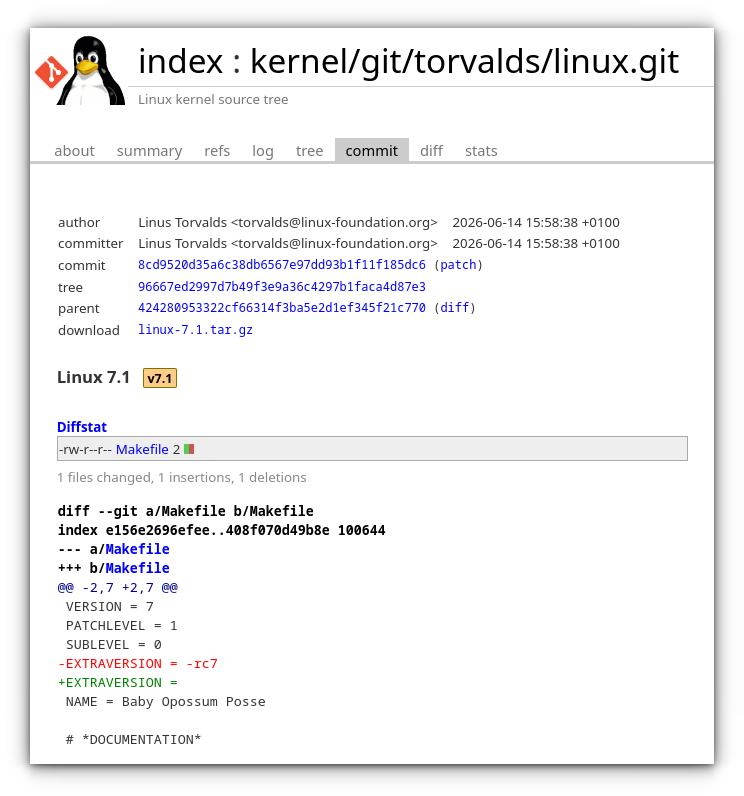
This stable version marks the end of a busy cycle that saw nearly 13,000 new changes. Over 2,000 developers worked on this version, including more than 300 people who contributed for the first time.
Table of Contents
Faster and Smarter Hardware Support
Developers added several important updates for different computer types in this Linux 7.1 release.
Intel users will notice that Flexible Return and Event Delivery (FRED) is now the default way the kernel handles specific system transitions. Meanwhile, the team removed support for very old 486 processors to make the code easier to maintain.
Arm users also get a boost because the kernel now uses new instructions to speed up "futex" operations. Additionally, the kernel improved support for Memory Partitioning and Monitoring (MPAM) on Arm systems.
AMD users were not left out, as the amd-pstate driver can now automatically change power settings based on whether you use a battery or a wall outlet.
Finally, the LoongArch architecture now supports more memory for 32-bit machines.
Better Storage and Filesystems
Linux Kernel 7.1 includes a major highlight for those who work with Windows drives: a completely rewritten NTFS driver. This new version supports full writes and should receive more active updates than the older driver.
Furthermore, Btrfs moved its "shutdown" feature out of testing, making it available for everyone to use.
The NFS server also gained a new security feature that allows it to sign file handles. This change helps protect systems against hackers who try to guess file locations.
Additionally, the exfat filesystem now supports pre-allocating space for files, which can help with performance.
Core Kernel and Security Fixes
The kernel team introduced three new flags for the clone3() system call to help manage how programs start and stop. One of these flags allows a parent program to automatically kill a child program if the connection between them breaks. Hence, this helps developers write more reliable software.
Security also received a significant update regarding how the system handles memory. By default, the kernel now restricts who can override memory permissions to only active "ptrace" users.
Furthermore, the team finally added documentation for the fast libcrypto library.
For more details, check the first half and the second half of Linux 7.1 merge window.
Cleaning Up the "New Normal"
Throughout the testing weeks, Torvalds noticed that the kernel is growing faster than it used to. He called this high volume of changes the "new normal" for Linux development.
To keep things manageable, the team removed over 140,000 lines of obsolete code. This cleanup removed very old networking drivers and protocols that almost no one uses anymore.
During this cycle, Torvalds also shared strong thoughts about AI-generated bug reports. He expressed frustration that many people use the same AI tools to find the same issues.
This "flood" of duplicate reports created extra work for the human maintainers. So, he urged developers to read the documentation and provide actual fixes instead of just sending automated alerts. More details in the link below:
Download and Test Linux Kernel 7.1
Well, Linux 7.1 release is now the "stable" version, and it will receive weekly bug fixes moving forward.
If you want to try the new Kernel 7.1, you can download the source code from the Official Linux Kernel Archives and the Linus Torvalds's git tree.
However, most users should wait for their favorite Linux version (like Ubuntu or Fedora) to include the Linux 7.1 in the official repositories. This way you can get the regular updates via package manager.
If you're on Ubuntu and its derivatives such as Linux Mint, Pop!_OS, you can use the Mainline, a GUI utility to install the latest mainline Kernel.
The merge window for the next version i.e Linux 7.2 is already opened and the maintainers are busy with pull requests. We will publish about the 7.2 RC development progress in the upcoming weeks. Stay tuned!
Update:
The latest stable update, Linux Kernel 7.1 has officially arrived in Fedora Linux. Update your Fedora systems today!
