
Linus Torvalds released the third release candidate (RC3) for Linux Kernel 7.1 on Sunday, 10 May 2026. This release continues the pattern of high patch volume that Torvalds previously suspected might be driven by developers using AI tooling.
The "New Normal" for Kernel Size
For the past few months, the Linux kernel has been growing faster than usual. Many developers wondered if the large number of changes in version 7.0 was just a one-time event.
But, Linus Torvalds noted that RC3 seems to confirm a new trend. In the Linux 7.1 RC3 announcement mail, he mentioned that these larger patch sizes are no longer a fluke but are instead the "new normal" for kernel development.
This increase in code volume might be due to developers using AI tooling to help write and submit patches more quickly.
A Major Focus on Networking
While the first two release candidates (RC1 and RC2) had specific themes, like AMD GPU updates or code renaming, Linux 7.1 RC3 is much more varied. That said, networking is the winner this week. Roughly one-third of the entire update focuses on networking core code, drivers, and testing.
In addition to networking, you will find several other important updates in this version:
- Driver Improvements: There are many fixes for sound and graphics (GPU) drivers.
- Architecture Support: The team added updates for various computer types, including PowerPC, x86, LoongArch, and Parisc.
- General Fixes: RC3 includes small but vital improvements for Rust infrastructure, security (SELinux), and file sharing (SMB).
How Can You Test Linux kernel 7.1 RC3?
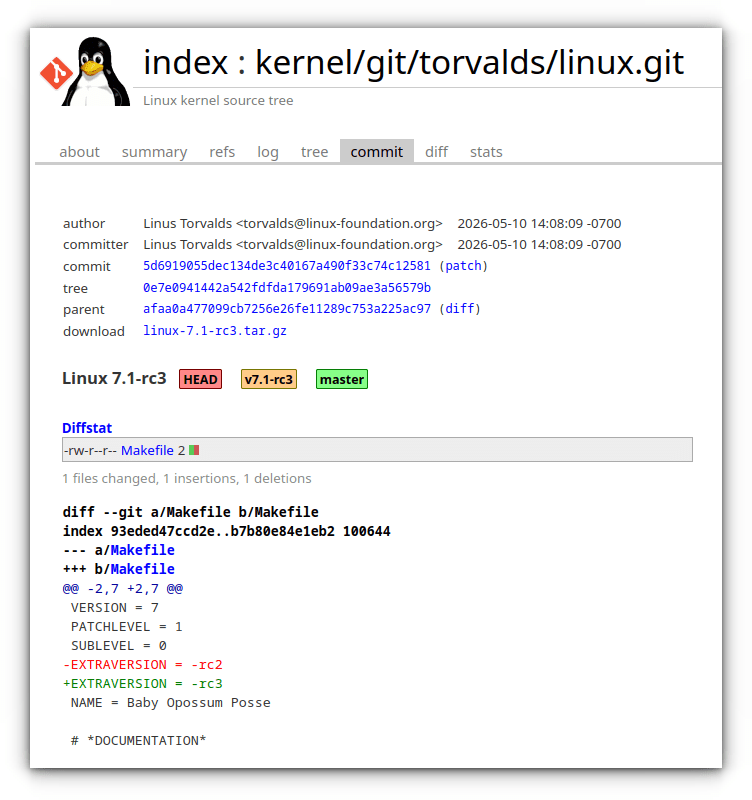
If you are an enthusiast who wants to see the latest features, you can find the source code at the Official Linux Kernel Archives and the Linus Torvalds's git tree.
Before trying RC3, you should keep a few things in mind:
- Build from Source: These are "prepatch" releases, which means you must compile them yourself.
- Expect Bugs: Release candidates are for testing and are often unstable.
- Use a Test Machine: Because RC3 is not yet a "stable" release, you should not use it on your main work computer.
What is Coming Next?
The Linux Kernel 7.1 development cycle is now in its third week of stabilization. We can expect a new release candidate every Sunday for the next four or five weeks. Once the code is stable and the major bugs are fixed, Linus will release the final version of Linux Kernel 7.1 for public use.
