
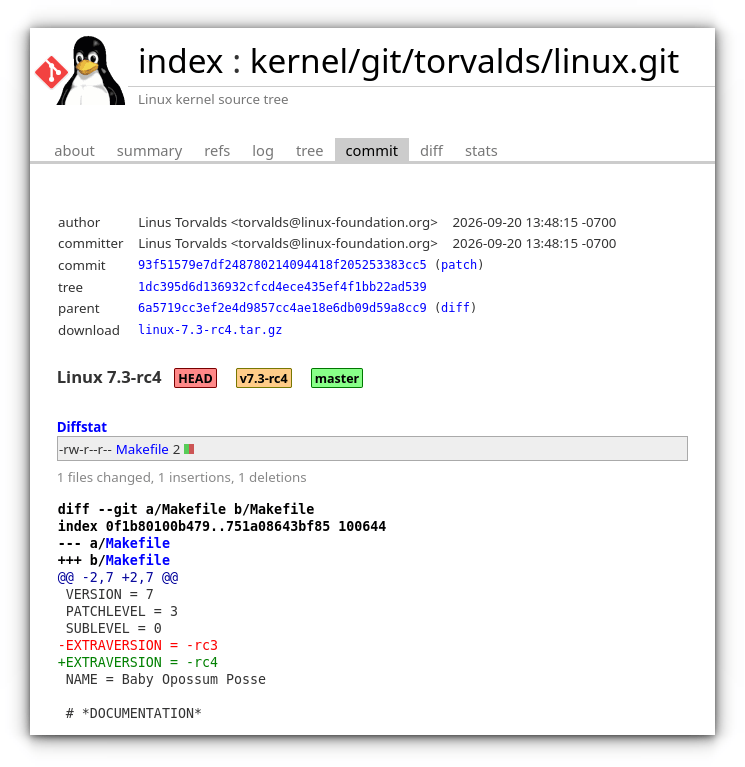
Linus Torvalds has announced the fourth release candidate (RC4) for the upcoming Linux Kernel 7.3 version on 20 September 2026. In the Linux 7.3-rc4 announcement mail, he noted that the release candidate size remains noticeably larger than normal for this stage of the kernel cycle.
The rc4 brings great progress. Developers fixed many edge-case bugs and cleaned up important subsystems across the codebase.
Here are the key technical highlights and trends from Linux 7.3-rc4:
Table of Contents
A Three-Way Split in Code Changes
Drivers usually dominate every kernel release. This week, however, the code changes show a remarkably even split across three main areas:
- One-third Drivers: Hardware support and graphics updates keep rolling in.
- One-third Filesystems and Networking: Storage protocols and network stacks received heavy attention.
- One-third Miscellaneous: Architecture fixes, core kernel tweaks, and developer tools round out the rest.
In addition, the single largest patch in this release simply deletes a leftover file. The team moved lib/alloc_tag.c to the mm/ directory during the initial merge window. However, the original copy accidentally remained in place until developers finally removed it in rc4.
Filesystems Receive Heavy Updates
Filesystems continue to draw an unusual amount of focus during the 7.3 development cycle. Specifically, SMB and NTFS lead the storage updates this week:
- NTFS Improvements: Developers added dynamic MFT tail reservations and repacked
$MFTrecord lists. Furthermore, new locks now protect runlist updates to prevent race conditions. - SMB and CIFS Fixes: The team enforced proper SMB2 session expiration rules. In addition, multi-user mounts now send lease break ACKs through the correct session. Developers also fixed memory leaks and use-after-free bugs on interface teardowns.
- Btrfs Stability: The code now derives
f_fsidwithdev_tonly when an activetemp_fsidexists, which restores stable filesystem IDs for users.
AI and LLMs Spot Hidden Bugs
Interestingly, Linus Torvalds highlighted a surge in small error-path cleanups across many drivers. He noted that Large Language Models (LLMs) seem particularly effective at catching these obscure error-handling flaws.
Most desktop users will never hit these rare failure paths during normal operation. However, if your system encounters a sudden hardware glitch or allocation failure, these fixes prevent hard crashes and keep your system running smoothly.
Core Kernel, Security, and Architecture Changes
Beyond storage and drivers, several key areas gained a few stability fixes:
- Processor Microcode: The kernel now explicitly rejects problematic microcode updates on Intel Granite Rapids systems to protect stability.
- ARM64 Architecture: Hibernation code now clones only the linear map that actually exists at runtime.
- Security Modules: SELinux now preserves user SIDs across nested backing files and rechecks intermediate files during memory protection changes.
- Networking and Bluetooth: Developers serialized state garbage collection in
xfrm. Meanwhile, Bluetooth driver updates validate service data lengths before reading UUIDs in packet headers.
Looking Ahead to the Final Release
The testing cycle for Linux 7.3 continues toward its final launch. If testing goes smoothly over the next month, Linus Torvalds will release the final stable Linux 7.3 kernel on October 18, 2026. If late regressions require an extra rc8 build, the final launch will shift to October 25, 2026.
Until then, developers and Linux enthusiasts can download and test the release candidates directly from the Official Linux Kernel Archives or clone the source code from Linus Torvalds' Git tree.
Linux 7.3 Release Schedule
- August 30, 2026: Linux 7.3-rc1 (Released)
- September 6, 2026: Linux 7.3-rc2 (Released)
- September 13, 2026: Linux 7.3-rc3 (Released)
- September 20, 2026: Linux 7.3-rc4 (Released)
- September 27, 2026: Linux 7.3-rc5 (Released)
- October 4, 2026: Linux 7.3-rc6 (Released)
- October 11, 2026: Linux 7.3-rc7 (Projected)
- October 18, 2026: Linux 7.3 Final Release (Projected)
