
Linus Torvalds has announced the third release candidate (RC3) for the upcoming Linux Kernel 7.3 version on September 13, 2026. This release lands right on schedule as the testing phase for Linux 7.3 gains momentum.
While release candidates often shrink in size as developers shift toward stability, Linux 7.3-rc3 remains a fairly large patch set. Furthermore, this release carries an unusually heavy emphasis on storage and file systems for a third candidate.
Table of Contents
Why Is Linux 7.3-rc3 So Large?
Typically, the third release candidate marks a quiet period where developers focus strictly on regression testing. However, Linux 7.3-rc3 stands out because it packs a larger filesystem footprint than users normally see in an rc3 update.
Even with the influx of filesystem changes, driver code still makes up the bulk of the overall patch. Specifically, sound and networking drivers account for most of the driver updates this week, while graphics driver updates play a much smaller role.
Key Subsystem Changes in Linux Kernel 7.3 RC3
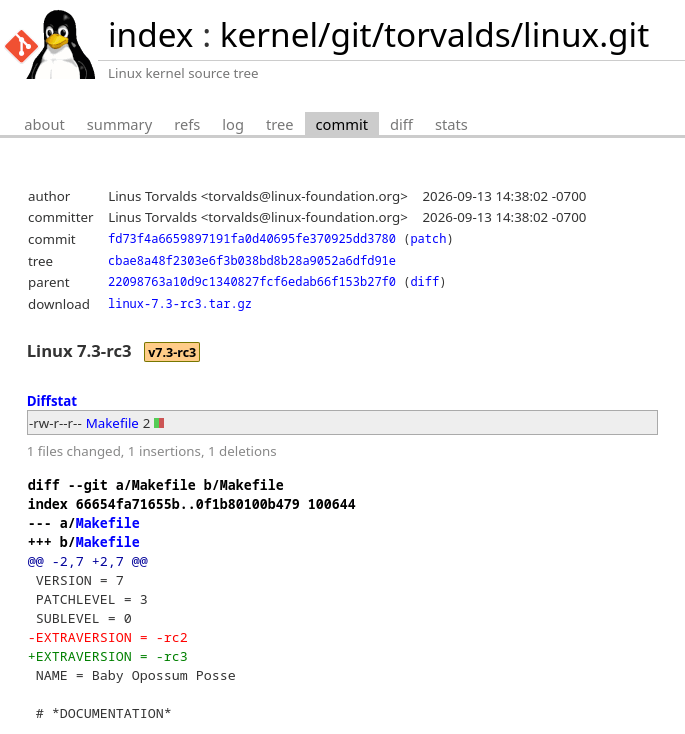
Development teams delivered important bug fixes and stability improvements across several critical areas of the kernel. Here is a complete breakdown of what is new in Linux 7.3-rc3:
1. Filesystems and Remote Storage
- XFS Stability: Developers resolved media verification issues on internal real-time volumes, fixed health monitor locking, and added missing lock annotations across log, cache, and CIL routines.
- SMB and CIFS Clients: Patches fix a heap overflow vulnerability during DACL owner/group rewrites, correct file type corruption in WSL reparse points, and reject out-of-bounds data offsets.
- NetFS and AFS: The update fixes unbuffered direct I/O write error handling, resolves readahead synchronization issues by loading folios upfront, and corrects directory block unmapping in AFS.
- EROFS and Btrfs: The team temporarily disabled LZ4 rolling decompression in EROFS and added new tree-checker validations for inode reference keys in Btrfs.
2. Networking and Sound Drivers
- Traffic Control and Schedulers: Developers capped queue lengths and clamped quanta across traffic control schedulers (such as
fq,sfq, andets) to prevent oversized ring allocations. - IPv4 and IPv6 Fixes: Updates resolve UDP length overflow bugs during Path MTU Discovery and refine Mellanox ethernet driver behavior.
- Audio Cleanups: The release fixes initialization failures in Intel AVS audio links, repairs stream lifecycle handling, and corrects runtime power management imbalance bugs in Cirrus Logic codecs.
3. Architectures and Security
- Architecture Fixes: Updates focus primarily on s390 and PowerPC architectures, addressing crypto mutex handling in atomic contexts and user-time accounting on interrupt entry.
- Landlock Security: The security team cleaned up ruleset validation checks, bounded escaped trace path output, and resolved a use-after-free bug in parent directory tracking.
- Tracing and Debugging: Patches correct memory corruption caused by histogram stacktrace modifiers and ensure proper reference tracking when opening option files.
What Is the Expected Linux 7.3 Schedule?
The release of rc3 keeps the Linux 7.3 kernel on track for its standard 9 to 10-week development cycle. Here is the estimated release calendar leading to the final version:
- August 30, 2026: Linux 7.3-rc1 (Released)
- September 6, 2026: Linux 7.3-rc2 (Released)
- September 13, 2026: Linux 7.3-rc3 (Released)
- September 20, 2026: Linux 7.3-rc4 (Released)
- September 27, 2026: Linux 7.3-rc5 (Released)
- October 4, 2026: Linux 7.3-rc6 (Released)
- October 11, 2026: Linux 7.3-rc7 (Released)
- October 18, 2026: Linux 7.3 Final Release
How to Download and Test Linux 7.3-rc3
Kernel testers and Linux enthusiasts can download Linux 7.3-rc3 directly from the Official Linux Kernel Archives or clone the source code from Linus Torvalds' Git tree.
Because this is a pre-release candidate, it may contain bugs or incomplete features. Consequently, daily drivers and production systems should remain on the latest stable kernel release until Linux 7.3 reaches its final release.
