
Table of Contents
Brief
- openKylin 2.0 is evolving into an AI-native operating system by integrating artificial intelligence into the core architecture rather than treating it as an add-on application.
- The fundamental strategic shift from "AI on OS" to "AI for OS" transforms the openKylin operating system from a passive resource manager into an active intelligent system.
- By building a native Linux AI subsystem, openKylin provides a unified interface that allows developers to access AI capabilities without needing to manage the complex underlying infrastructure or diverse model frameworks.
- To handle hardware fragmentation across platforms like ARM and RISC-V, it uses a three-layer subsystem (Inference Framework, Runtime, and SDK) and a hybrid inference model that dynamically balances tasks between local hardware and the cloud based on performance and privacy needs.
Introduction
Most operating systems treat AI as a guest. You install a chatbot here, a voice assistant there. The OS itself doesn't know or care — it just runs the apps.
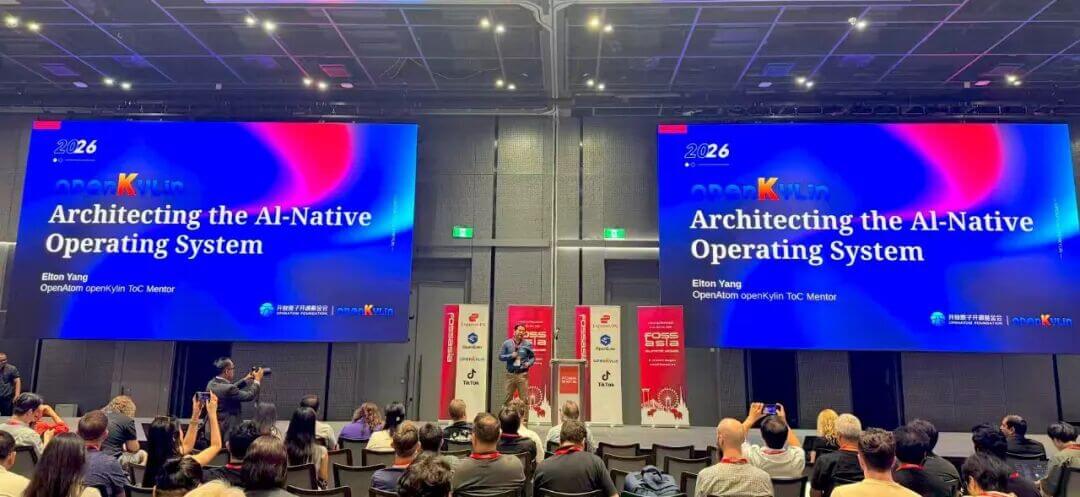
openKylin wants to change that. At FOSSASIA Summit 2026 in Bangkok, Thailand (March 8–10), the team presented an architecture where AI isn't an app running on top of the OS.
Instead, openKylin integrates AI directly at the core of Linux — part of how it boots, how it manages hardware, and how it exposes capabilities to developers.
In the traditional "AI on OS" approach, the operating system acts as a passive resource management platform that simply provides the environment for standalone AI software to run.
openKylin’s vision for the future, "AI for OS," involves a full-stack AI reconstruction where intelligence is integrated as a fundamental, native capability of the system architecture.
That's a bold claim. Now, let's look at what they actually built.
The Problem openKylin Is Trying to Solve
Every hardware platform has its own quirks. An Intel CPU handles inference differently than an ARM-based NPU. RISC-V accelerators have their own instruction sets. Model formats (ONNX, TensorFlow Lite, GGUF) don't always play nicely together.
The result? Developers end up writing platform-specific glue code. The same AI feature needs rewriting for every device it runs on. It's a fragmentation problem that slows down the whole ecosystem.
openKylin's answer is a three-layer decoupled architecture that separates the hardware complexity from the developer experience.
Think of it as building a clean abstraction stack — the same way a web browser hides the OS from web apps, this architecture hides the hardware from AI workloads.
The Three-Layer Architecture
The architecture was presented publicly during the FOSSASIA Summit's technical sessions.
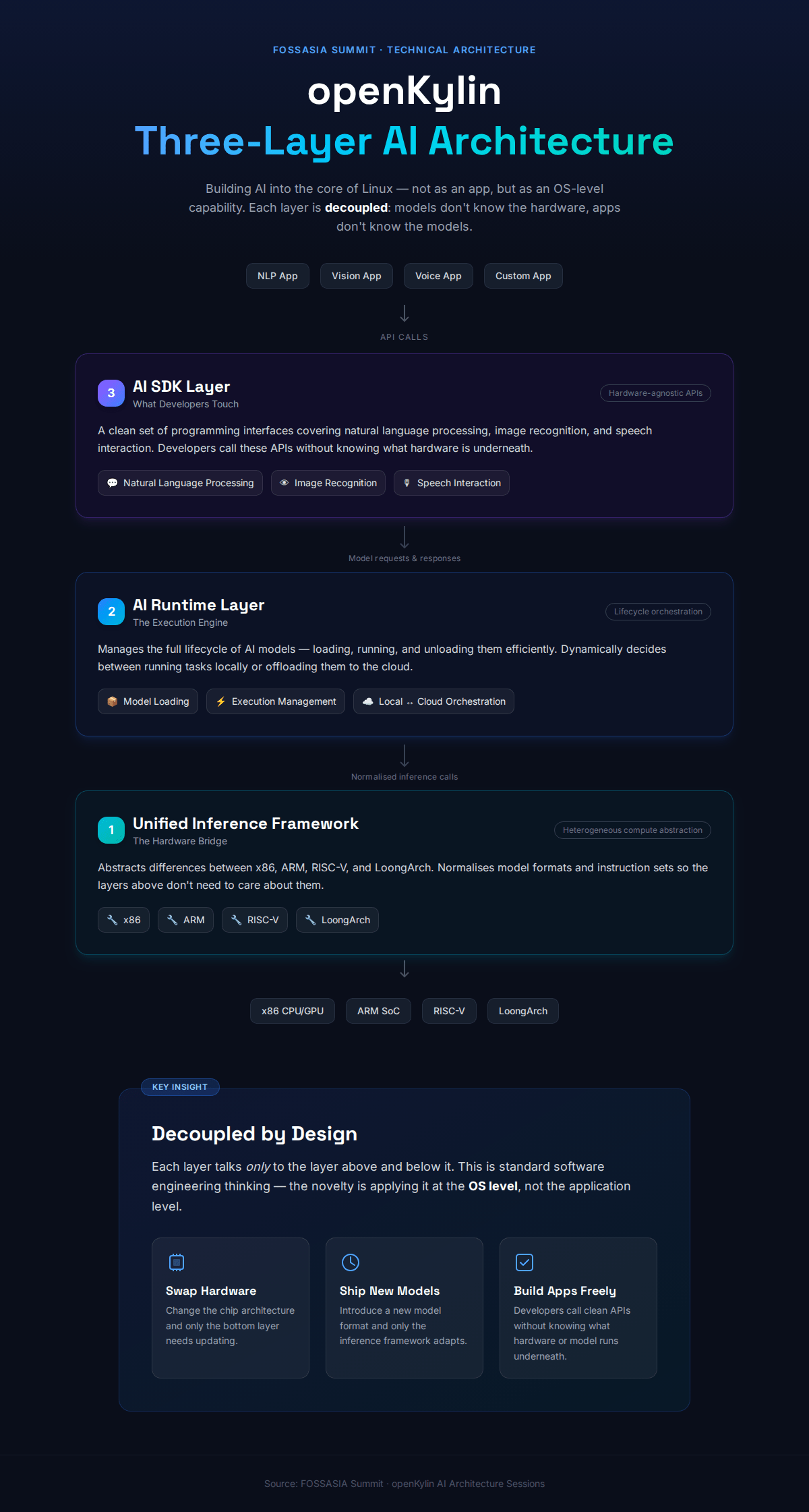
Here's how each layer works:
AI SDK Layer (Layer 3): What Developers Touch
A clean set of programming interfaces covering natural language processing, image recognition, and speech interaction. Developers call these APIs without knowing what hardware is underneath.
AI Runtime Layer (Layer 2): The Execution Engine
Manages the full lifecycle of AI models: loading, running, and unloading them efficiently. It also orchestrates the dynamic decision between running tasks locally or offloading them to the cloud.
Unified Inference Framework (Layer 1): The Hardheterogeneous computeware Bridge
Abstracts differences between x86, ARM, RISC-V, and LoongArch. Normalises model formats and instruction sets so the layers above don't need to care about them.
The key word here is decoupled. Models don't need to know which hardware they're running on. Applications don't need to know which models are loaded. Each layer talks only to the layer above and below it. Change the hardware? Only the bottom layer needs updating. Ship a new model format? Same deal.
This is standard software engineering thinking. The novelty is applying it at the OS level, not the application level.
The Smart Part: Deciding Where to Run AI Tasks
One of the most practically interesting features is the AI Engine module, the component inside the AI Runtime Layer that decides, in real time, where to execute a given AI task.
When an application requests an AI service, the engine looks at three factors:
- Available computing resources on the local device at that moment
- Network conditions — is the connection fast and stable enough to offload?
- Privacy requirements of the specific task being requested
The output is automatic. A request to summarise a personal document routes to local inference, and your data stays on your device.
A request to generate a high-resolution image from scratch, where compute demands are heavy and the data isn't sensitive, might go to the cloud if you're on a good connection.
The application developer doesn't write this logic. The OS handles it.
This matters because privacy has been a real tension point in AI deployment. Many users don't want their data leaving the device for basic tasks.
openKylin's approach treats this as a routing problem, not a policy problem. The system routes sensitive work locally by design.
What Changes at the User Level
In openKylin 2.0, the AI subsystem surfaces as real features in the desktop environment, not just developer infrastructure. This release brings:
- An AI assistant integrated directly into the desktop
- System-wide text-to-image generation accessible from anywhere in the OS
- Intelligent fuzzy search that understands semantic meaning, not just exact keywords
- Clipboard intelligence — the clipboard can transform copied content based on context
These aren't separate apps. They're system-level capabilities exposed through the AI SDK layer. Any application can call them through the same APIs developers use to build their own AI features. That's the "AI for OS" vision in practice — the OS itself becomes a shared AI platform, not just a platform that runs AI apps.
How This Compares to Other AI-OS Efforts
openKylin is not alone in pushing AI into the operating system layer.
Windows Copilot+ already integrates AI deeply into the OS, combining on-device inference with selective cloud support.
In contrast, Ubuntu, backed by Canonical, focuses on AI at the application and infrastructure level through tools like containers and MLOps stacks, rather than embedding it into core system layers.
What sets openKylin apart is its emphasis on hardware flexibility. While Copilot+ is currently optimized for Arm64 NPUs (especially on Qualcomm platforms) and lacks comparable support for emerging architectures like RISC-V, openKylin is designed with heterogeneous compute in mind.
Its Unified Inference Framework aims to abstract across CPUs, GPUs, and NPUs, including less mature architectures.
This reflects a broader strategic bet: that the future of computing will not be dominated by a single architecture, but shaped by a more diverse and fragmented hardware ecosystem.
What to Watch For Next
The Summit talks also pointed toward several directions openKylin is exploring beyond the current architecture:
- Multi-agent collaboration: AI agents that can hand off tasks to each other at the OS level
- Lightweight device-side models: Smaller models optimised to run well on low-power hardware
- System-level AI interfaces: Deeper hooks between AI capabilities and core OS functions
None of these are shipping features yet. They're the roadmap, and roadmaps change. But the directional logic is consistent: treat the OS as the AI platform, not just the thing that runs AI apps.
Resource:
