
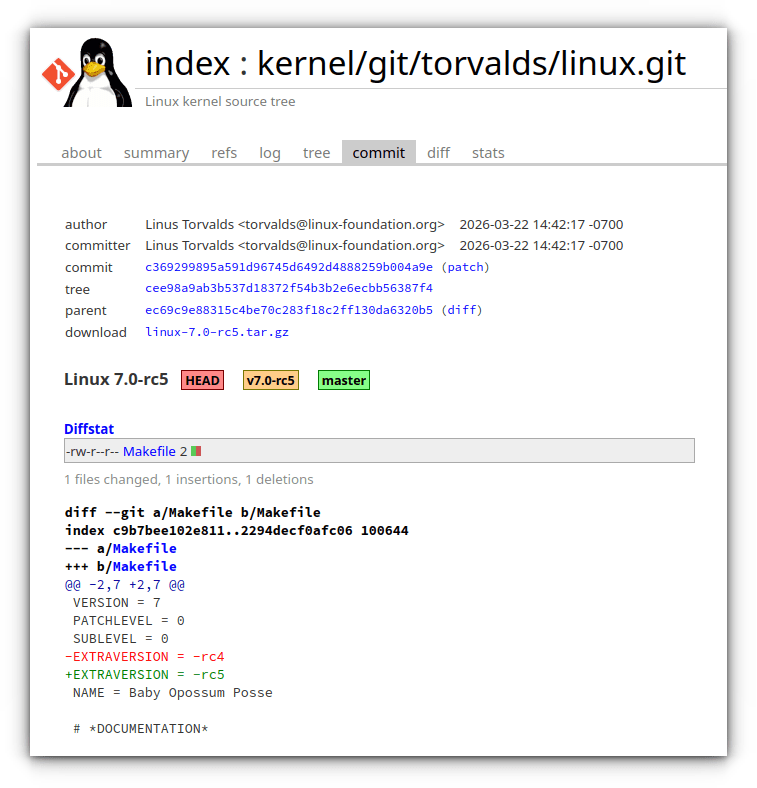
Linus Torvalds shared some good news this week with the release of fifth release candidate (RC5) for the upcoming Linux Kernel 7.0. After a very busy start to the version 7.0 cycle, things are finally starting to calm down. This latest version arrived on 22nd March 2026, and it shows that the kernel is moving toward a stable finish.
Table of Contents
A Welcome Shift in Size
For the last few weeks, the release candidates (rc2, rc3, and rc4) stayed "bigger than usual". However, rc5 is smaller than those previous versions. While it is still a bit larger than typical fifth candidates from past years, Torvalds views this as a "good sign overall".
Furthermore, the nature of the code has changed. Instead of massive overhauls, most of the new updates consist of small "few-liners". Consequently, the work looks much safer and less likely to cause major problems as the team prepares for the final 7.0 release.
What's New in Linux 7.0-RC5?
In the Linux 7.0-rc5 announcement mail, Linus Torvalds describes the current batch of changes as "innocuous" or harmless.
The distribution of code in Linux 7.0-rc5 version feels very familiar to long-time users. Drivers make up about half of the entire update. Specifically, developers focused on GPUs and networking, though the update also includes some unusual changes for serial devices.
The other half of the patch is what Torvalds calls a "mixed bag". It includes:
- Core Networking: Refinements to how the system handles data.
- Filesystems: Important updates for storage systems like BTRFS and KSMBD.
- Security and Logic: Fixes for BPF and various architecture issues.
- Testing: New "selftests" to ensure the kernel remains stable under different conditions.
Notable Hardware and Software Fixes
Even though the update is smaller, it still packs some helpful improvements for specific hardware. For example, the kernel now supports the Logitech MX Master 4 mouse over Bluetooth. Additionally, the team added bounds checking for AMD graphics components to prevent errors.
On the security side, developers fixed several "race conditions" and memory issues. For instance, the AppArmor system received more stability tweaks to prevent memory leaks. These small but vital changes ensure that your hardware runs smoothly and stays secure.
Download and Test Linux Kernel 7.0 RC5
Although the 7.0 cycle has trended bigger than usual, the move toward smaller, simpler fixes suggests that the "pent-up work" from earlier is finally finishing.
As always, Torvalds encourages everyone to keep testing. You can get the latest Kernel 7.0 RC5 version from the Kernel.org website or the Linus Torvalds's git tree.
Your feedback is important to make sure the final version of Linux 7.0 is a "solid progress" marker for millions of users.
This release highlights the "calming down period" that Torvalds expects during a healthy development cycle. Since the code is now mostly small fixes, we are likely only a few weeks away from the official launch of Linux 7.0.
