
Linus Torvalds officially released Linux Kernel 7.0 on April 12, 2026. He describes this release as a "solid progress" marker rather than a feature-driven overhaul. The development cycle remained unusually active, likely due to a surge in AI-assisted bug reporting.
In the Linux 7.0 announcement mail, Torvalds noted that the final week of development followed a trend of "lots of small fixes". So, he felt comfortable tagging the final version and pushing it out to the world.
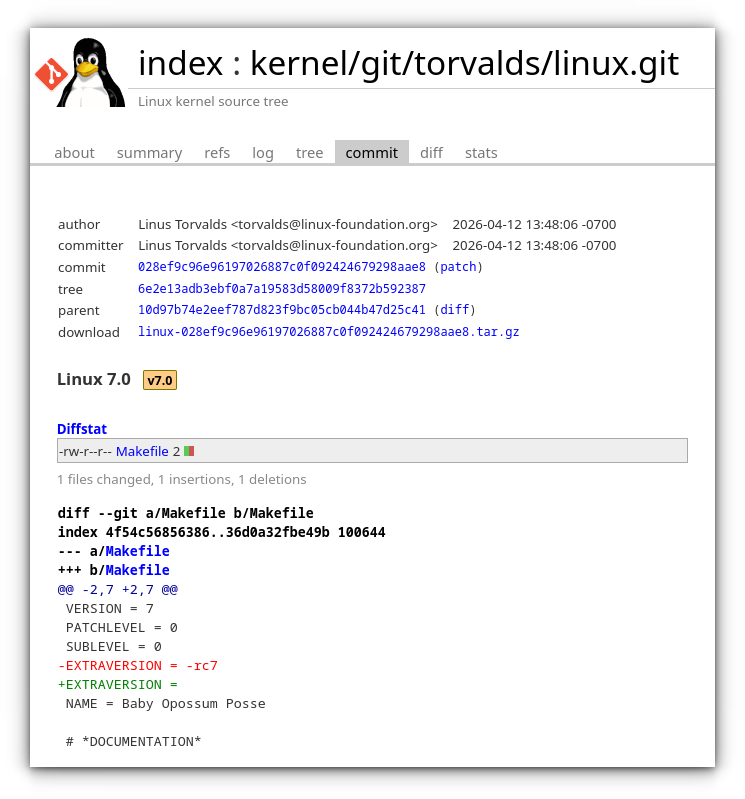
Table of Contents
Top New Features in Linux 7.0
- Better Error Reporting: A new API now helps filesystems report metadata corruption and file I/O errors to userspace in a standard way.
- Self-Healing Storage: The XFS filesystem now supports a health monitoring feature that can deliver live information about health events to userspace daemons.
- Rust Is Here to Stay: Rust support is officially no longer experimental, making it a permanent part of the kernel infrastructure.
- Faster Networking: The kernel now enables AccECN support by default, which allows for much better handling of TCP congestion.
- Improved Security: Support for Clang static analysis helps developers find locking bugs during the build process.
The Mystery of the Busy Release Cycle
Linux Kernel version 7.0 development was unusually active. Every week after the first release candidate stayed larger than typical versions. Linus suspects a "psychological result" where the new major number encouraged developers to work harder.
Additionally, Linus noted that the final week involved many small but important fixes. He believes that AI tools are now helping developers find more "corner cases" in the code. This automated bug hunting may become the "new normal" for keeping Linux stable.
Torvalds' Numbering Philosophy: "We have a new major number purely because I'm easily confused and not good with big numbers... It's the usual 'solid progress' marker, nothing more."
Self-Healing Storage and Filesystems
A significant technical achievement in Linux 7.0 release is self-healing storage for the XFS filesystem.
The kernel now uses a health monitoring system to track metadata errors in real-time. Instead of crashing, the system sends these events to a background program.
This program can then initiate online repairs while the drive is still mounted. So, users can fix minor disk corruption without taking their entire system offline.
The Btrfs filesystem also gained experimental support for a "remap tree" to improve how it moves data internally.
Permanent Rust and Better Security
Linux Kernel 7.0 makes Rust support permanent. The Rust programming language is no longer experimental and is now a core part of the kernel infrastructure. This shift helps prevent memory-safety bugs before they happen.
Security also looks toward the future with post-quantum digital signatures. The kernel now supports ML-DSA signatures to authenticate modules. These signatures protect your system against advanced computers that might try to fake authentication in the future.
Faster Performance and Modern Hardware
Linux 7.0 release gains more efficiency than the previous versions. Specifically, the second phase of the swap table overhaul arrived. Benchmarks show a 20% speedup for memory-heavy tasks like Redis.
Additionally, networking is now smoother because Accurate ECN (AccECN) is enabled by default. This technology provides better feedback on network congestion to improve internet speeds.
Furthermore, Kernel 7.0 expands its reach to new hardware. It adds mainline support for the SpacemiT K3, the first desktop-class RISC-V RVA23 chip. Gamers will enjoy expanded support for handheld consoles like the OneXPlayer and Aokzoe models.
The kernel also includes early support for Intel Nova Lake and AMD Zen 6 components.
Shedding the Old
To move forward, the kernel is leaving some ancient technology behind. Developers removed the old "laptop mode" because solid-state drives (SSDs) have made it obsolete.
They also killed off 1980s-style linuxrc-based booting systems to focus on modern methods.
For more details, refer to the first half (Part 1) and second half (Part 2) of the 7.0 merge window published by LWN.
Release Candidate Progression (rc1 – rc7)
The Linux 7.0 development cycle was characterized by an unusually high volume of activity during the middle release candidates. While the merge window was technically "smooth," the subsequent candidates remained consistently larger than historical norms for this stage of the cycle.
| Release Candidate | Date | Primary Characteristics | Torvalds' Sentiment |
|---|---|---|---|
| rc1 | 22nd February 2026 | 11.5k non-merge commits; standard merge window distribution. | Technically "smooth." |
| rc2 | 2nd March 2026 | Anomalous code parity between drivers (25%) and filesystems (25%). | "Bigger than usual." |
| rc3 | 9th March 2026 | High volume; selftests accounted for nearly 20% of the patch. | "Some of the biggest in recent history." |
| rc4 | 15th March 2026 | Sustained activity; dominated by non-breaking ID/quirk additions. | "Unnervingly" busy; suspected psychological effect. |
| rc5 | 22nd March 2026 | Noticeable reduction in commit volume; half the diff comprised of drivers. | A perceived "mirage" of calming. |
| rc6 | 29th March 2026 | Surge in filesystem and VFS fixes; uptick in trivial but legitimate regressions. | Re-evaluated rc5 as a "mirage." |
| rc7 | 5th April 2026 | Late-stage stabilization; drivers return to 50% of the patch. | Ready for final release; code is "innocuous." |
Some Linux Distributions Already Ship Kernel 7.0
If you want to try the new kernel, several distributions have already started packaging it.
- Arch Linux users can find it via the AUR.
- Fedora Rawhide and Exherbo have versions available.
- Ubuntu 26.04 is testing the code as well.
Should You Go with Linux 7.0 or Wait?
Desktop enthusiasts and handheld gamers should Go. The update adds support for several new gaming devices and improves UI responsiveness through scheduler tweaks.
Production server administrators should Wait. Community feedback suggests minor boot issues for custom builds, and most stable distributions will not package version 7.0 until the 7.1 cycle begins.
Download and Test Linux Kernel 7.0
After a stable kernel release, Linux distributions eventually package it and make it available in their repositories. The latest Linux 7.0 will be available in the default repositories of popular Linux distributions in a week or two.
If you're impatient and very eager to try out this new version, you can download the Kernel 7.0 from the Kernel.org website and/or the Linus Torvalds's git tree and compile it yourself.
If you're on Ubuntu and its derivatives such as Linux Mint, Pop!_OS, you can use the Mainline, a GUI utility to install the latest mainline Kernel.
The merge window for Linux 7.1 opens immediately following this release. Therefore, developers are already busy with over four dozen new pull requests. As the community adopts version 7.0, users can look forward to a more secure, faster, and more compatible Linux experience than ever before.
Suggested Read:
